How Does Section 179 Deduction Work for Vehicles Before Year End

Section 179 lets a business deduct a vehicle's cost in the year the vehicle starts work, up to a weight-based cap. The answer to "how does section 179 deduction work for vehicles" is a formula. Cost times business use comes first, then the cap, then bonus depreciation. The vehicle must be placed in service by December 31, 2026.
Key Takeaways
- The deduction starts with cost multiplied by the business-use percentage, and business use must exceed 50%.
- A heavy SUV is capped at $32,000 of Section 179 for 2026, and bonus depreciation covers the rest.
- A passenger car under 6,000 pounds is capped at $20,300 in year one with bonus, or $12,300 without it.
- The vehicle must be placed in service, ready for work, by December 31, 2026, not just ordered.
- Financing does not shrink the deduction, because the placed-in-service date controls, not the payment date.
- Form 4562 reports the election, and Part V holds the vehicle's mileage and business-use details.
How Does Section 179 Deduction Work for Vehicles Before Year End?
Section 179 deduction for vehicles works by converting the business share of a vehicle's price into a first-year expense. The deduction lands in the tax year the vehicle is placed in service, so December 31 is the cutoff. A vehicle that starts work on January 2 moves the deduction into the next year.
According to the Internal Revenue Service (IRS), the 2026 Section 179 limit is $2,560,000. The deduction phases out dollar for dollar once purchases pass $4,090,000. It reaches zero at $6,650,000, so a single vehicle rarely touches those totals.
The vehicle's own caps decide the result. A CPA who gives Section 179 help checks the weight rating, the business-use percentage and the delivery date together. The calculation itself runs in a fixed order.
How Is the Section 179 Vehicle Deduction Calculated?
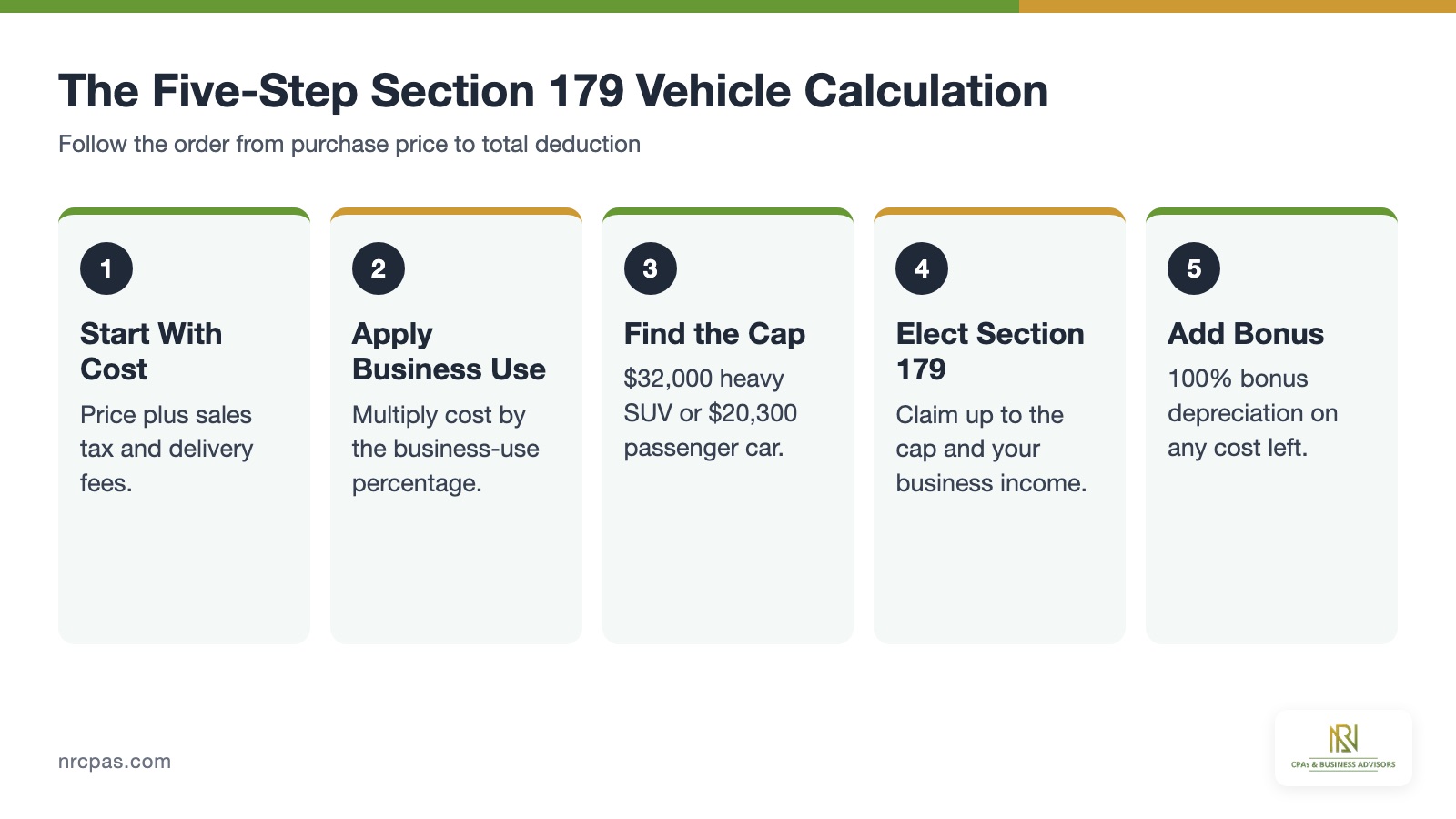
The Section 179 vehicle deduction is calculated in five steps, listed below in the order the IRS applies them. Each step shrinks or caps the number before it. The Section 179 deduction calculation applies to every vehicle, from a sedan to a work truck.
- Start with the vehicle's purchase price, including sales tax and delivery fees.
- Multiply that cost by the business-use percentage to find the business cost.
- Apply the vehicle's cap: $32,000 for a heavy SUV, or the $20,300 passenger car ceiling.
- Claim the Section 179 amount you elect, up to that cap and your business income.
- Claim 100% bonus depreciation, then regular depreciation, on any cost left over.
The graphic below shows the same five steps as one route from price to deduction.
According to the IRS, 100% bonus depreciation is permanent for property acquired after January 19, 2025. That rule is why the leftover cost in step five can be fully deducted. The Section 179 portion also follows the Section 179 mechanics every other asset follows. The business-use percentage in step two moves the number most.
How Does Business Use Percentage Change the Deduction?
Business use percentage changes the deduction by shrinking the cost that qualifies, one percentage point at a time. Business use must be more than 50%, and exactly 50% fails. A vehicle used 80% for work deducts 80% of its cost.
The IRS requires adequate records for vehicle use, which means the date, destination, purpose and miles of each trip. According to IRS Publication 463, a log kept at the time of each trip is the strongest proof. The table below runs four 2026 examples through the formula.
| Vehicle | Business use | Business cost | Year-one deduction |
|---|---|---|---|
| $78,000 heavy SUV | 100% | $78,000 | $78,000 |
| $78,000 heavy SUV | 80% | $62,400 | $62,400 |
| $36,000 passenger car | 60% | $21,600 | $12,180 |
| $62,000 pickup with a 6-foot bed | 90% | $55,800 | $55,800 |
The SUV rows reach full business cost because bonus depreciation covers the amount above the cap. The car row stops at $12,180, which is the $20,300 ceiling times 60%. The pickup row skips the SUV cap, so Section 179 alone covers the cost. The SUV rows show how the cap and the bonus split a price.
How Does the Heavy SUV Cap Work With Bonus Depreciation?
The heavy SUV cap works by limiting only the Section 179 slice, while bonus depreciation takes the remaining cost. This Section 179 SUV limit never touches the bonus amount. For 2026, the Section 179 cap on an SUV rated 6,001 to 14,000 pounds is $32,000. According to the IRS, the 2025 cap was $31,300.
A $78,000 SUV used 100% for business splits into two deductions. Section 179 takes $32,000, and bonus depreciation takes the remaining $46,000. The two together equal $78,000, which is the full price deducted in year one.
At an assumed 24% federal bracket, that $78,000 deduction cuts federal tax by $18,720. The same SUV used 80% for work has a business cost of $62,400. Section 179 takes $32,000 and bonus takes $30,400, while the $15,600 personal share stays non-deductible. A buyer weighing a heavy SUV example sees the same split at a different price.
The flow graphic below traces the $78,000 SUV from price to deduction.

Bonus depreciation is automatic unless the business opts out for that class of property. Pairing the two deductions is explained in the guide to bonus depreciation stacking. Both deductions depend on one date, the day the vehicle starts work.
What Does Placed in Service by December 31 Mean for a Vehicle?
Placed in service by December 31 means the vehicle is ready and available for business use on or before that date. A vehicle that is ordered but not delivered by December 31 earns no deduction for that year. The signed purchase order alone does not count.
The IRS looks at readiness, not payment or title paperwork. A van delivered on December 29 and driven to a client site on December 30 qualifies for 2026. A truck that waits for a bed upfit until January slides into 2027.
Dealers often miss delivery windows in December, so a year-end vehicle purchase needs a written delivery date. The business should also keep proof of the in-service date. The records below support the date.
- A bill of sale or delivery receipt dated on or before December 31.
- Insurance and registration in the business's name, effective by that date.
- The odometer reading on the first day of business use.
- A mileage log entry for the first work trip.
The in-service date holds up whether the business paid cash or borrowed. That raises the next question, which is how financing treats the deduction.
Does Financing a Vehicle Change the Section 179 Deduction?
Financing a vehicle does not change the Section 179 deduction, because the tax owner deducts the full cost. Section 179 for financed vehicles works like a cash purchase. A loan with a small down payment still produces a full first-year deduction. The business deducts the loan's interest separately as a business expense.
The type of agreement matters more than the payment plan. A bank loan and a finance lease make the business the tax owner. An operating lease leaves ownership with the lessor, so the lessee has no Section 179 deduction to claim. The table below compares the four common structures.
| Method | Tax owner | Section 179 in 2026 | Cash out in 2026 |
|---|---|---|---|
| Cash purchase | Business | Yes | Full price |
| Bank loan | Business | Yes | Down payment and payments |
| Finance lease to own | Business | Yes | Lease payments |
| Operating lease | Lessor | No | Lease payments |
The loan row is why financing helps cash flow. A business that borrows $78,000 can deduct $78,000 in 2026 while paying monthly over several years. That gap between deduction and cash deserves attention from a cash flow planning view. The deduction also needs the right tax form.
How Do You Claim the Deduction on Form 4562?
You claim the Section 179 vehicle deduction on Form 4562, Depreciation and Amortization, filed with the business's tax return. Vehicles are listed property, so Part V comes first. According to the IRS instructions, Part V is completed before Part I when a business has listed property.
The steps below follow the order a preparer fills out Form 4562 for vehicles.
- Complete Part V with the vehicle description, the date placed in service, total miles and business miles.
- Enter the business-use percentage and the cost basis for each vehicle in Part V.
- Enter the Section 179 amount for the vehicle, which carries into Part I line 7.
- Complete Part I lines 1 through 5 for the $2,560,000 limit and the $4,090,000 phase-out.
- Check the taxable income limit, then record the deduction on line 12 and any carryover on line 13.
- Attach the form to the Schedule C, Form 1065, Form 1120-S or Form 1120.
Bonus depreciation on the remaining cost is reported alongside the Section 179 amount in Part V. A walkthrough of vehicle line entries shows each line with sample numbers. The election is made on the return itself, including an extended return. Before the return, the vehicle has to be in service, so a final checklist helps.
What Should You Finish Before December 31?
You should finish eight tasks before December 31 so the vehicle counts in 2026. The delivery date and the first logged work trip are the two that fail most often at year end. The list below puts them in a workable order.
- Read the gross vehicle weight rating (GVWR) on the door-jamb label, and confirm the weight class.
- Confirm the seller is unrelated and the vehicle is new to the business.
- Get a written delivery date before December 31, not an estimated one.
- Title, insure and register the vehicle in the business's name.
- Start a mileage log on day one, and record the odometer reading.
- Estimate 2026 taxable business income to confirm it can absorb the deduction.
- Compare Section 179 against bonus depreciation for the vehicle's class.
- Ask a CPA to review the numbers before signing the purchase.
A business making used vehicle purchases follows the same list. Each task protects the deduction, and the deduction itself has limits that follow it past year end. Those follow-on rules fill the last section.
What Else Affects a Vehicle Deduction After Year End?
Four follow-on rules affect a vehicle deduction after year end: the income limit, recapture, the mileage rate and state conformity. The short answers below cover each rule, plus one on late-year timing.
Can Taxable Income Limit the Section 179 Deduction?
Yes, taxable business income limits the Section 179 deduction, and any excess carries forward to later years. A business that earns $80,000 and buys a $150,000 truck can deduct only $80,000 under Section 179 for the year. The unused $70,000 carries forward without an expiration date.
Bonus depreciation has no income limit, so it can create a loss. The Section 179 limit still applies at the owner level for partnerships and S corporations.
What Happens If Business Use Drops to 50% or Less?
Business use at 50% or less after the first year triggers recapture, which adds part of the deduction back to income. Recapture is the Section 179 amount minus the straight-line depreciation the owner would have claimed. The amount is reported on Form 4797 as ordinary income.
Vehicles carry a five-year recovery period. The five-year business use window is the period in which that test applies.
Can You Still Use the Standard Mileage Rate After Section 179?
No, the standard mileage rate is unavailable after the business claims Section 179 or MACRS depreciation on that vehicle. According to the IRS, the rate must be chosen in the first year a vehicle is in service. A vehicle deducted under Section 179 then uses actual expenses for every later year.
Actual expenses include fuel, insurance, repairs, tires and registration. A log of those costs, kept with the mileage log, supports the return.
Do State Rules Change the Federal Deduction?
Yes, state rules can change the result, because some states do not follow federal Section 179 or bonus depreciation. According to the California Franchise Tax Board, California does not conform to federal bonus depreciation. A federal deduction of $78,000 can produce a smaller state deduction.
The state difference means a business should run both returns before the purchase. The 2026 limit rules are federal figures only.
Does the Mid-Quarter Convention Matter for Late-Year Purchases?
Yes, the mid-quarter convention can matter when over 40% of a year's depreciable property starts work in the last three months. The convention lowers regular depreciation on the cost left after Section 179. A vehicle fully expensed under Section 179 and bonus depreciation has no leftover cost for the convention to reduce.
The convention matters most for a passenger car, where the $20,300 ceiling leaves cost for later years. A year-end buyer with several late purchases should have the test run before filing.
Who Can Review a Vehicle Purchase Before December 31?
A CPA can review a vehicle purchase before December 31. The review tests the weight class, cap, business use and delivery date. We handle that review for business owners at NR CPAs, and founder Nischay Rawal, CPA, EA, leads the team. The office number is (305) 872-3096.
Business owners who want a second set of eyes can reach the NR CPA group before signing a purchase order.
Every answer to "how does section 179 deduction work for vehicles" depends on the delivery date. That date rests on the dealer's schedule, any upfit work and the first logged work trip. A short business vehicle strategy review settles that date for your exact truck, SUV or van before the year closes.