Does Range Rover Qualify for Section 179 and When Does It Apply

Yes, a Range Rover qualifies for Section 179 when its gross vehicle weight rating (GVWR) is over 6,000 pounds. The business must also use it more than 50% of the time. The Range Rover and Range Rover Sport clear that line, while the Velar and Evoque do not. The deduction is capped at $32,000 for 2026, and bonus depreciation covers the rest.
Key Takeaways
- The Range Rover and Range Rover Sport have a GVWR between 7,095 and 7,670 pounds, so both count as heavy SUVs.
- The Range Rover Velar (5,620 to 5,885 pounds) and Range Rover Evoque (5,355 pounds) fall under the 6,000 pound line.
- The 2026 Section 179 cap on a heavy SUV is $32,000, and the 2025 cap was $31,300.
- Bonus depreciation at 100% deducts the cost left after the Section 179 cap.
- Business use of 50% or less ends the deduction and triggers recapture as ordinary income.
Does Range Rover Qualify for Section 179 and When Does It Apply?
A Range Rover qualifies for Section 179 when the SUV has a GVWR over 6,000 pounds and more than 50% business use. The in-service date must fall inside the tax year. The full-size Range Rover and the Range Rover Sport both pass the weight test. According to the Internal Revenue Service (IRS), a heavy sport utility vehicle (SUV) weighs over 6,000 and up to 14,000 pounds GVWR.
Section 179 lets a business deduct the cost of qualifying equipment in the purchase year, not over several years. The search "does range rover qualify for section 179 and when does it apply" ends in that rule. Owners who map the purchase date and business-use share with vehicle purchase advice know the deduction before delivery.
The rule applies to the year the SUV is placed in service, meaning ready and available for business use. A Range Rover delivered on December 29 counts for that year, and one delivered on January 2 counts for the next year. The weight test comes first, so the next section covers which Range Rover models are over 6,000 pounds.
Which Range Rover Models Are Over 6,000 Pounds?
Every Range Rover and Range Rover Sport trim listed below is over 6,000 pounds GVWR. The Velar and Evoque are not. GVWR is the maximum loaded weight the manufacturer sets for the vehicle. That rating includes the SUV, fuel, passengers and cargo.
According to Kelley Blue Book (KBB) listings of Land Rover specifications, the 2026 ratings run as shown below. The table lists 12 rows across four models.
| Model and trim | GVWR | Over 6,000 pounds | 2026 Section 179 cap |
|---|---|---|---|
| Range Rover P400 SE | 7,385 pounds | Yes | $32,000 |
| Range Rover P530 SE | 7,450 pounds | Yes | $32,000 |
| Range Rover P530 Autobiography LWB | 7,495 pounds | Yes | $32,000 |
| Range Rover P530 Autobiography LWB 7-seat | 7,670 pounds | Yes | $32,000 |
| Range Rover P550e SE | 7,670 pounds | Yes | $32,000 |
| Range Rover Sport P400 Dynamic SE | 7,095 pounds | Yes | $32,000 |
| Range Rover Sport P530 Dynamic SE | 7,160 pounds | Yes | $32,000 |
| Range Rover Sport P460e Dynamic SE | 7,605 pounds | Yes | $32,000 |
| Range Rover Sport SV | 7,160 pounds | Yes | $32,000 |
| Range Rover Velar P250 S | 5,620 pounds | No | Passenger car caps |
| Range Rover Velar P400 Dynamic SE and Autobiography | 5,885 pounds | No | Passenger car caps |
| Range Rover Evoque P250 Core S and Dynamic SE | 5,355 pounds | No | Passenger car caps |
The graphic below shows the same ratings next to the 6,000 pound line.
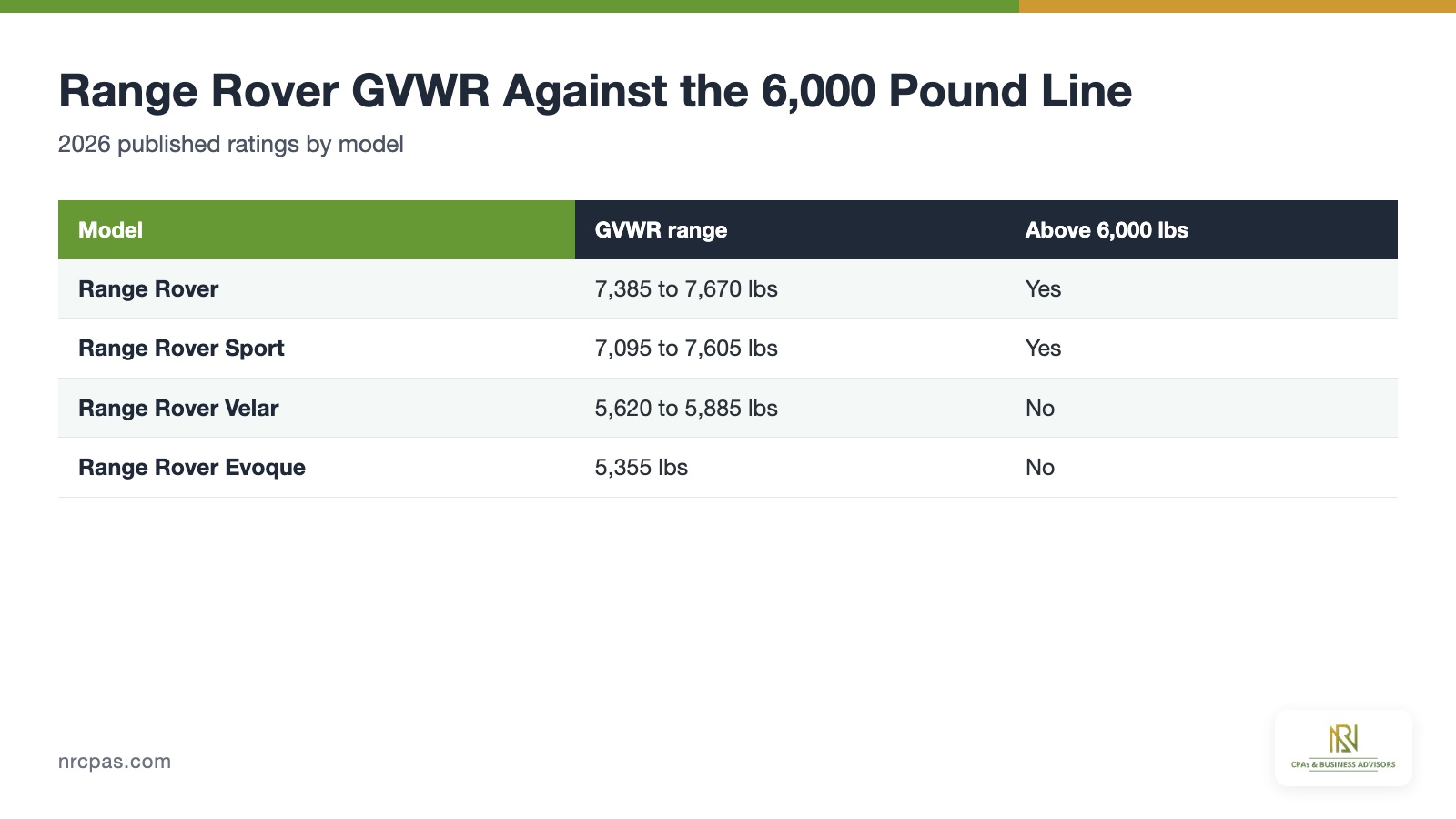
Sources list a few trims with slightly different figures, such as the 7-seat Range Rover at 7,450 pounds in one KBB entry. Wheelbase, seating and engine all move the rating, so the label on the vehicle decides.
Why Do the Velar and Evoque Fall Under 6,000 Pounds?
The Velar and Evoque fall under 6,000 pounds because both are compact-class SUVs built on lighter platforms. KBB lists the 2026 Velar at 5,620 pounds for the P250 S and 5,885 pounds for both P400 trims. The same data lists the Evoque P250 at 5,355 pounds.
A Velar or Evoque is a passenger automobile for tax purposes, not a heavy SUV. Passenger automobiles face the depreciation caps in Internal Revenue Code Section 280F. According to the IRS, those caps for 2026 are $20,300 in the first year with bonus depreciation and $12,300 without it. A Velar therefore cannot be fully deducted in one year, even at 100% business use.
The graphic below compares how the four models are treated.

Does GVWR or Curb Weight Decide the 6,000 Pound Test?
GVWR decides the 6,000 pound test for a Range Rover, not curb weight. Crest Capital notes that a rating of exactly 6,000 pounds does not pass, because the rating must be more than 6,000 pounds. The Range Rover and Range Rover Sport are rated as trucks, so the manufacturer label controls.
How Do You Verify Your Range Rover's GVWR?
Verify the GVWR of a Range Rover by reading the certification label on the driver's door jamb. The label states the rating in pounds for the exact vehicle in the driveway. Trim, seat count and model year can shift the number, so the label beats any website.
Photograph the label on delivery day and keep the image in the tax file. A published rating for a similar trim is a planning figure, and the door-jamb rating is the proof. With the weight settled, the dollar amount comes next.
How Much Can You Deduct on a Range Rover Under Section 179?
You can deduct up to $32,000 on a Range Rover under Section 179 for the 2026 tax year, according to the IRS. The IRS set the same heavy SUV cap at $31,300 for 2025. Congress sets the cap in Internal Revenue Code Section 179(b)(5), and the IRS adjusts it each year for inflation.
The cap sits inside a larger overall limit. According to the IRS, the 2026 Section 179 limit is $2,560,000, and the limit shrinks once purchases pass $4,090,000. The deduction reaches zero at $6,650,000 of qualifying purchases. The 2025 figures were $2,500,000 and $4,000,000, as the Section 179 expiration question shows.
Taxable income also limits the deduction. According to the IRS, Section 179 cannot exceed the taxable income from the active conduct of the business. Unused amounts carry forward. Owners who want the full rules can review the Section 179 overview before running numbers. The cap is only the first step, so the next section shows how the deduction is calculated.
How Is the Section 179 Deduction Calculated on a Range Rover?
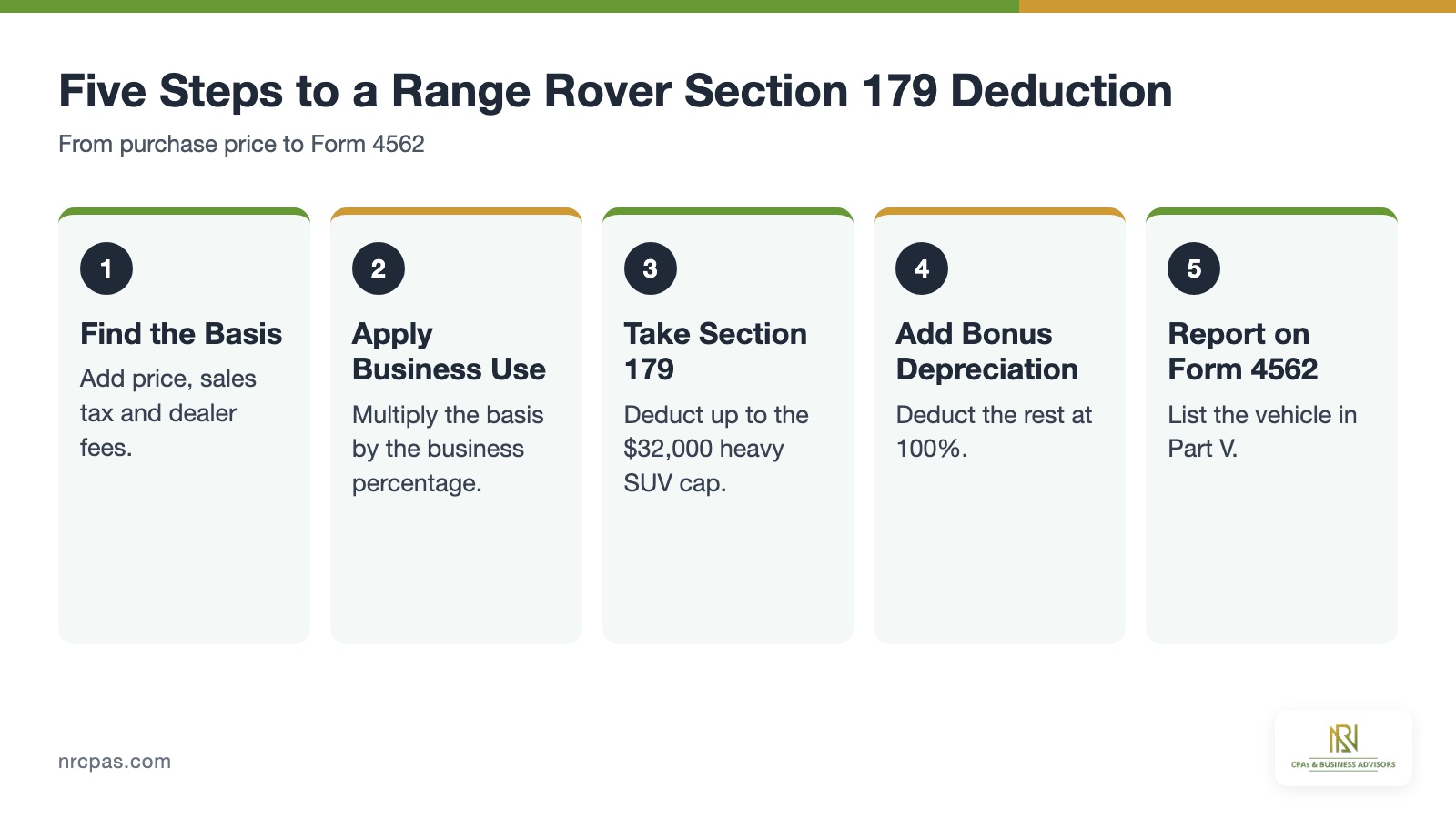
The Section 179 deduction on a Range Rover is calculated in five steps, which the numbered list below shows in order.
- Add the purchase price, sales tax and dealer fees to find the cost basis.
- Multiply the cost basis by the business-use percentage.
- Take Section 179 on that amount, up to the $32,000 heavy SUV cap.
- Deduct the remaining basis with 100% bonus depreciation.
- Report the deduction on Form 4562, with the vehicle in Part V.
The same five steps appear in the graphic below.
A worked example shows the math. According to KBB, the 2026 Range Rover starts at a $115,450 sticker price, so a round $120,000 basis keeps the numbers clean. The table below shows the deduction at three business-use levels.
| Business use | Deductible basis | Section 179 | Bonus depreciation |
|---|---|---|---|
| 100% | $120,000 | $32,000 | $88,000 |
| 80% | $96,000 | $32,000 | $64,000 |
| 60% | $72,000 | $32,000 | $40,000 |
Each row deducts the full deductible basis in year one, and the personal share never becomes a deduction. Placing the figures on the return follows Form 4562 steps, and the bonus column needs its own explanation.
Can You Take Bonus Depreciation on a Range Rover?
You can take bonus depreciation on a Range Rover, and the rate is 100% for the 2026 tax year. According to the IRS, the One Big Beautiful Bill Act restored 100% bonus depreciation for qualifying property acquired after January 19, 2025. Bonus depreciation has no heavy SUV cap of its own.
Bonus depreciation also removes the taxable income limit that applies to Section 179. A business with a small profit can still create a loss from the bonus portion. The two deductions work together on the same SUV, as the vehicle bonus rules explain.
Section 179 is elected first, up to $32,000, and bonus depreciation then absorbs the remaining basis. The 100% rate is the reason the heavy SUV cap rarely limits a Range Rover owner. Business use decides how much basis is left, so the next section covers the use test.
How Much Business Use Does a Range Rover Need?
A Range Rover needs more than 50% qualified business use for Section 179 to apply at all. At exactly 50% or below, Section 179 and bonus depreciation are both unavailable. The vehicle then moves to the slower Alternative Depreciation System.
Commuting between home and a main office does not count as business use. Client visits, job sites, deliveries and travel between work locations do count. The IRS expects a record that proves each trip.
A usable record carries four items, shown in the bulleted list below.
- The date of each business trip.
- The miles driven on each trip.
- The place visited and the business reason.
- The odometer reading on January 1 and December 31.
Claiming Section 179 or bonus depreciation also bars the standard mileage rate for that vehicle, so actual expenses must be tracked afterward. The business-use share also sets the deductible basis, as the worked table above shows. Keeping that share above 50% matters for years after the purchase, because recapture follows a drop.
When Does Section 179 Apply to a Range Rover?
Section 179 applies to a Range Rover in the year the SUV is placed in service for the business. The date of delivery, not the date of the order or deposit, sets the tax year. A Range Rover must be in service by December 31 to earn a deduction on that year's return.
Custom Range Rover orders often take months to arrive. A November order that arrives in January produces a deduction for the following tax year. Year-end purchases work best with a revenue forecast, which CFO forecasting supplies.
Purchase structure matters as well. Section 179 requires a purchase, so a true operating lease gives no Section 179 deduction. A financed purchase still qualifies in full, and the lessor, not the lessee, takes depreciation on a leased SUV. The deduction uses the cost of the SUV, not the cash paid in the year.
What Happens If You Sell a Range Rover Early?
Selling a Range Rover early triggers recapture, which means part of the deduction returns as ordinary income. According to the IRS, recapture applies when business use falls to 50% or less during the recovery period. Automobiles use a 5-year recovery period under the Modified Accelerated Cost Recovery System (MACRS).
A fully expensed Range Rover has an adjusted basis of zero, so the whole sale price becomes taxable gain. The gain is reported on Form 4797 under Internal Revenue Code Section 1245. Recapture is taxed at ordinary rates, not at the lower capital gains rates.
The holding requirement therefore deserves a plan before purchase. Recapture is one of several side topics around this deduction, and the group below covers the rest.
What Other Questions Do Range Rover Owners Ask About Section 179?
Range Rover owners ask about commercial status, used vehicles, depreciation and comparable SUVs. Each short answer below stands alone.
Is a Range Rover Classed as a Commercial Vehicle?
No, a Range Rover is not classed as a commercial vehicle, because Land Rover builds it as a passenger SUV. The tax code does not require a commercial label. The IRS looks at GVWR, business use and the placed-in-service date.
A Range Rover over 6,000 pounds gets heavy SUV treatment without a commercial title. Titling the SUV in the business name is a record-keeping habit and not a legal condition.
Does Section 179 Apply to a Used Range Rover?
Yes, Section 179 applies to a used Range Rover when the SUV is new to the business. According to the IRS, used property qualifies when the taxpayer never used it before. The seller also cannot be a related party. A used Range Rover from an unrelated seller gets the same $32,000 cap.
Owners who sell a personal Range Rover to their own LLC get no deduction. Rules for pre-owned vehicles cover those related-party sales in detail.
Why Do Range Rovers Depreciate So Fast?
Range Rovers depreciate fast because luxury SUVs with high prices and high repair costs lose resale value quickly. According to iSeeCars, the Range Rover lost an average of 61.7% of its value over five years. The same study period shows 41.8% as the industry-wide five-year figure.
That loss makes the first-year deduction more valuable. A deduction taken in year one recovers cost before the market value falls. Resale value still matters, because a quick sale can trigger recapture.
What SUVs Qualify for Section 179 Besides a Range Rover?
The SUVs that qualify for Section 179 are those rated from 6,001 to 14,000 pounds GVWR, such as many BMW X5 trims. The BMW X5 deduction follows the same $32,000 cap.
Pickups follow a different test. According to the IRS, a pickup with a 6-foot cargo bed escapes the passenger automobile caps in Section 280F. Details on the F-150 bed rules show how that exception works.
What If the IRS Questions the Range Rover Deduction?
An IRS notice about a Range Rover deduction usually asks for the mileage log, the GVWR label and the purchase papers. A missing record can turn a deduction into a tax bill with penalties and interest. Fast, complete answers to an IRS notice response keep the issue small.
How Can a CPA Help With a Range Rover Purchase?
A CPA can check the GVWR, the business-use share and the in-service date before the purchase closes. We run the Section 179 and bonus numbers for each model so the deduction is known up front. The team at NR CPAs group is led by founder Nischay Rawal, CPA, EA. Call (305) 872-3096 for a vehicle review.
The search "does range rover qualify for section 179 and when does it apply" has a short answer. It needs a model, a weight rating and a date. Sound vehicle deduction planning pulls all three together.