Does RAM 1500 Qualify for Section 179 and How Much Can You Deduct

Yes, a RAM 1500 qualifies for Section 179 when its gross vehicle weight rating (GVWR) tops 6,000 pounds. Business use must be above 50%, and the truck must be in service by December 31. Published 2026 RAM 1500 configurations list a GVWR from 6,800 to 7,800 pounds. The bed length decides whether the $32,000 heavy SUV cap applies.
Key Takeaways
- Every published 2026 RAM 1500 configuration is rated above the 6,000-pound GVWR test.
- A bed of at least 6 feet, such as the 6'4" box, avoids the $32,000 heavy SUV cap.
- A 5'7" box crew cab is capped at $32,000 of Section 179, but 100% bonus depreciation covers the rest.
- Business use must stay above 50%, or the IRS recaptures part of the deduction.
- The 2025 limit is $2,500,000 and the 2026 limit is $2,560,000.
Does RAM 1500 Qualify for Section 179 as a Business Truck?
A RAM 1500 qualifies for Section 179 as a business truck when it passes three tests: weight, business use and placed-in-service timing. The RAM 1500 passes the weight test in every published configuration, so business use and timing decide the rest. Section 179 lets a business deduct the purchase price in the year of purchase instead of over several years.
The deduction applies to new and used trucks, financed trucks and leased trucks that the business owns for tax purposes. The Internal Revenue Service (IRS) sets the rules for each test in Publication 946. Owners who plan the purchase with a tax planning CPA before December 31 avoid missing the placed-in-service date.
The first test is the weight rating, and the RAM 1500 clears it with room to spare.
Is a RAM 1500 Over 6,000 Pounds?
A RAM 1500 is over 6,000 pounds when the test uses GVWR, which is the maximum loaded weight set by the manufacturer. The IRS measures the 6,000-pound test by GVWR and not by curb weight. A 4x2 Quad Cab RAM 1500 weighs about 4,800 pounds empty, yet its GVWR is much higher.
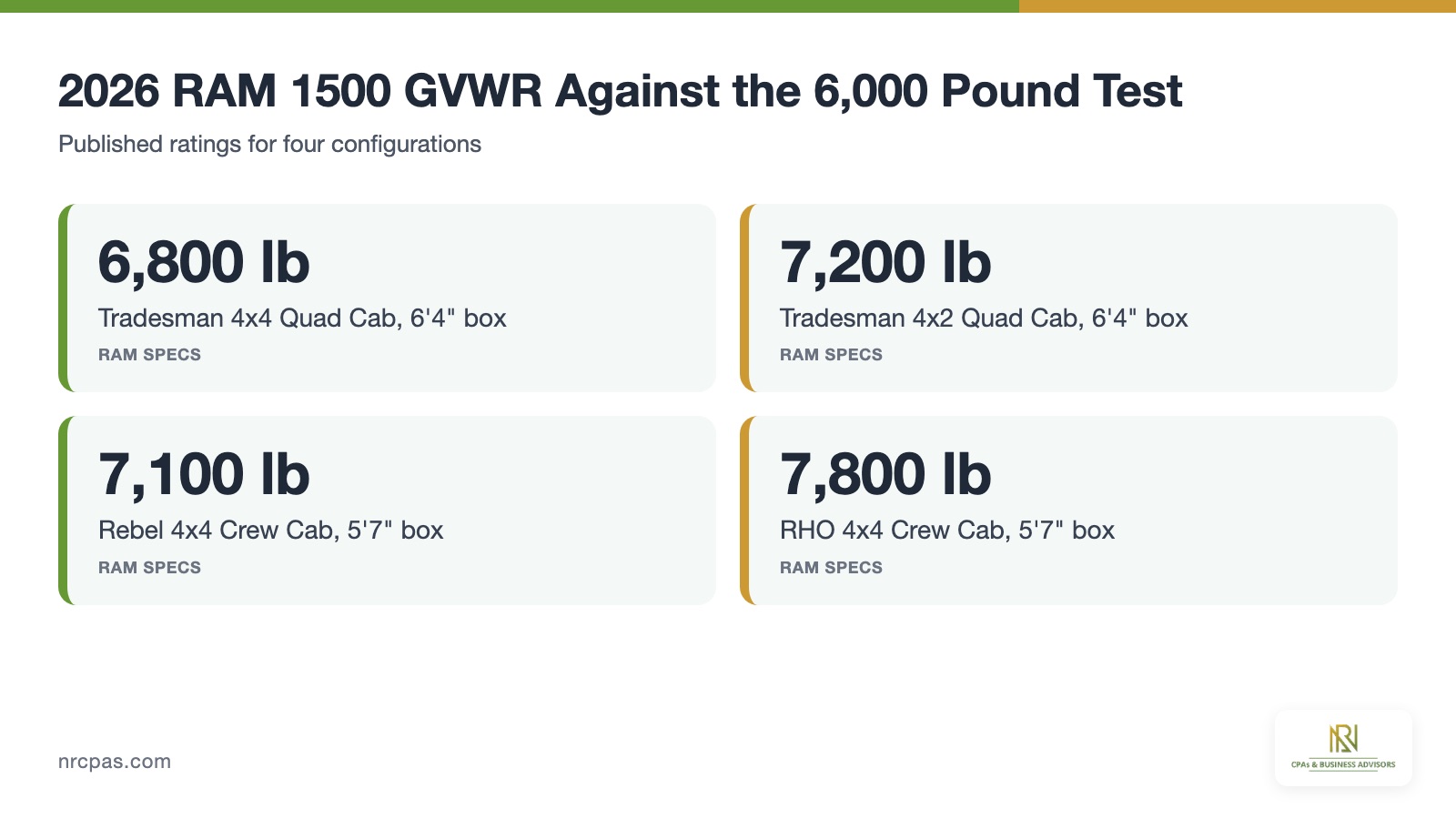
According to Ram's 2026 published specifications, the Tradesman 4x2 Quad Cab with the 6'4" box has a GVWR of 7,200 pounds. The same Quad Cab in 4x4 shows 6,800 pounds. Both clear the 6,000-pound line by at least 800 pounds.
The table below lists published GVWR figures for five 2026 RAM 1500 configurations.
| Configuration | Bed | GVWR | Heavy SUV Cap |
|---|---|---|---|
| Tradesman 4x2 Quad Cab | 6'4" | 7,200 lb | No cap |
| Tradesman 4x4 Quad Cab | 6'4" | 6,800 lb | No cap |
| Tradesman 4x2 Crew Cab | 5'7" | 6,900 lb | Capped |
| Rebel 4x4 Crew Cab | 5'7" | 7,100 lb | Capped |
| RHO 4x4 Crew Cab | 5'7" | 7,800 lb | Capped |
Each row clears 6,000 pounds, and the last column shows where the bed length starts to matter. The graphic below shows four of those GVWR ratings against the 6,000-pound test.
Ram does not publish a single GVWR for the whole lineup. Trim, cab, drivetrain and engine each move the rating. The label on the driver's door jamb gives the exact figure for a specific truck. Keep that label number in the tax file.
Weight is only the entry ticket, so the next question is how much of the price the deduction covers.
How Much Can You Deduct for a RAM 1500 Under Section 179?
You can deduct the full price of a RAM 1500 under Section 179 when the bed is at least 6 feet. A shorter bed limits the deduction to $32,000. The $32,000 figure is the 2026 heavy SUV cap under Internal Revenue Code Section 179(b)(5). The cap was $31,300 for vehicles placed in service in 2025.
The cap applies to vehicles rated 6,001 to 14,000 pounds GVWR that are built mainly to carry passengers. Pickups with a long enough cargo bed fall outside that definition, as the next section explains.
The deduction is also limited by business use. A truck used 80% for business supports 80% of the cost and 80% of the cap. The table below applies those rules to a $65,000 RAM 1500.
| Scenario | Section 179 | Bonus Depreciation | Year-One Total |
|---|---|---|---|
| 5'7" Crew Cab, 100% business | $32,000 | $33,000 | $65,000 |
| 5'7" Crew Cab, 80% business | $25,600 | $26,400 | $52,000 |
| 6'4" Quad Cab, 100% business | $65,000 | $0 | $65,000 |
| 6'4" Quad Cab, 60% business | $39,000 | $0 | $39,000 |
The totals match in the first and third rows, so the cap changes the method but not the year-one result. The cap still matters when taxable income is limited, because bonus depreciation behaves differently from Section 179.
Bed length is the detail that moves a truck from one row to another.
Does the RAM 1500 Bed Length Change the Section 179 Limit?
The RAM 1500 bed length changes the Section 179 limit. A bed of 6 feet or more removes the heavy SUV cap. A pickup is exempt from the cap when its open cargo area measures at least 6 feet inside. The cargo area must also be closed off from the passenger compartment.
Ram lists the 6'4" box at 76.3 inches of length and the 5'7" box at 67.4 inches. Six feet equals 72 inches, so the 6'4" box clears the line by about 4 inches. The 5'7" box falls short by about 5 inches.
The comparison graphic below shows both beds against the 72-inch line.
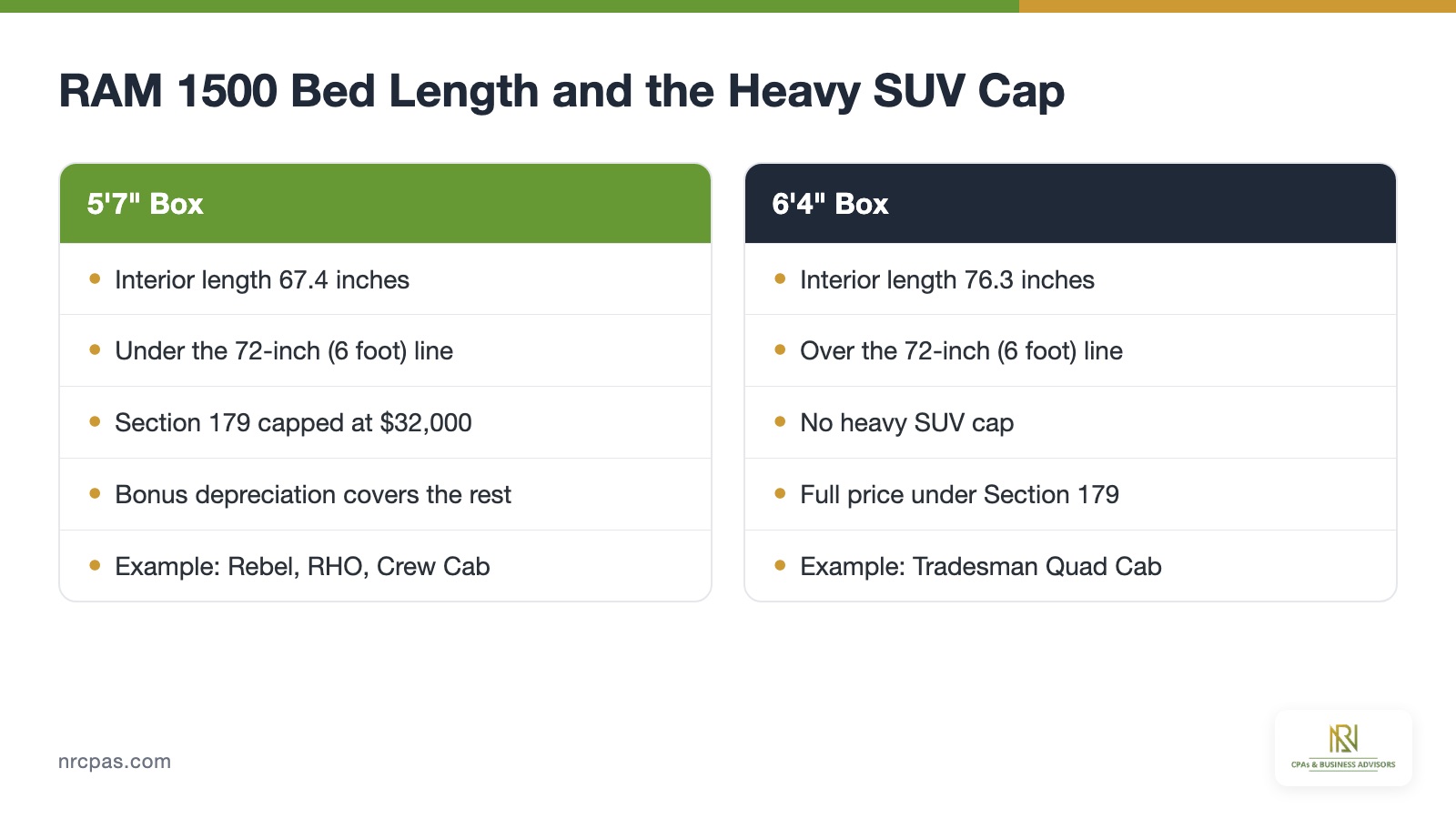
Measure the bed from the inside of the front bulkhead to the inside of the closed tailgate. Crew cab trims such as the Rebel and RHO come with the 5'7" box only, so the cap applies to them.
The cap does not end the tax savings, because depreciation picks up the remaining price.
How Does Bonus Depreciation Apply to a RAM 1500?
Bonus depreciation applies to a RAM 1500 as a first-year write-off of the remaining cost after Section 179. Bonus depreciation is back at 100% for property acquired and placed in service after January 19, 2025. According to the IRS, Public Law 119-21 reinstated that 100% rate.
The One Big Beautiful Bill Act is the law behind both the higher Section 179 limits and the 100% bonus rate. Bonus depreciation has no dollar cap and no taxable income limit. That feature helps a business with a small profit and a large truck purchase.
A heavy vehicle over 6,000 pounds also avoids the passenger automobile depreciation limits. According to the IRS in Revenue Procedure 2026-15, a lighter passenger car gets only $20,300 in year one with bonus depreciation. Without bonus, that first-year limit is $12,300, and the second year allows $19,800.
A RAM 1500 over 6,000 pounds escapes those limits, which is why weight matters so much. Owners can compare the two methods in this first-year write-off before choosing how to split the deduction.
Both methods depend on one condition that the owner controls, which is how much the truck is used for business.
How Much Business Use Does a RAM 1500 Need for Section 179?
A RAM 1500 needs business use above 50% to qualify for Section 179. Business use at 50% or less removes the Section 179 election completely. The truck then depreciates under the alternative depreciation system over a longer period.
Business use includes jobsite trips, client visits, hauling materials and deliveries. Commuting between home and the regular workplace does not count. A mileage log with dates, miles and purpose is the standard proof. According to the IRS, the business standard mileage rate is 72.5 cents per mile for 2026.
The rate also shows why a log matters: every business mile has a recorded value. Business use must stay above 50% in later years too. According to the IRS, a drop to 50% or less triggers recapture under Section 280F.
Recapture means the owner reports part of the earlier deduction as ordinary income. The amount equals the depreciation taken minus what straight-line depreciation would have allowed. Owners can review the ownership requirements before selling a truck or converting it to personal use.
Business use sets the percentage, and the yearly dollar limits set the ceiling.
What Are the 2025 and 2026 Section 179 Limits for a RAM 1500?
The 2025 Section 179 limit is $2,500,000 and the 2026 limit is $2,560,000. The phase-out starts at $4,000,000 for 2025 and $4,090,000 for 2026. According to the IRS, the 2026 deduction disappears completely at $6,650,000 of qualifying purchases.
A RAM 1500 uses only a small part of those limits. A $65,000 truck is about 2.5% of the 2026 maximum. The limits matter more for a business that also buys machinery, computers and furniture in the same year.
The list below compares the 2025 and 2026 figures that apply to a RAM 1500 owner.
- Section 179 maximum: $2,500,000 for 2025 and $2,560,000 for 2026.
- Phase-out start: $4,000,000 for 2025 and $4,090,000 for 2026.
- Heavy SUV cap: $31,300 for 2025 and $32,000 for 2026.
- Bonus depreciation: 100% after January 19, 2025.
The Section 179 deduction also cannot exceed the business taxable income for the year. Any excess carries forward to the next year. The steps for the 2026 calculation explain how that calculation works.
With the limits set, the last step is claiming the truck on the return.
How Do You Claim a RAM 1500 Under Section 179 on Your Tax Return?
You claim a RAM 1500 under Section 179 by filing IRS Form 4562 with the business tax return. Form 4562 reports the cost, the in-service date and the business-use percentage of the truck. The deduction then flows to the business return, such as Schedule C for a sole proprietor.
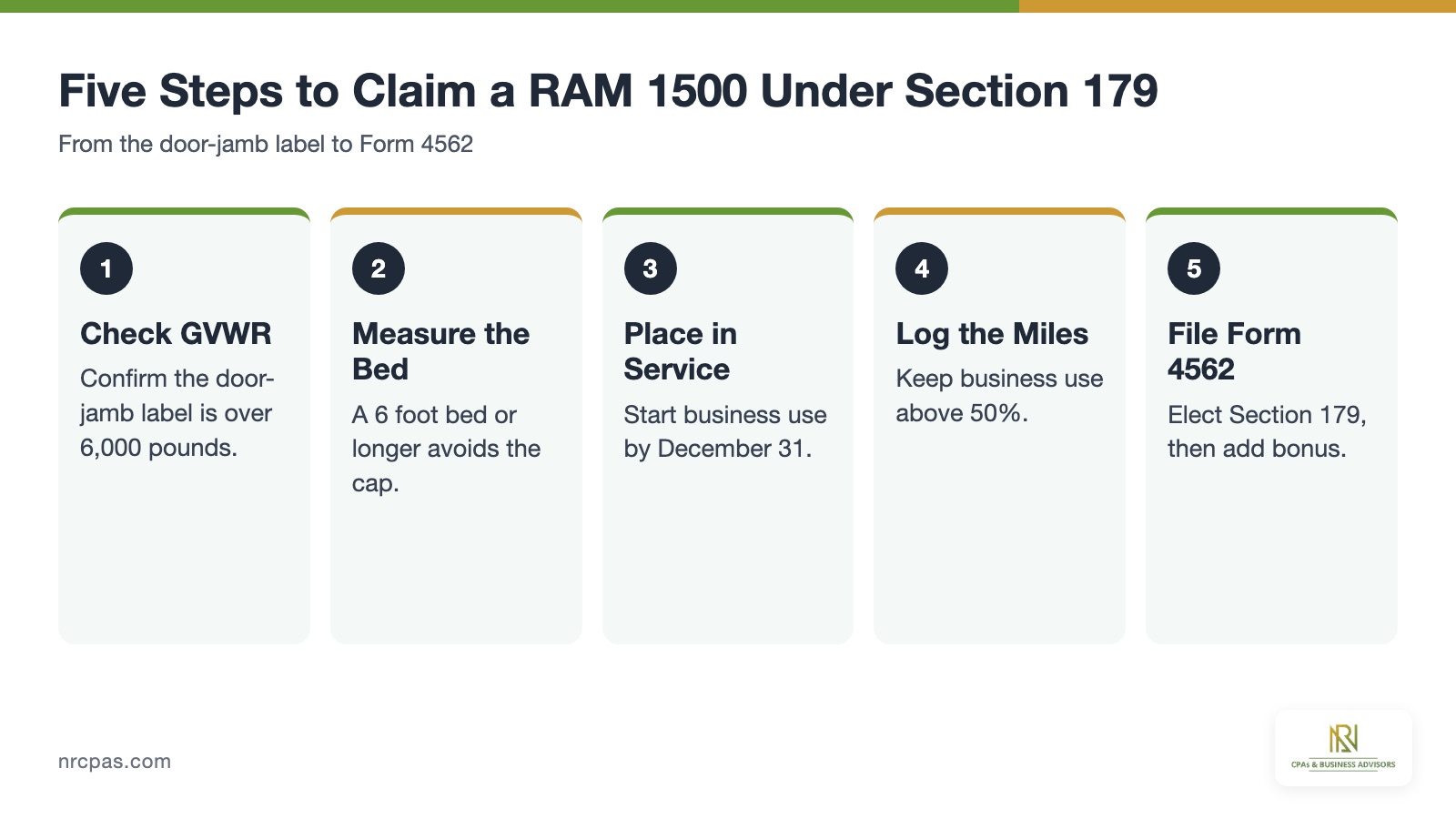
Five steps cover the claim from purchase to filing.
- Confirm the GVWR on the door-jamb label is over 6,000 pounds.
- Measure the bed to see whether the heavy SUV cap applies.
- Place the truck in service and start using it for business by December 31.
- Keep a mileage log that shows business use above 50%.
- File Form 4562 and elect Section 179, then apply bonus depreciation to the rest.
The graphic below lays out the same five steps in order.
The line where the deduction lands depends on the return type, and the guide to tax return placement shows each location. The IRS also requires records of business, investment and personal use for as long as the return can be audited.
The main rules are now clear, and a few side topics remain for RAM 1500 owners.
What Else Should RAM 1500 Owners Know About Section 179?
RAM 1500 owners should also know how used trucks, income limits, mileage rates and other models fit Section 179. The topics below answer the side questions that follow most truck purchases.
Does RAM 1500 Qualify for Section 179 When Bought Used?
Yes, you can deduct a used RAM 1500 under Section 179, if the business did not previously use the truck. The truck must be new to the buyer. A truck bought from a dealer or a private seller passes that test.
Trucks bought from a related person do not qualify. The rules for secondhand trucks list each exception in detail.
Does RAM 1500 Qualify for Section 179 on a Financed Purchase?
A financed RAM 1500 qualifies for Section 179 on its full price, even when a loan covers most of the cost. The business owns the truck for tax purposes once it signs the purchase contract. The loan payments do not reduce the deduction.
A lease works differently, because the lessor claims the deduction unless the lease is a purchase in disguise. Owners should read the contract before assuming the deduction.
Is Section 179 Better Than Bonus Depreciation for a RAM 1500?
Section 179 is better than bonus depreciation for a RAM 1500 when the owner wants control over the deduction amount. Section 179 lets the owner choose how much to deduct, which helps when taxable income is low. Bonus depreciation applies automatically unless the owner elects out.
Bonus depreciation has no taxable income limit, so it suits a year with a loss. Many owners use Section 179 for the capped portion and bonus for the rest.
Is There an Income Limit for Section 179 on a RAM 1500?
Yes, Section 179 has an income limit because the deduction cannot exceed the business taxable income for the year. The disallowed amount carries forward with no expiration date. A new business with a loss in the first year should plan for that limit.
Bonus depreciation can fill the gap. A loss year still gets the 100% first-year write-off on the truck. The deduction fundamentals explain the limit in full.
Should You Use the Mileage Rate or Section 179 on a RAM 1500?
You should use the mileage rate or Section 179 on a RAM 1500 based on the miles driven and the truck price. The 72.5-cent rate pays 72.5 cents per business mile in 2026. A truck driven 10,000 business miles produces a $7,250 deduction under that rate.
Section 179 and bonus depreciation produce a far larger first-year deduction on a $65,000 truck. The two methods cannot be combined on the same vehicle.
How Do Other Trucks and SUVs Compare With the RAM 1500?
Other heavy vehicles follow the same 6,000-pound test, and the details differ by model. The Ford F-150 rules use the same 6-foot bed exemption as the RAM 1500. An SUV such as the BMW X5 always faces the heavy SUV cap because it has no pickup bed.
Readers comparing luxury SUVs can review the luxury SUV deduction.
Does a RAM 2500 or 3500 Qualify for Section 179 Too?
A RAM 2500 or 3500 qualifies for Section 179 on the same tests as the RAM 1500. According to Ram, its incentives page offers a first-year deduction of up to 100% of the price. That page covers the Ram 1500, 2500, 3500, Chassis Cab and ProMaster.
Heavy-duty pickups sit well above the 6,000-pound line, so the weight test is never the obstacle. Business use and the placed-in-service date still decide the result.
What Records Prove Business Use of a RAM 1500?
A mileage log, purchase papers and service receipts prove the business use of a RAM 1500. A mileage log with dates, miles and purpose is the strongest record because the IRS tests the percentage, not the intent.
The purchase contract shows the cost and the in-service date. Maintenance receipts show the odometer readings that support the log. The IRS requires these records for as long as the return can be audited.
How Can a CPA Help With a RAM 1500 Purchase?
A CPA helps with a RAM 1500 purchase by checking the GVWR, bed length and deduction split before the truck enters service. We review each purchase against the business use records and the taxable income for the year.
The NR CPAs staff works under founder Nischay Rawal, CPA, EA, and can be reached at (305) 872-3096. Clients bring truck purchases, equipment buys and entity questions to the firm before year-end. That timing lets the deduction be planned instead of guessed.
Owners planning a truck purchase can start with year-end tax strategy to match the deduction to the income for the year.