Can Section 179 Deduction Be Carried Forward to Next Year

Yes, a Section 179 deduction can be carried forward, but only the part blocked by the business income limitation. The blocked amount moves to Form 4562 line 13 and carries forward with no expiration date. A cut caused by the dollar phase-out is lost for good, and the deduction never creates a net operating loss.
Key Takeaways
- Only the business income limitation creates a Section 179 carryover.
- The carryover has no expiration date and rolls forward until income absorbs it.
- Form 4562 line 10 brings the balance in, and line 13 sends the new balance forward.
- Partners and S corporation shareholders face the limit at the entity and at the owner level.
- Bonus depreciation has no income limit and can create a net operating loss.
Can Section 179 Deduction Be Carried Forward to Next Year?
A Section 179 deduction can be carried forward to next year when taxable income is too low to absorb it. The unused amount carries forward for an unlimited number of years. Treasury Regulation 1.179-3 calls the balance the carryover of disallowed deduction.
Many businesses buy equipment before profits arrive. According to the U.S. Small Business Administration (SBA) Office of Advocacy, the country has 36.2 million small businesses. Those businesses employ about 46% of private-sector workers. A thin income year can erase a first-year write-off, so the Section 179 rules reward owners who know the carryover. The carryover keeps the deduction alive, but it delays the tax savings until income catches up.
Equipment purchases are easier to size when each dollar has a planned year. Owners who build carryforward planning into each purchase know which year absorbs each dollar. That planning starts with the income test that creates the carryover.
What Is the Business Income Limitation for Section 179?
The business income limitation caps the Section 179 deduction at taxable income from the active conduct of a trade or business. The cap is measured before the Section 179 deduction itself. A passive investor has no active business income, so passive income does not count.
Wages count as business income for an individual. According to the Internal Revenue Service (IRS), the Form 4562 instructions count all wages, salaries, tips and other employee compensation. A married couple filing jointly combines the income of both spouses.
The limit applies to the taxpayer, not to each business. Profit from one business can absorb equipment bought by another business. A loss in one business shrinks the pool.
The dollar caps leave the income test as the usual constraint. According to the IRS, the 2025 Section 179 limit is $2,500,000, and the phase-out begins at $4,000,000 of qualifying property. Revenue Procedure 2025-32 sets the inflation-indexed limits for 2026. The limit is $2,560,000, and the phase-out starts at $4,090,000.
Those two dollar caps are separate tests from the income cap, and only one of them leaves a balance behind.
Does the Section 179 Phase-Out Create a Carryover?
The Section 179 phase-out does not create a carryover, because the lost amount was never electable. A phase-out reduction is permanent. The limit falls one dollar for each dollar of property placed in service above the threshold.
A business that places $5,000,000 of property in service in 2025 exceeds the $4,000,000 threshold by $1,000,000. The 2025 limit then drops from $2,500,000 to $1,500,000. The deduction reaches zero at $6,500,000 for 2025 and at $6,650,000 for 2026.
That permanent loss is the reason owners compare Section 179 with bonus depreciation, which a later section covers. The income test, in contrast, leaves a balance, and the balance follows a fixed yearly routine.
How Does the Section 179 Carryover Work From Year to Year?
The Section 179 carryover works by adding last year's disallowed amount to this year's deduction, up to this year's income limit. The carryover can use only the dollar room left after the current-year election. Regulation 1.179-3 sets the added amount at the lesser of the prior balance or the unused dollar allowance.
The yearly routine runs in four steps.
- Compute taxable income from active businesses before any Section 179 deduction.
- Deduct the current-year Section 179 election, up to that income.
- Add the prior-year carryover, up to the remaining income and the unused dollar allowance.
- Carry any leftover balance to the next tax year.
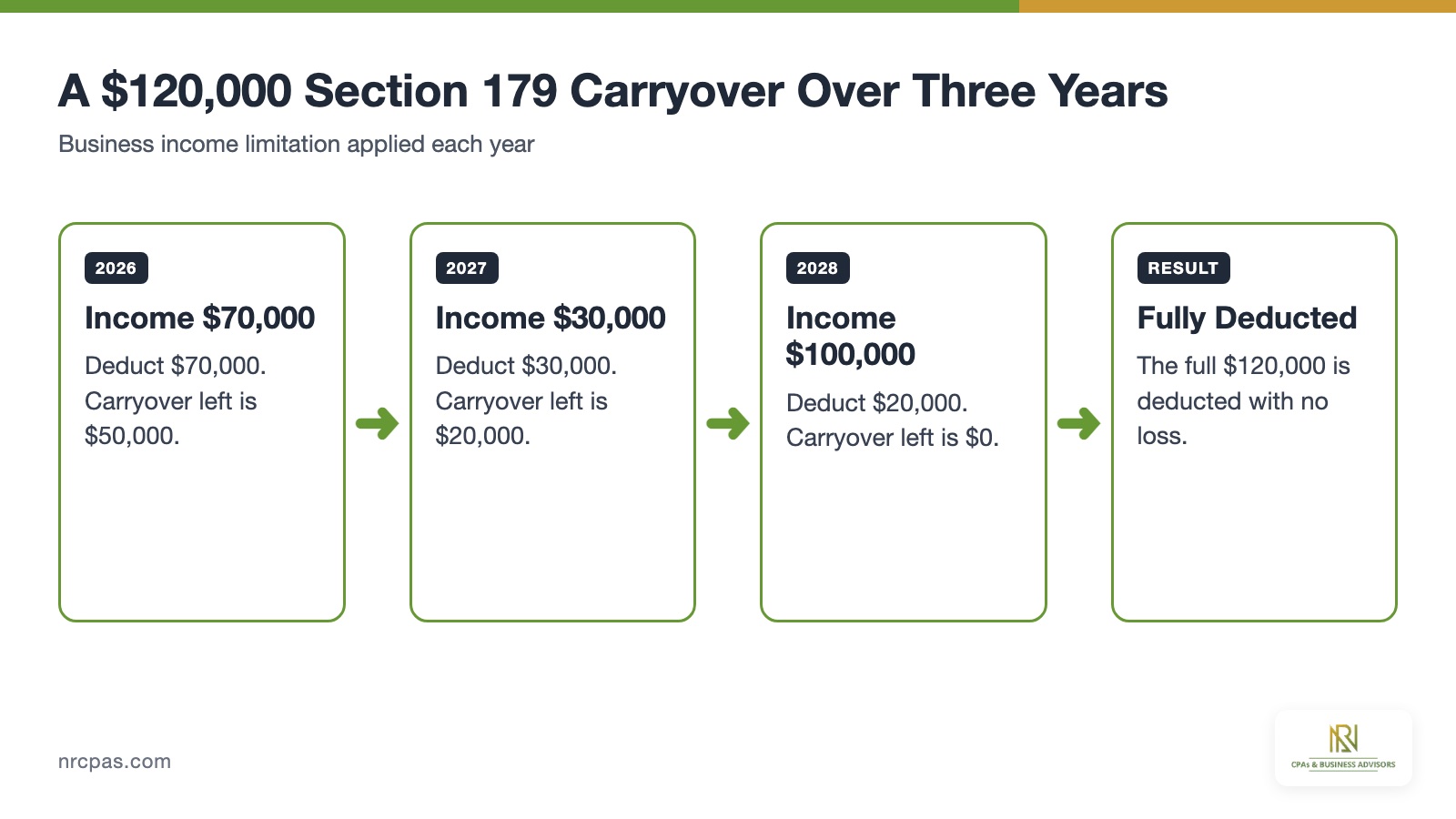
The table below follows a $120,000 equipment purchase elected in 2026 through three tax years.
| Tax Year | Income Before Section 179 | Deduction Allowed | Carryover Left |
|---|---|---|---|
| 2026 | $70,000 | $70,000 | $50,000 |
| 2027 | $30,000 | $30,000 | $20,000 |
| 2028 | $100,000 | $20,000 | $0 |
The balance reaches $0 in 2028, and the full $120,000 is deducted over three years with no loss. The flow graphic below traces the same three years.
Regulation 1.179-3 also controls which assets hold the balance. The owner selects the properties in the year they are placed in service and records the choice in the books. Without a selection, the balance is spread equally across the elected items, and the earliest year is deducted first. Pre-owned property qualifies, so the same tracking covers pre-owned equipment bought in the same year.
Those balances live on one tax form, and its lines run in a fixed order.
Where Does the Carryover Go on Form 4562 Lines 10 Through 13?
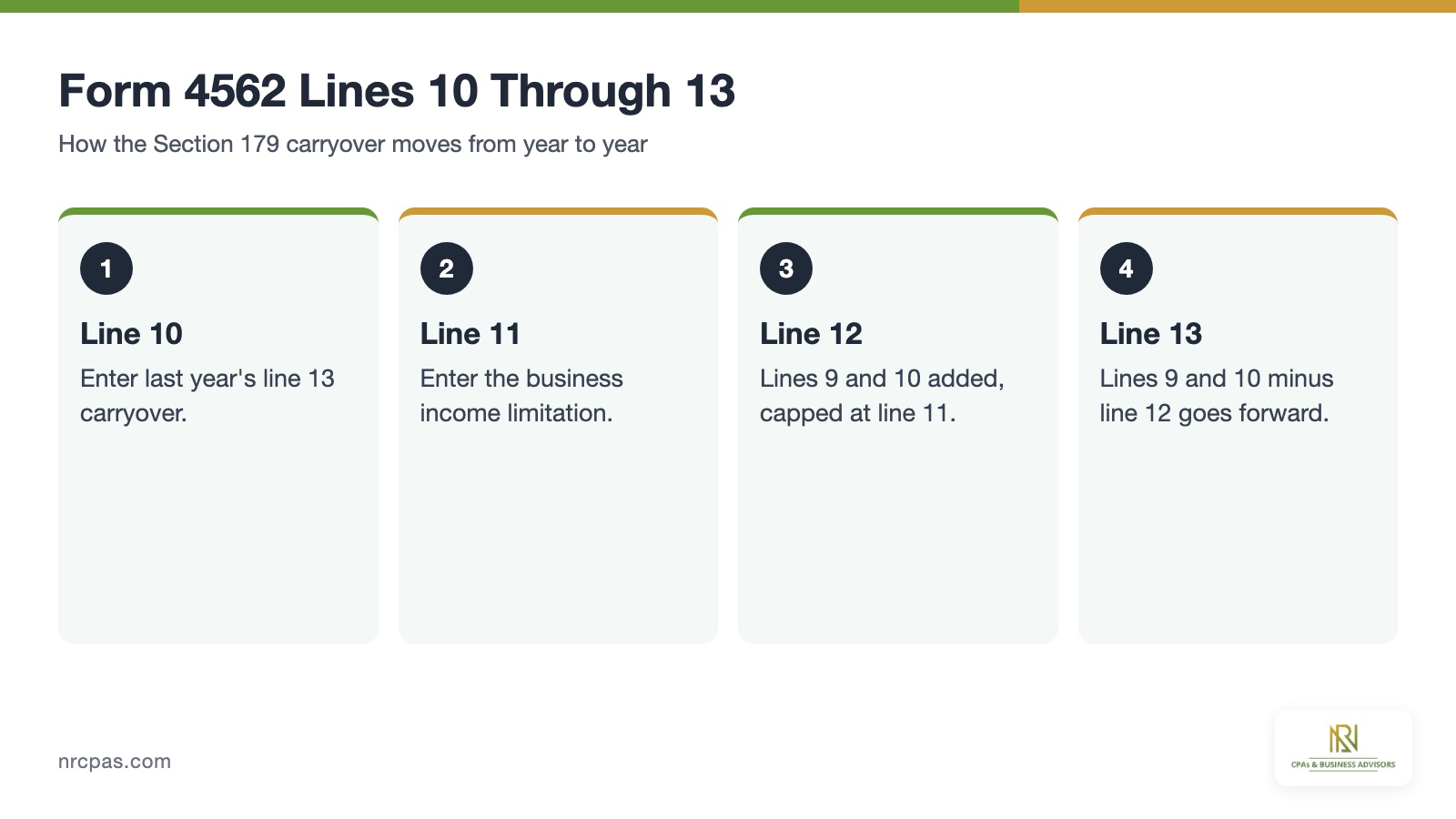
The carryover goes on Form 4562, Part I. Line 10 brings in last year's balance, and line 13 sends the new balance forward. Line 13 is the carryover of disallowed deduction to next year. Line 11 holds the business income limitation, and line 12 holds the deduction allowed.
- Line 10: enter the carryover from line 13 of last year's Form 4562.
- Line 11: enter the taxable income limit from active trades or businesses.
- Line 12: enter lines 9 and 10 added together, but never more than line 11.
- Line 13: enter lines 9 and 10 added together, minus line 12.
Line 9 holds the current-year election after the dollar limit. The steps graphic below shows how lines 9 through 13 chain together.
The balance only travels forward when the form is filed for that year, so a loss year still needs a Form 4562. Owners who want to confirm where the form sits on the return can review Form 4562 basics before filing.
Entity owners add a second layer to those lines, because the Schedule K-1 changes who holds the balance.
Can Section 179 Deduction Be Carried Forward by Partners and S Corporation Shareholders?
Yes, partnerships and S corporations carry the deduction forward, and the owner's own return holds most of the balance. The business income limitation applies at the entity level and again at the owner level. Regulation 1.179-3 states that a partnership can have its own carryover, with similar rules for S corporations.
Pass-through entities are common. According to the IRS Statistics of Income Bulletin, partnerships filed about 4.5 million returns for 2021. Those returns covered more than 30 million partners. IRS Publication 5655 adds that pass-through corporate filers made up 5.1 million of the 6.7 million active corporate returns for 2021.
The two-level test works in five parts.
- The entity applies the dollar limit and phase-out to its own purchases.
- The entity caps its deduction at its own trade or business income.
- Any amount blocked at the entity stays a carryover at the entity.
- Each owner applies a personal business income limit to the K-1 amount.
- The owner carries any blocked K-1 amount forward on the owner's Form 4562.
The owner's dollar limit is shared across every K-1 and every personal purchase. Basis moves even when the deduction does not. The owner reduces basis in the partnership interest or S corporation stock by the full allocation. A carried amount still reduces basis.
Owners comparing entity types can weigh owner basis rules against the basis effects before buying equipment inside the entity. Owners with thin K-1 income can avoid the carryover altogether by using bonus depreciation, which has no income test.
Can Bonus Depreciation Replace a Section 179 Carryover?
Bonus depreciation can replace a Section 179 carryover, because bonus depreciation has no business income limitation. Bonus depreciation can create a net operating loss, and Section 179 cannot. Under IRS Notice 2026-11, bonus depreciation is 100% for qualifying property acquired after January 19, 2025.
A net operating loss (NOL) occurs when deductions exceed income. According to the IRS, an NOL from tax years after 2017 carries forward indefinitely. The deduction for years after 2020 is limited to 80% of taxable income. Post-2017 NOLs generally cannot be carried back, except for farming losses.
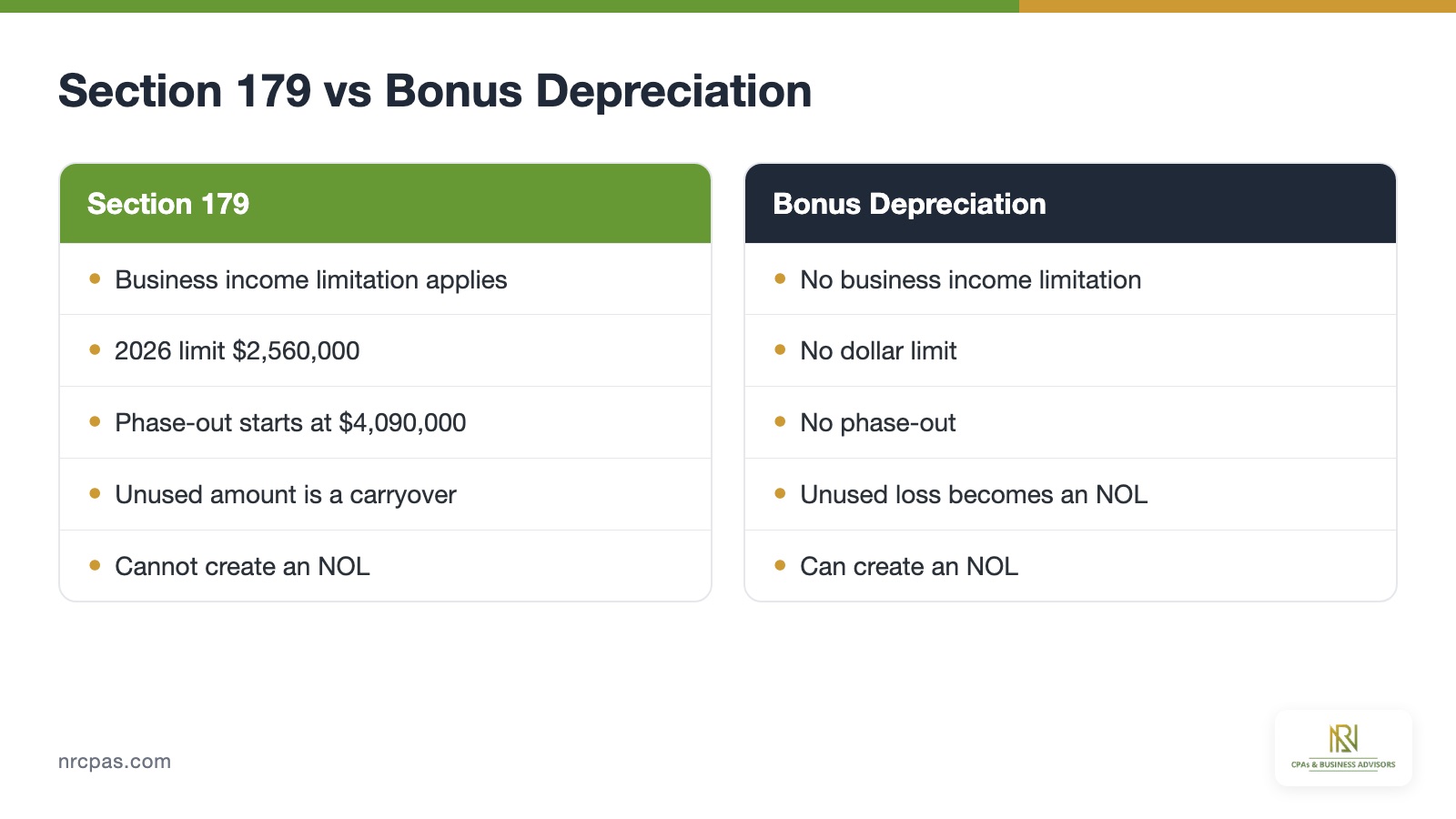
A Section 179 carryover can offset the full business income limit in a later year. An NOL offsets at most 80% of taxable income. The table below compares the two methods side by side.
| Feature | Section 179 | Bonus Depreciation |
|---|---|---|
| Business income limitation | Yes | None |
| Dollar limit | $2,560,000, phase-out from $4,090,000 | None |
| Unused amount | Carryover, no expiration | Becomes an NOL, no expiration |
| Can create an NOL | No | Yes |
| Election level | Asset by asset | Whole property class |
Vehicles show the difference clearly. The heavy SUV cap limits only Section 179, to $31,300 for 2025 and $32,000 for 2026. Bonus depreciation covers the rest of the cost. Buyers can review bonus on vehicles before choosing a split. Buyers who split cost this way keep the Section 179 election small and the income test easy to meet.
Profit patterns decide the split between the two methods. A business with uneven profits can use an income timing strategy to decide how much cost goes to each method. The leftover balance from that split raises the next group of questions.
What Else Should Owners Know About a Section 179 Carryforward?
A Section 179 carryforward raises five side questions, covering duration, timing, sales, asset types and record support. The answers below stay short, and each rests on Regulation 1.179-3.
How Long Can a Section 179 Carryover Last?
A Section 179 carryover lasts for an unlimited number of years under Regulation 1.179-3. No expiration date applies to the balance. The balance waits until business income absorbs it.
The records must show each asset, its original cost, the amount used each year and the remaining balance. Vehicle owners also track the vehicle ownership rules, because early business-use changes trigger Section 179 recapture.
Must a Business Use the Carryover in the First Profitable Year?
Yes, a business uses the carryover in the first year with enough income and unused dollar allowance. The law adds the carryover to the allowed deduction automatically. An owner cannot park the balance for a higher-rate year.
A carryover also moves in one direction only. The balance never goes back to an earlier tax year.
Can Section 179 Deduction Be Carried Forward After a Sale or Recapture?
No, a Section 179 carryover cannot be deducted after the property is sold or transferred. The outstanding balance is added to the property's basis immediately before the transfer. Neither the seller nor the buyer deducts it.
Section 179 recapture works the same way for the balance. Once recapture applies, the outstanding carryover for that property is no longer available. A partner who sells an interest adds the balance to the basis of that interest first.
Does the Asset Type Change the Carryover Rules?
No, the carryover rules are the same for equipment, off-the-shelf software and qualified real property. Only eligibility differs by asset. Landlords confirm eligibility first, using the rental property rules before any election.
Who Can Track a Section 179 Carryforward Across Entities?
A CPA firm can track a Section 179 carryforward across every asset, entity and owner. We build carryover schedules that tie to Form 4562 each year, and we match them to asset ledger entries in the books. Each schedule lists the cost, the election, the yearly deduction and the remaining balance for one asset. Owners then see the carryover balance at every year end.
Founder Nischay Rawal, CPA, EA, leads the NR advisory team. Call (305) 872-3096 to review an equipment purchase before year end. Early review lets the team compare the carryover against bonus depreciation before the asset is placed in service.
Business owners who want each purchase timed against income can work with tax planning advisors on Section 179 and bonus depreciation.