Does NJ Allow Section 179 Depreciation and How Much


No, New Jersey does not allow the full federal Section 179 deduction, and the state stops the deduction at $25,000. The federal 2026 limit is $2,560,000, so any larger federal write-off needs a New Jersey add-back. New Jersey allows Section 179 only up to $25,000, and the rest is depreciated over time.
Key Takeaways
- New Jersey allows a maximum Section 179 deduction of $25,000 for the Gross Income Tax and the Corporation Business Tax.
- The federal 2026 Section 179 limit is $2,560,000, with a phase-out that starts at $4,090,000.
- New Jersey rejects federal 100% bonus depreciation and the 50% allowance. The old 30% allowance counts only when claimed federally.
- Form GIT-DEP calculates the New Jersey depreciation adjustment for individuals, partnerships and S corporations.
- Unused New Jersey Section 179 cannot be carried forward, and the deduction has no business income limit.
Does NJ Allow Section 179 Depreciation on Business Equipment?
New Jersey allows Section 179 depreciation on business equipment, but the New Jersey Division of Taxation caps the deduction at $25,000. The cap covers the Gross Income Tax and the Corporation Business Tax. A federal deduction above $25,000 does not carry into New Jersey income. The Division of Taxation calls this a decoupling from federal Section 179 rules.
The decoupling comes from P.L. 2004, c.65, which applies to assets placed in service on or after January 1, 2004. According to the New Jersey Division of Taxation, the state calculates Section 179 under the Internal Revenue Code of December 31, 2002. Later federal increases in the limit never reached the state.
Careful state depreciation planning starts with that gap between the two limits. The next question is how wide the gap is in dollars.
How Much Section 179 Can a New Jersey Taxpayer Claim?
A New Jersey taxpayer can claim up to $25,000 of Section 179, according to Form GIT-DEP from the Division of Taxation. The federal limit is $2,560,000 for 2026, according to the Internal Revenue Service (IRS). The table below compares the two limits side by side.
| Rule | Federal 2025 | Federal 2026 | New Jersey |
|---|---|---|---|
| Maximum deduction | $2,500,000 | $2,560,000 | $25,000 |
| Phase-out begins | $4,000,000 | $4,090,000 | Reduced-dollar limit uses the $25,000 maximum |
| Fully phased out | $6,500,000 | $6,650,000 | Not applicable |
| Business income limit | Yes | Yes | None |
| Carryforward of unused amount | Yes | Yes | None |
The federal figures come from IRS Publication 946 and Revenue Procedure 2025-32. The graphic below turns the two limits into one comparison.

According to the Division of Taxation, the New Jersey cap has no business income limit. A loss-making business can still claim the $25,000 on its New Jersey return. A federal return, by contrast, limits Section 179 to taxable business income.
The cap is the same for every taxpayer type, but it is counted differently for each one. Those counting rules come next.
Does the $25,000 NJ Section 179 Deduction Limit Apply to Each Owner or Each Entity?
The $25,000 NJ Section 179 deduction limit applies to each entity and to each individual income category, according to Form GIT-DEP. Each partnership and each S corporation gets its own $25,000 maximum. The entity then passes the New Jersey adjustment to owners on their NJK-1 or NJ-K-1.
An individual, estate or trust has a separate counting rule. The Division of Taxation limits Section 179 to $25,000 within each category, such as net profits from business. One Worksheet GIT-DEP covers each category.
Corporations follow a different form. The 2025 CBT-100 instructions tell a corporation to enter the lesser of federal Section 179 or $25,000 on Schedule S. An S corporation structure therefore changes how many $25,000 caps a family of businesses can use.
The Division of Taxation also sets a higher cap for Liberty Zone property. Liberty Zone property qualifies for a $60,000 maximum, which is the $25,000 state cap plus up to $35,000 of federal increase. That special rule covers property in lower Manhattan.
Section 179 is only half of the depreciation story. The other half is bonus depreciation, which New Jersey treats on a separate track.
Does New Jersey Allow Bonus Depreciation?
New Jersey does not allow the current federal bonus depreciation, which is 100% after January 19, 2025, according to the IRS. New Jersey accepts only the legacy 30% special allowance, and only when the taxpayer claimed it federally. The 50% special allowance is not allowed under Form GIT-DEP.
The rule on New Jersey bonus depreciation has a long history. The Business Tax Reform Act, P.L. 2002, c.40, first decoupled the Corporation Business Tax from bonus depreciation for privilege periods starting on or after January 1, 2002. P.L. 2004, c.65 extended that decoupling to the Gross Income Tax for taxable years starting on or after January 1, 2004. The federal 100% rule from the 2025 tax law adds a much larger gap.
A taxpayer who claimed 100% bonus federally must recompute the asset under New Jersey rules. The recomputation uses regular MACRS, the Modified Accelerated Cost Recovery System. A vehicle bonus claim follows the same state rule.
The comparison graphic below lists the federal and New Jersey positions line by line.

The federal 100% allowance and the New Jersey rule produce different tax bases for the same asset. Closing that difference takes a short calculation on Form GIT-DEP.
How Do You Calculate the NJ Depreciation Adjustment With Form GIT-DEP?
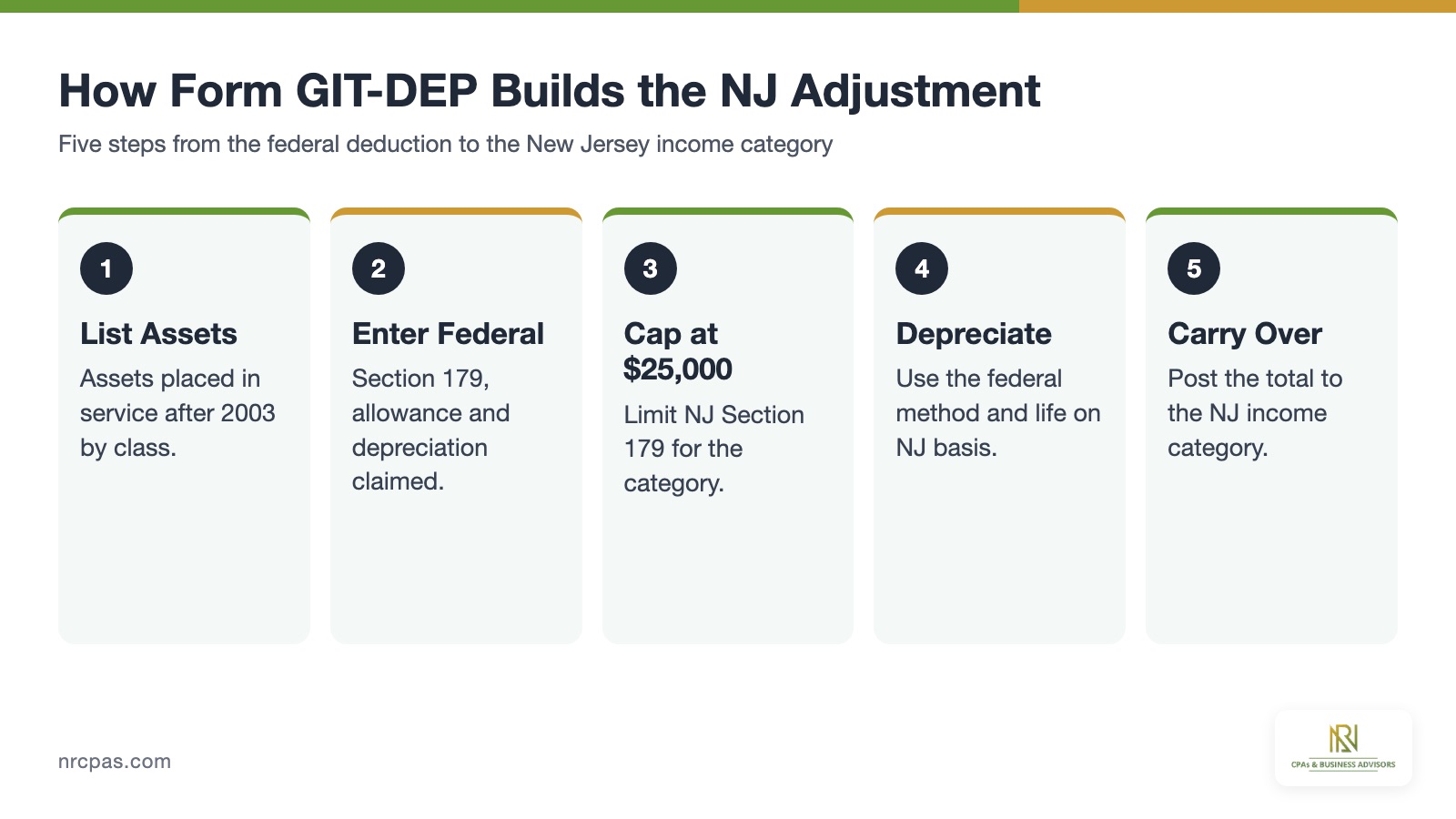
You calculate the NJ depreciation adjustment by completing Form GIT-DEP for each income category and carrying the total to the return. Form GIT-DEP has four parts, and the Division of Taxation revised the current version in October 2025. The steps below follow the order of those parts.
- List each asset placed in service after December 31, 2003, with its property class and year placed in service.
- Enter the federal Section 179, special allowance and depreciation deducted for the year.
- Limit the New Jersey Section 179 deduction to $25,000 for all assets in the category.
- Subtract the New Jersey Section 179 from the federal basis, then apply the federal method and life to that New Jersey basis.
- Carry the total adjustment to the matching New Jersey income category.
The steps appear in the graphic below, in the same order as the form.
A worked example shows the numbers. A business buys a $100,000 machine, which is 7-year property, and deducts the full cost federally in year one. According to IRS Publication 946, the half-year MACRS rates for 7-year property are 14.29%, 24.49% and 17.49% in the first three years.
The New Jersey deduction in year one equals $25,000 plus 14.29% of the remaining $75,000. That total is about $35,718. The table below shows the first three years.
| Tax Year | Federal Deduction | NJ Deduction | NJ Income Adjustment |
|---|---|---|---|
| Year 1 | $100,000 | $35,718 | Add $64,282 |
| Year 2 | $0 | $18,368 | Subtract $18,368 |
| Year 3 | $0 | $13,118 | Subtract $13,118 |
The adjustment reverses over the remaining years until the New Jersey basis reaches zero. A taxpayer who took 100% bonus federally instead gets a New Jersey first-year deduction of $14,290, which is 14.29% of $100,000. A Section 179 election therefore beats bonus depreciation for New Jersey by $21,428 in year one.
The Corporation Business Tax follows the same idea on a different form. The comparison between the two taxes comes next.
How Do the Gross Income Tax and the NJ Corporation Business Tax Treat Section 179?
The Gross Income Tax and the NJ Corporation Business Tax both cap Section 179 at $25,000, with different forms and rates. Individuals, estates and trusts use Form GIT-DEP, while corporations use Schedule S of the CBT-100 or CBT-100S. The table below sets out the differences.
| Item | Gross Income Tax | Corporation Business Tax |
|---|---|---|
| Who files | Individuals, estates, trusts, partners, S corporation shareholders | C corporations and S corporations with CBT filing duties |
| Adjustment form | Form GIT-DEP | Schedule S, Part I |
| Section 179 cap | $25,000 | $25,000 |
| Bonus depreciation | 30% only if claimed federally | Decoupled since 2002 |
| Top rate | 10.75% | 9% |
According to the Division of Taxation, the Gross Income Tax rate reaches 10.75% on income from $1 million to $5 million. According to the 2025 CBT-100 instructions, corporations pay 9% on allocated net income above $100,000. The Corporation Business Tax also carries a minimum tax that runs from $500 to $2,000 by gross receipts.
The add-back of federal Section 179 above $25,000 raises entire net income for a corporation. A higher base raises the 9% tax for that year, so the 2026 expensing cap matters for cash planning. A $64,282 first-year add-back at 9% creates about $5,785 of extra tax in year one.
That extra tax is a timing difference, and the sale of the asset can bring it back. Recapture is the next rule to check.
How Does Section 179 Recapture Work in New Jersey?
Section 179 recapture in New Jersey is recalculated under the state's lower amounts, and Part III of Form GIT-DEP records it. Recapture income is reported to New Jersey after it is recomputed on the New Jersey basis. Federal recapture applies when business use of the asset falls to 50% or less.
Part IV of Form GIT-DEP adjusts the gain or loss on a sale. The New Jersey basis is higher than the federal basis in the example above, so the New Jersey gain is smaller. A sale for $20,000 after the year-two deductions shows the effect.
The federal basis in that example is $0, so the federal gain is $20,000. The New Jersey basis is $100,000 minus $35,718 and $18,368, which equals $45,914. The New Jersey result is a loss of $25,914.
Disposition rules work only when each asset has a record in both systems. Those records are a matter of daily bookkeeping.
What Else Should New Jersey Business Owners Know About Section 179?
New Jersey business owners also need to handle records, vehicles, used property, rentals and the federal return. The sections below answer each of those side topics in short form.
Do You Need Separate Federal and NJ Depreciation Schedules?
Yes, you need separate federal and NJ depreciation schedules, because the two systems carry different bases after the first year. The Division of Taxation requires Form GIT-DEP until the asset is fully depreciated or disposed of. Monthly fixed asset records keep both columns current.
One trap deserves a mention. According to the Division of Taxation, an unreported first adjustment leaves the New Jersey basis equal to the federal basis. No adjustment is allowed in later years.
Does the 2026 Federal Limit Change the New Jersey Cap?
No, the 2026 federal limit does not change the New Jersey cap, which stays at $25,000. According to the IRS, the 2026 federal figures are $2,560,000 for the deduction and $4,090,000 for the phase-out start. The heavy SUV cap rises from $31,300 for 2025 to $32,000 for 2026.
Only a change in New Jersey law can move the $25,000 figure. The Division of Taxation's current forms still show $25,000 as of the October 2025 revision. Owners who see a federal increase should keep planning New Jersey on its own number.
Does NJ Allow Section 179 Depreciation on Used Equipment?
Yes, NJ allows Section 179 depreciation on used equipment, up to the same $25,000 cap. The federal rule that allows used asset purchases carries into the state computation. The equipment must be new to the taxpayer and bought for business use.
Does NJ Allow Section 179 Depreciation on Rental Property?
Yes, NJ allows Section 179 depreciation on qualifying rental property equipment, inside the $25,000 category cap. The Division of Taxation counts net income from rents as its own income category, with its own Form GIT-DEP. The federal limits on rental property expensing still apply first.
Where Does the New Jersey Adjustment Go on the Tax Return?
The adjustment goes on the matching income category of the New Jersey return, and the federal deduction goes on Form 4562. Form 4562 reports the federal Section 179 election before any state adjustment. Reviewing the Form 4562 entries first prevents a mismatch with Form GIT-DEP.
How Many New Jersey Businesses Face This Rule?
About 194,859 New Jersey small employers face this rule, according to the U.S. Small Business Administration (SBA) Office of Advocacy. Small employers make up 98.2% of New Jersey employers in the SBA 2025 state profile. Small firms employ 1,861,009 workers, which is 48.8% of the total.
How Can a CPA Help With New Jersey Depreciation Adjustments?
A CPA can build the federal and New Jersey schedules, run Form GIT-DEP and time purchases around both caps. We review asset lists before year end, so the add-back and its cash cost are known before the purchase.
The team at NR CPA advisors is led by founder Nischay Rawal, CPA, EA. Call the office at (305) 872-3096 to review a New Jersey equipment purchase, a vehicle purchase or a year-end asset list.
Owners can request depreciation tax planning before the next asset is placed in service.