IRS CP2000 Notice: What It Means And How To Respond?

June 29, 2026
IRS Notices
No items found.

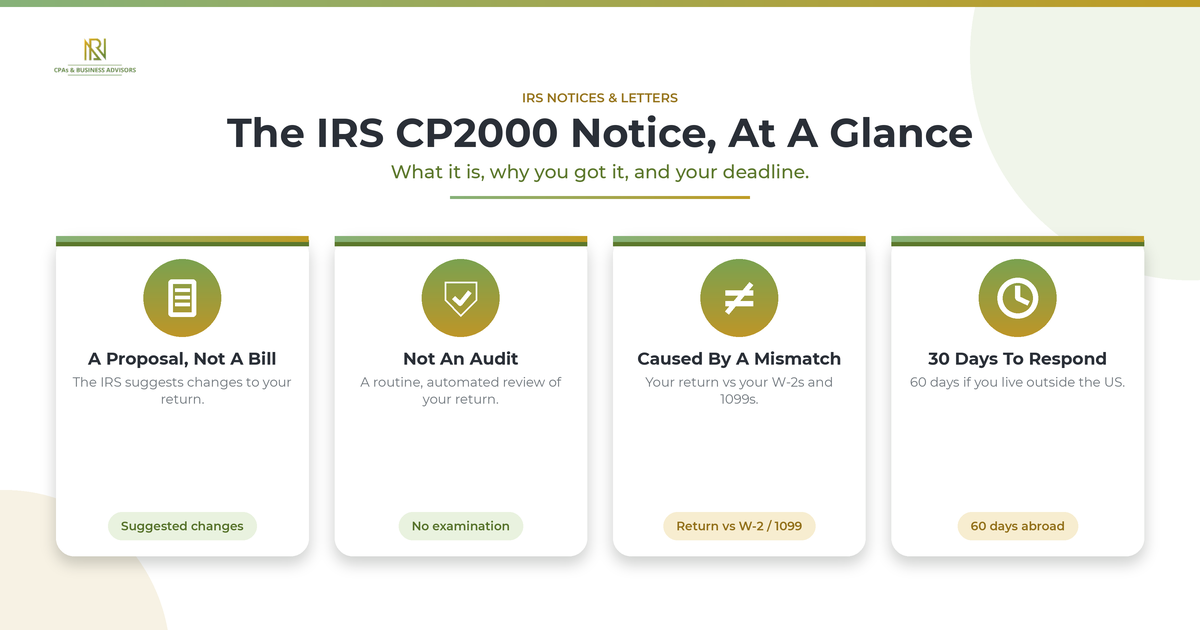
An IRS CP2000 notice is a letter proposing changes to your tax return because the income reported to the IRS by third parties, like employers or banks, does not match what you reported. According to the IRS, it is not a bill and not an audit. It is a proposal, and you generally have 30 days to respond.

What Is An IRS CP2000 Notice?

A CP2000 notice is the IRS's Notice of Underreported Income, a proposal to adjust your return when third-party records don't match what you filed. According to the IRS, its Automated Underreporter system compares the income, payments, credits, and deductions on your return against the Forms W-2, 1098, and 1099 that employers, banks, and other payers send in. When something doesn't line up, a tax examiner reviews it and the IRS issues a CP2000. The proposed change can mean you owe more, but it can also lower your tax or produce a refund.

Why Did You Get A CP2000 Notice?

You received a CP2000 because the IRS's records show income or other items that don't match your return. According to the IRS, the notice comes from its Automated Underreporter program, which flags discrepancies between your return and the information returns filed under your Social Security number. Common triggers are a missing 1099, a forgotten W-2, stock sales reported on a 1099-B, or interest and dividend income left off the return. It does not necessarily mean you did anything wrong. In practice, many CP2000 notices overstate the balance, because the automated match doesn't account for related deductions such as the cost basis of investments you sold.

Is A CP2000 Notice An Audit?

No. A CP2000 notice is not an audit, and it is not a bill. According to the IRS, the CP2000 is a proposal to adjust your income, payments, credits, or deductions, not a formal examination of your records. You still have to respond by the deadline, but receiving one does not mean you are being audited. Staying calm and replying on time is what keeps it from escalating.
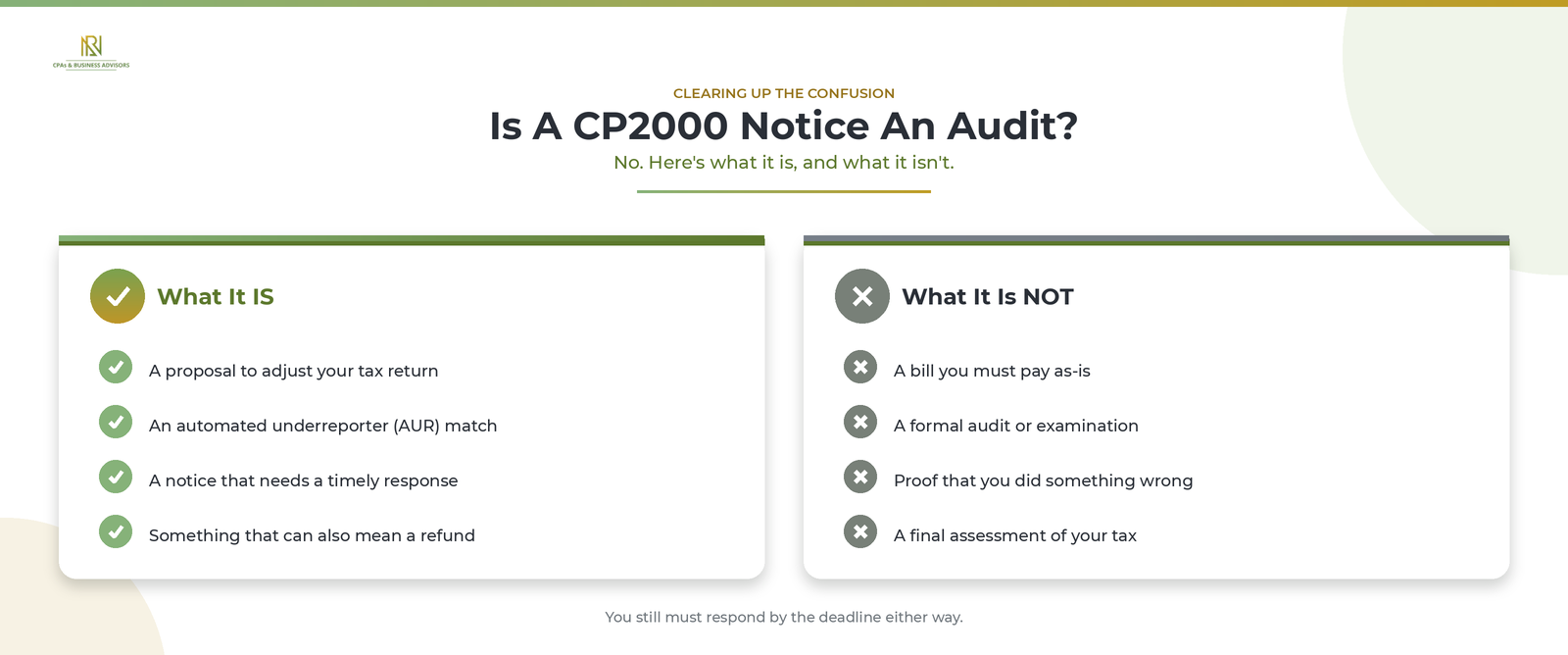
Is a CP2000 notice an audit

What Does A CP2000 Notice Include?

A CP2000 spells out exactly what the IRS believes is wrong and how to reply. According to the IRS, the notice shows:

  • The amounts you reported on your original or amended return.
  • The amounts third parties reported paying you.
  • The payer's name, ID number, and the type of document filed, such as a W-2 or 1099.
  • The proposed changes to your income, tax, credits, and payments, plus any interest.
  • A response form, a payment voucher, and a reply envelope.
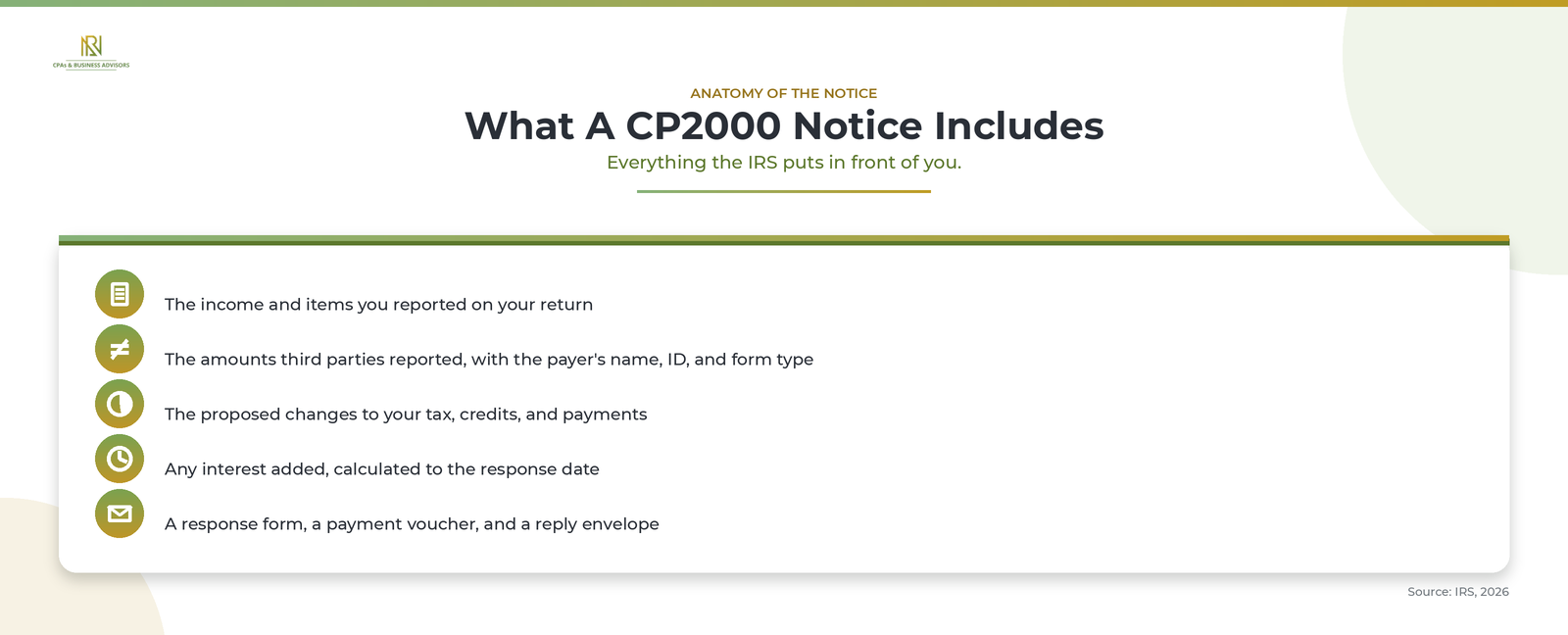
What a CP2000 notice includes

How To Respond To A CP2000 Notice

The first page summarizes the proposed change and gives a phone number to call, so that is where to start.

How To Respond To A CP2000 Notice

Respond by reviewing the proposed changes, deciding whether you agree, and returning the response form by the deadline. According to the IRS, you can reply through its Document Upload Tool, by fax, or by mail to the address on the notice. The basic steps are:

  1. Gather every W-2, 1098, and 1099 filed under your Social Security number for that year.
  2. Compare those forms against the return you filed to see whether the IRS is right.
  3. Recalculate the tax, factoring in any deductions the automated match missed.
  4. Decide whether you agree, partially agree, or disagree.
  5. Complete the response form, sign it (both spouses if you filed jointly), and return it by the due date.

If anything is unclear, call the phone number on the notice, and check your account about eight weeks after you reply to confirm the IRS has resolved it.

 (before the agree/disagree subheadings)How to respond to a CP2000 notice

If You Agree With The Notice

If the IRS is right, agreeing is simple. According to the IRS, you check the box that says you agree, sign and date the response form, and return it. If you have the money, pay the proposed amount, because paying within 30 days stops additional interest and possibly penalties from building. You do not need to file an amended return unless you have other income, credits, or expenses to report.

If You Disagree With The Notice

If you think the notice is wrong, you must still respond by the deadline, with proof. According to the IRS, you check the box showing you disagree and include a signed statement explaining why, along with copies of any supporting documents, such as corrected forms or records of your cost basis. Send photocopies, never your originals, and keep everything for your records. A clear, documented explanation is what gets the IRS to accept your position and drop the proposed change.

If You Partially Agree

Sometimes part of the notice is right and part is wrong. In that case you mark the response form accordingly and explain, in writing, the specific items you dispute, with documentation for each. According to the IRS, if your explanation resolves some but not all of the discrepancies, it will send a revised CP2000 with a new calculation, which you then review and answer the same way.

Should You File An Amended Return?

Do not send a standalone amended return as your CP2000 response. A Form 1040-X goes to a different IRS unit and may not be matched to your notice, which can cost you the chance to contest penalties or appeal. According to the IRS, if you do have other income, credits, or expenses to report, you complete Form 1040-X, write "CP2000" across the top, and submit it together with your response form. And if you find the same mismatch on another year's return, file an amended return for that year to stop similar penalties from accruing.

What Is The Deadline To Respond?

You generally have 30 days from the date on the notice to respond, or 60 days if you live outside the United States. According to the IRS, that date is also where the interest calculation runs to, so replying and paying promptly limits what you owe. If you need more time, call the phone number on the notice before the deadline; the IRS usually grants a 30-day extension when you ask before it issues the next notice.

What Happens If You Ignore A CP2000 Notice?

If you don't respond, the IRS treats the proposed changes as correct and moves to assess the tax. According to the IRS, when it doesn't hear from you by the response date, it sends a Statutory Notice of Deficiency, also called a CP3219A or 90-day letter. That notice gives you the right to challenge the proposal in U.S. Tax Court, but once it is issued you can no longer settle the matter through the regular CP2000 process or appeal it inside the IRS. Ignoring the letter only adds interest and penalties and removes your easiest options, so responding on time matters.

What happens if you ignore a CP2000

Can You Contest The Penalties Or Appeal?

Yes. You can dispute the penalties and ask for an appeal, even if you agree with the additional tax. A CP2000 that proposes more tax often carries the 20% accuracy-related penalty, which may not even be shown on the notice. According to the IRS, you have the right to appeal a proposed adjustment through its Independent Office of Appeals, so it is smart to include an appeal request in your response in case the IRS disagrees and the deadline gets close. In your statement, lay out the facts and the reason the penalty shouldn't apply, such as reasonable cause or a first-time penalty abatement. If the IRS later proposes the same amount without addressing your reply, you can ask for CP2000 reconsideration.

What If You Agree But Can't Pay?

If you owe but can't pay it all at once, you still have options. According to the IRS, paying in full by the date on the notice stops additional interest and penalties, but if you can't, you can set up an installment agreement to spread the balance into monthly payments. If paying anything would create real hardship, an offer in compromise or the wider set of relief programs the IRS offers may fit. Request the plan with your response so the IRS knows you intend to pay.

Should You Handle A CP2000 Notice Yourself Or Hire A Professional?

You can handle a straightforward CP2000 yourself, especially when you simply forgot a form and agree with the change. Hiring help earns its cost when the amount is large, when you disagree and need to build a documented case, when stock sales or business income are involved, or when the notice may stem from identity theft. According to the IRS, if someone used your Social Security number, you send a completed Form 14039, Identity Theft Affidavit, with your reply. For complex or high-dollar notices, a firm offering IRS tax resolution services can prepare the response, contest penalties, and deal with the IRS for you. You can also authorize a tax professional to represent you by filing Form 2848.

How To Avoid CP2000 Notices In The Future

The best way to avoid another CP2000 is to make sure your return matches what the IRS already has. According to the IRS, you should wait until you have all your income documents before filing, check each W-2, 1098, and 1099 for accuracy, keep complete records, and report any income document that arrives after you file on an amended return. If you sold investments, confirm your broker reported your cost basis, since missing basis is a common reason the automated match overstates income.

Frequently Asked Questions

What happens if the IRS sends a CP2000 notice? The IRS is proposing a change to your return based on a mismatch with third-party records. You review it, then agree or disagree by the deadline.

Does a CP2000 trigger an audit? No. A CP2000 is not an audit, though it is handled formally and you must respond on time.

What does a CP2000 notice typically indicate? It usually means income reported under your Social Security number, such as a 1099 or W-2, was left off or misstated on your return.

How do I respond to a CP2000 letter? Compare the notice to your records, complete the response form showing whether you agree or disagree, attach a signed statement and documents if you disagree, and return it by fax, mail, or the IRS Document Upload Tool within 30 days.

How do I check the status of my CP2000? Call the phone number on the notice, or review your IRS account about eight weeks after you reply.

A CP2000 notice feels alarming, but it is a routine, fixable proposal, not a verdict. Read it closely, compare it against your own records, and respond by the deadline, agreeing if the IRS is right and documenting your case if it isn't. Handled on time, most CP2000 notices close quickly, often for less than the letter first proposed.

Tax and Financial Insights
by NR CPAs & Business Advisors

Explore practical articles that explain tax strategies, financial considerations, and important topics that may affect your business decisions.

Federal Tax Lien: How To Remove Or Withdraw It

A federal tax lien is the government's legal claim against your property when you fail to pay a tax debt after the IRS has assessed the amount owed and sent you a bill. According to the IRS, the lien attaches to all of your property, including real estate, vehicles, financial accounts, and business assets, as well as any property you acquire in the future while the lien is active. The lien protects the government's interest by establishing its priority over other creditors.

A federal tax lien is created automatically by law once three conditions are met: the IRS assesses the tax, sends you a Notice and Demand for Payment, and you neglect or refuse to pay the balance in time. According to the IRS, the agency then files a public document called a Notice of Federal Tax Lien (NFTL) with your state or county recording office to alert other creditors that the government has a legal right to your property. The lien itself exists from the moment you fail to pay, but the public notice is what damages your credit and affects your ability to sell or borrow against your assets.

How A Federal Tax Lien Affects You

A federal tax lien can significantly impact your finances, credit, and ability to conduct business. According to the IRS, the effects include the following.

  • Credit damage. Once the Notice of Federal Tax Lien is filed, it becomes a public record. Lenders, landlords, and creditors can see it, and it can lower your ability to obtain credit, loans, or mortgages.
  • Property restrictions. The lien attaches to all your current and future assets. You cannot sell or refinance real estate without satisfying or addressing the lien first.
  • Business impact. The lien attaches to business property and accounts receivable, which can interfere with operations and relationships with vendors and clients.
  • Bankruptcy limitations. According to the IRS, a tax lien and the Notice of Federal Tax Lien may continue even after bankruptcy in certain situations.

How To Remove A Federal Tax Lien

The IRS provides four methods for removing or reducing the impact of a federal tax lien: paying the debt in full, requesting a discharge, requesting subordination, and requesting a withdrawal.

Pay The Debt In Full

Paying your tax debt in full is the most direct way to eliminate a federal tax lien. According to the IRS, the agency releases the lien within 30 days after the balance, including penalties and interest, is paid in full. If you cannot pay the entire amount at once, an installment agreement allows you to pay over time, and the lien is released once the final payment is made.

Discharge Of Property

A discharge removes the lien from a specific piece of property, allowing you to sell or transfer it. According to the IRS, a discharge may be granted if the remaining property still subject to the lien is worth at least double the total tax liability plus all other encumbrances, or if the IRS receives payment equal to the government's interest in the property being discharged. This option is commonly used to facilitate real estate sales when the lien amount exceeds the property value.

Subordination

Subordination does not remove the lien but allows other creditors to move ahead of the IRS in priority. According to the IRS, this can make it easier to obtain a mortgage or loan because the lending institution's lien takes priority over the government's claim. The IRS may approve subordination if it determines that doing so will ultimately increase the total amount collected.

Withdrawal

A withdrawal removes the public Notice of Federal Tax Lien from the record, though you remain liable for the underlying debt. According to the IRS, a withdrawal may be granted if the agency filed the notice prematurely or not in accordance with its procedures, if you have entered into a Direct Debit installment agreement, or if the withdrawal would facilitate collection. Under the IRS Fresh Start program, taxpayers who owe $25,000 or less and have a Direct Debit installment agreement may request withdrawal of the NFTL after making three consecutive payments.

Federal Tax Lien vs Levy

A lien and a levy are two different IRS actions, and understanding the distinction is important. According to the IRS, a lien is a legal claim that secures the government's interest in your property. It does not take your property. A levy, by contrast, actually seizes your property to satisfy the tax debt. Levies can target wages, bank accounts, Social Security benefits, vehicles, and real estate.

The IRS typically files a lien first and proceeds to a levy only after sending multiple collection notices and a Final Notice of Intent to Levy. Addressing the lien early through payment, a resolution agreement, or one of the removal options above can prevent the situation from escalating to a levy.

How To Prevent A Federal Tax Lien

The simplest way to prevent a federal tax lien is to file your tax returns on time and pay the full amount owed. If you cannot pay in full, acting before the IRS files a lien gives you the most options. According to the IRS, setting up a payment plan before a lien is filed can prevent the public notice from being recorded. Taxpayers who owe $50,000 or less can apply for a streamlined installment agreement online, and those who qualify for the IRS Fresh Start program benefit from higher thresholds before the IRS will file a lien.

If you already owe the IRS and are unsure which resolution path to pursue, the full range of IRS resolution options includes installment agreements, Offers in Compromise, Currently Not Collectible status, and penalty relief.

Frequently Asked Questions About Federal Tax Liens

How Long Does A Federal Tax Lien Last?

A federal tax lien generally lasts until the underlying tax debt is paid in full or the 10-year Collection Statute Expiration Date (CSED) passes. According to the IRS, the NFTL will self-release 30 days after the 10-year collection period expires if the IRS does not refile it. However, certain actions such as installment agreements, Offers in Compromise, and bankruptcy can suspend or extend the CSED.

Can A Federal Tax Lien Be Filed Without Warning?

The IRS must send you a Notice and Demand for Payment before a lien can arise, and must notify you within five business days after filing the Notice of Federal Tax Lien. According to the IRS, you have the right to request a Collection Due Process (CDP) hearing to challenge the filing.

Does A Federal Tax Lien Show Up On My Credit Report?

The major credit bureaus no longer include tax liens on standard credit reports, but the Notice of Federal Tax Lien remains a public record. Lenders who search public records during the mortgage or loan approval process will still find it, and it can affect your ability to obtain financing.

IRS Innocent Spouse Relief: When You're Not Liable

Innocent spouse relief is an IRS program that can remove your responsibility for paying additional taxes, penalties, and interest when your spouse or former spouse understated the taxes owed on a joint return without your knowledge. According to the IRS, when you file a joint tax return, both spouses are jointly and severally liable for the full tax amount, which means the IRS can collect the entire balance from either spouse, even after a divorce. Innocent spouse relief is an exception to that rule for spouses who did not know about or benefit from the errors on the return.

According to the IRS, innocent spouse relief applies only to taxes due on your spouse's income from employment or self-employment. It does not cover taxes on your own income, household employment taxes, business taxes, or trust fund recovery penalties. The relief is available whether you are still married, separated, or divorced.

The Three Types Of Innocent Spouse Relief

The IRS evaluates three forms of relief when you file a request, and you do not need to specify which type applies to your situation because the IRS will automatically consider all three.

Innocent Spouse Relief

This is the primary form of relief, available when your joint return understated the tax due because of errors attributable to your spouse, and you did not know or have reason to know about those errors. According to the IRS, errors that qualify include unreported income, incorrect deductions or credits, and incorrect asset values. The IRS considers whether a reasonable person in your circumstances would have known about the errors and whether you received any financial benefit from the understated income.

Separation Of Liability Relief

This form of relief divides the understated tax, penalties, and interest between you and your spouse based on each person's share of the errors. According to the IRS, you are generally eligible if you are divorced, legally separated, or have not lived with your spouse for at least 12 months before filing the request. You must also demonstrate that you did not know about the errors when you signed the return.

Equitable Relief

If you do not qualify for innocent spouse relief or separation of liability, the IRS may grant equitable relief if holding you responsible for the tax debt would be unfair given all the facts and circumstances. According to the IRS, equitable relief considers factors including your current marital status, whether you suffered economic hardship, whether you knew or had reason to know about the understated tax, and whether you were a victim of domestic abuse that affected your ability to challenge the return.

Who Qualifies For Innocent Spouse Relief

To be eligible, you must have filed a joint return that understated the tax due because of errors attributable to your spouse, and you must not have known or had reason to know about those errors when you signed the return. According to the IRS, you are not eligible in any year where you signed an Offer in Compromise with the IRS, signed a closing agreement covering the same taxes, or a court has already issued a final decision denying you relief.

Victims of domestic abuse receive a special exception. According to the IRS, you may still qualify for relief even if you had some knowledge of the errors if you signed the return because of spousal abuse, threats, or coercion and were afraid to challenge the items on the return.

The IRS approval rate for innocent spouse relief is relatively low. According to Jackson Hewitt, the IRS received over 26,000 requests in a recent year and fully approved fewer than 5,000. The fact-based, case-by-case nature of the evaluation means that the strength of your documentation and the clarity of your explanation are critical to the outcome.

How To Apply For Innocent Spouse Relief

To request relief, file Form 8857, Request for Innocent Spouse Relief, with the IRS. According to the IRS, Form 8857 covers all three types of relief (innocent spouse, separation of liability, and equitable), so you do not need to determine which type fits your situation. The IRS will evaluate your information and apply the appropriate form of relief if you qualify.

Form 8857 is a seven-page form that requires detailed information about your tax situation, your relationship with your spouse, your knowledge of the return's contents, and your financial circumstances. You should include supporting documentation such as divorce decrees, court orders, financial records, and any correspondence that demonstrates you did not know about the errors. According to the IRS, you must file the request within two years of receiving an IRS notice of an audit or additional taxes due because of an error on your return.

While your request is being reviewed, continue to file your tax returns and pay any taxes you owe. If you received an IRS notice about a balance and cannot pay while the review is pending, you may be able to set up an installment agreement to manage the amount in the meantime.

Innocent Spouse vs Injured Spouse

Innocent spouse relief and injured spouse relief are two separate IRS programs that address different problems. They are frequently confused because of their similar names, but they apply in entirely different situations.

  • Innocent spouse relief removes your liability for tax debt caused by your spouse's errors or omissions on a joint return. It addresses the underlying tax, penalties, and interest.
  • Injured spouse relief protects your share of a joint tax refund from being applied to your spouse's past-due debts such as student loans, child support, or state taxes. It does not address tax liability at all. You request injured spouse relief by filing Form 8379.

If you owe the IRS because of your spouse's errors, you need innocent spouse relief (Form 8857). If your refund was taken to pay your spouse's separate debts, you need injured spouse relief (Form 8379).

What Happens After You Apply

After you submit Form 8857, the IRS will notify your current or former spouse that you filed a request, which allows them to participate in the review process. According to the IRS, the review can take six months or longer. When the review is complete, the IRS sends a letter of determination with its decision. If approved, the IRS removes your responsibility for the additional tax, penalties, and interest attributable to your spouse's actions.

If the IRS denies your request, both spouses have the right to appeal within 30 days of the determination letter. You can file Form 12509, Statement of Disagreement, and request a review by the IRS Independent Office of Appeals. If you cannot reach agreement through Appeals, you can petition the U.S. Tax Court. Taxpayers exploring other ways to resolve joint tax debt beyond innocent spouse relief can review the full range of IRS resolution options available for balances you cannot pay.

Frequently Asked Questions

Do I Have To Be Divorced To Qualify?

No, you do not have to be divorced to qualify for innocent spouse relief. According to the IRS, the relief is available whether you are married, separated, or divorced. However, separation of liability relief specifically requires that you are divorced, legally separated, or have not lived with your spouse for at least 12 months.

Will My Spouse Be Notified?

Yes, the IRS is required to notify your current or former spouse when you file Form 8857. According to the IRS, the other spouse has the right to participate in the review process and can appeal the decision if relief is granted.

What If I Knew About Some But Not All Of The Errors?

The IRS evaluates each item on the return separately, so you may receive partial relief for items you did not know about while remaining liable for items you were aware of. According to the IRS, the determination depends on whether a reasonable person in your situation would have known about each specific error.

Want tax & accounting tips & insights?Sign up for our newsletter.

Thank you! Your submission has been received!
Oops! Something went wrong while submitting the form.