%201.avif)


.png)
.png)

IRS Payment Plans And Installment Agreements: How They Work, Who Qualifies, And How To Set One Up (2026)

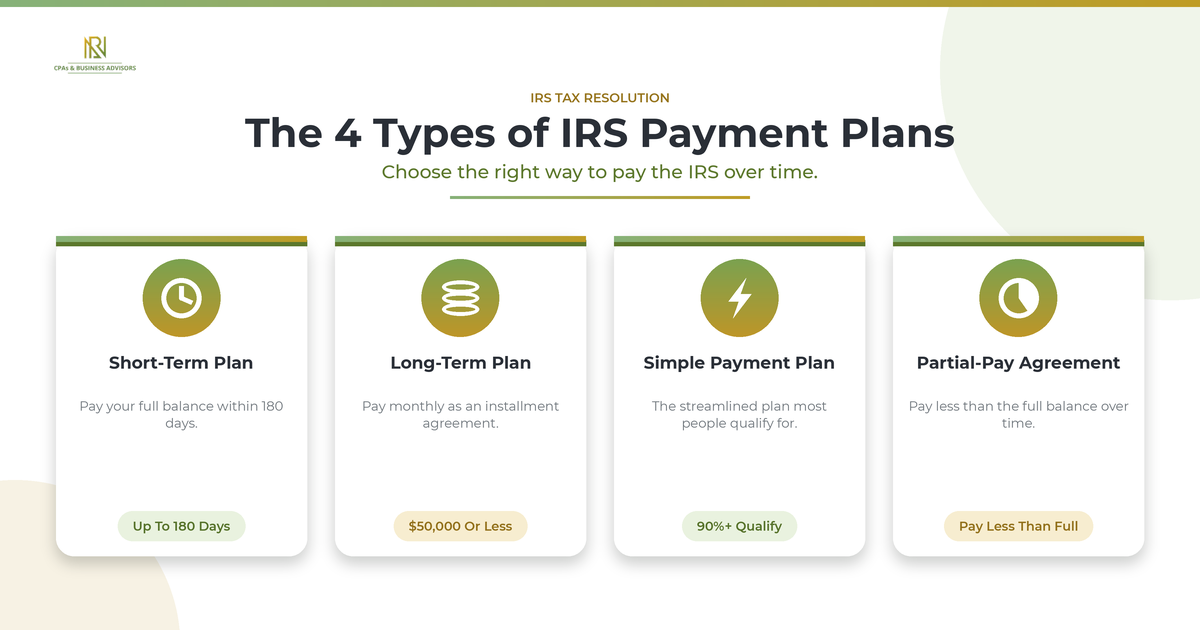
An IRS payment plan is an agreement to pay your federal tax bill over time, and most people who owe back taxes can set one up themselves. According to the IRS, there are two main categories: a short-term plan for balances you can clear within 180 days, and a long-term plan, also called an installment agreement, for balances you pay monthly over a longer period.
This guide covers how each plan works in 2026, who qualifies, what it costs, the current interest rate, how to apply, and how to choose the right one, including the newer Simple Payment Plan that the IRS says now covers more than 90% of individual taxpayers.
What Is An IRS Payment Plan?
An IRS payment plan is an agreement with the IRS to pay the taxes you owe within an extended timeframe. According to the IRS, you should request one if you believe you can pay your balance in full within that extended time. You can set a plan up online, by phone, or by mail, and the IRS sorts plans into two categories based on how long you need: short-term and long-term.
The important thing to understand is that a payment plan does not reduce what you owe. It spreads the balance into manageable payments while interest and penalties keep accruing, which we cover below. For most people, it is the most straightforward way to resolve a tax bill they cannot pay all at once.
Is A Payment Plan The Same As An Installment Agreement?
Mostly, yes. A long-term payment plan and an installment agreement are the same thing, and the IRS uses the terms interchangeably for monthly plans. A short-term payment plan is not technically an installment agreement, because you pay the full balance within 180 days rather than in ongoing monthly installments. So every installment agreement is a payment plan, but not every payment plan is an installment agreement.
What Types Of IRS Payment Plans Are There?
There are two main types of IRS payment plans, short-term and long-term, and the long-term category includes a few variations depending on how much you owe and how much you can pay. The options are:
- A short-term payment plan, for balances paid within 180 days.
- A long-term payment plan, or installment agreement, for monthly payments over a longer period.
- The Simple Payment Plan, the IRS's streamlined long-term plan that most individuals now qualify for.
- A partial-pay installment agreement, for people who cannot pay the full balance even over time.
Here is how each one works.
Short-Term Payment Plan
A short-term payment plan gives you up to 180 days to pay your balance in full. According to the IRS, you can apply online if you owe less than $100,000 in combined tax, penalties, and interest, and there is no setup fee. You can pay directly from a bank account, by check or money order, or by debit or credit card, though card payments carry a processing fee. Interest and the late-payment penalty keep accruing until the balance reaches zero, so a short-term plan costs less the faster you clear it.
Long-Term Payment Plan (Installment Agreement)
A long-term payment plan, or installment agreement, lets you make monthly payments on your balance. According to the IRS, you can apply online if you owe $50,000 or less in combined tax, penalties, and interest and have filed all required returns. Under the current rules, your monthly amount needs to be large enough to clear the balance within the collection period, which the IRS generally has ten years to enforce. If you owe $10,000 or less, the IRS notes that acceptance is essentially guaranteed as long as you have filed and paid on time for the past five years and agree to pay the balance within three years.
The Simple Payment Plan: What Changed In 2026
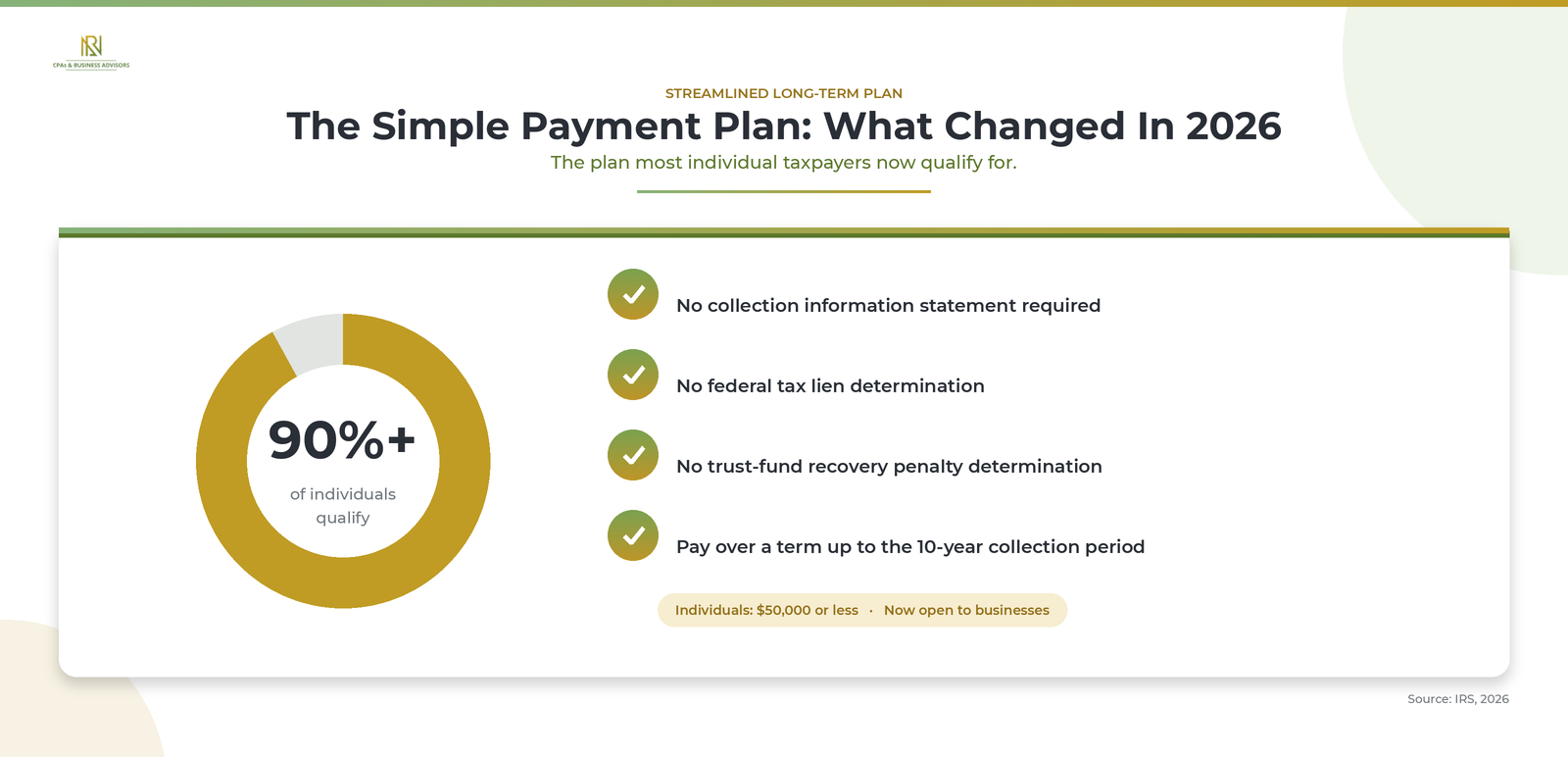
The Simple Payment Plan is the IRS's streamlined long-term plan, and it is the option most people now use. According to the IRS, more than 90% of individual taxpayers qualify, and the plan requires no collection information statement, no lien determination, and no trust-fund recovery penalty determination. Individuals qualify with $50,000 or less in assessed taxes, penalties, and interest, and the IRS recently extended the option to businesses. You pay over a term of your choosing, up to the roughly ten-year collection period, though the IRS cautions that a longer term means more interest and penalties. This is the biggest recent change to IRS payment plans, and it is why older advice about dividing your balance by 72 months is now out of date.
Partial-Pay Installment Agreement (PPIA)
A partial-pay installment agreement lets you make monthly payments that will not cover your full balance before the collection period ends. The IRS allows this when you genuinely cannot afford payments large enough to pay the debt in full, and any balance still left when the ten-year collection statute expires is generally written off. Because you are proposing to pay less than the full amount, the IRS requires a financial statement on Form 433-F and reviews your finances periodically, usually every two years, to see whether your payment should increase. It is one of the few ways to pay less than you owe without an Offer in Compromise.
Who Qualifies For An IRS Payment Plan?
Most people who owe federal taxes qualify for a payment plan. According to the IRS, the main requirements are that you are current on all your filing and payment obligations and that your balance fits within the plan's limits. In practice, you generally qualify if:
- You have filed all required tax returns.
- You are current on this year's obligations, such as estimated payments or paycheck withholding.
- Your balance is within the limit for the plan you want, such as $50,000 or less for a Simple Payment Plan or under $100,000 for a short-term plan.
- For a partial-pay agreement, your income, expenses, and assets show you cannot pay in full.
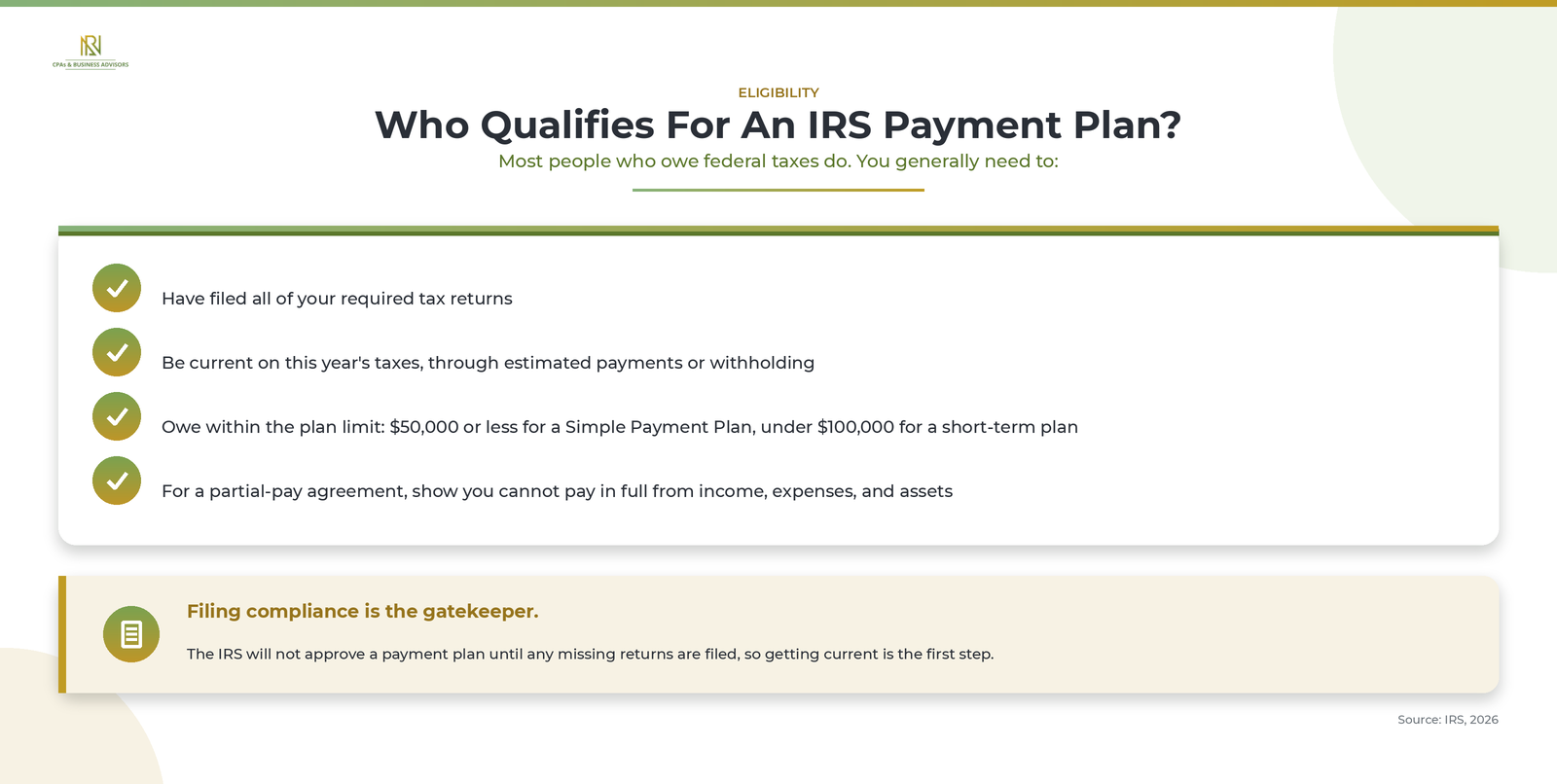
Filing compliance is the gatekeeper. If a required return is missing, the IRS will not approve a plan until you file it, so getting current is the first step.
What If You Owe More Than $50,000?
If you owe more than $50,000, you can still set up a plan, but the process involves more. According to the IRS, you will generally need to provide a financial statement on Form 433-F or Form 433-H so the agency can review your income, expenses, and assets. The IRS also offers a useful middle path: taxpayers already working with the agency who owe $250,000 or less can propose a monthly payment that clears the balance over the collection period without a financial statement, though the IRS notes that a federal tax lien determination still applies.
How Do You Set Up An IRS Payment Plan?
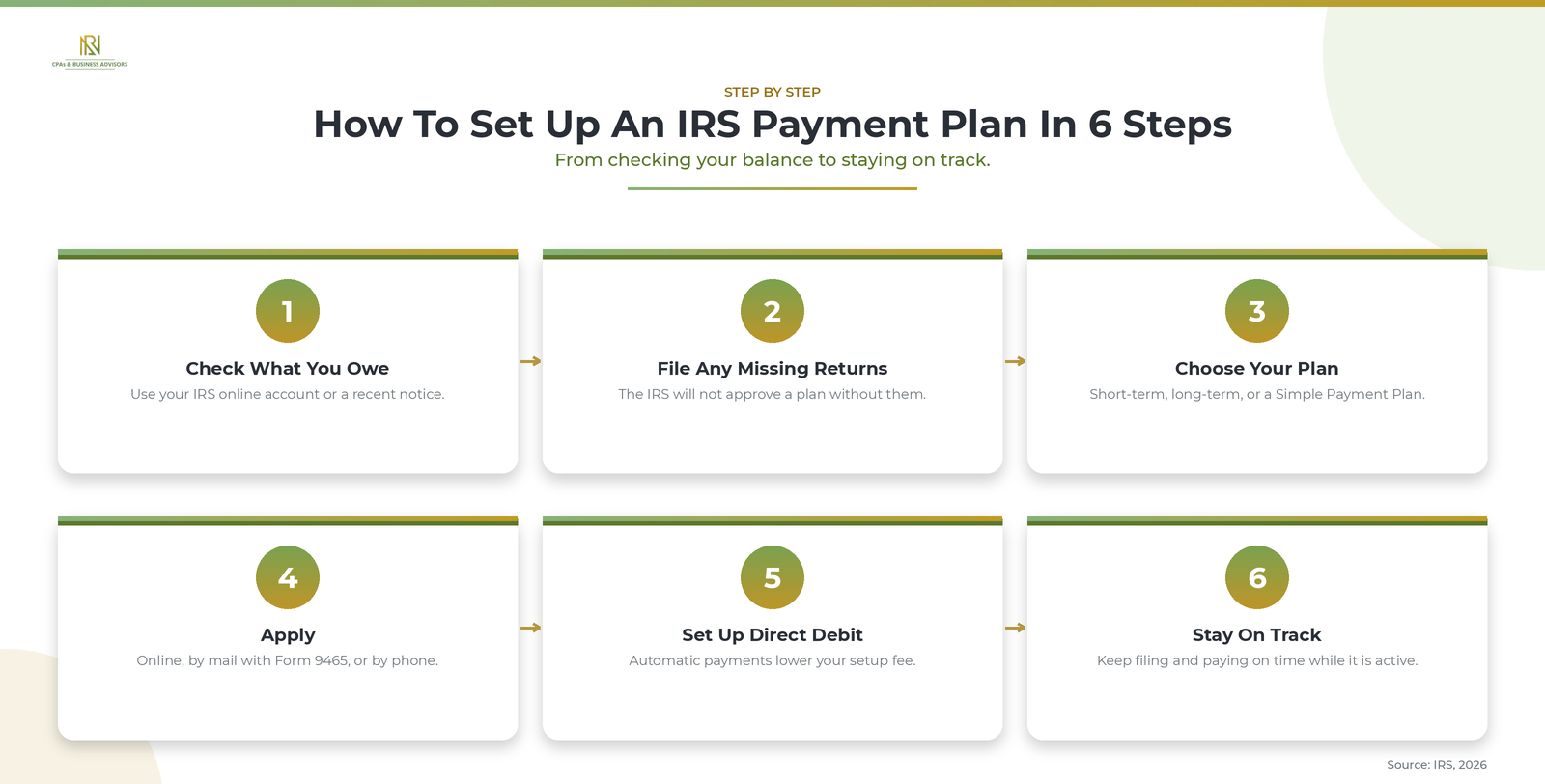
The fastest way to set up an IRS payment plan is online through the Online Payment Agreement tool, which gives you an immediate decision. You can also apply by mail or by phone. The basic steps are:
- Confirm what you owe and for which years, using your IRS online account or a recent notice.
- File any missing tax returns, since the IRS will not approve a plan without them.
- Choose the plan that fits, a short-term plan if you can pay within 180 days or a long-term or Simple Payment Plan if you need monthly payments.
- Apply online, by mail with Form 9465, or by phone.
- Set up automatic payments if you can, since direct debit lowers your setup fee and reduces the chance of default.
- Keep filing and paying on time while the plan is active.
Applying Online (Online Payment Agreement)
Applying online is the cheapest and quickest option. According to the IRS, you create or sign in to your online account, verify your identity, and receive an immediate decision on your plan. You will need a photo ID to set up the account, and if you choose a direct-debit agreement, your bank routing and account numbers. Sole proprietors and independent contractors apply as individuals.
Applying By Phone Or Mail (Form 9465)
If you cannot or prefer not to apply online, you can file Form 9465, the Installment Agreement Request, by mail, attaching Form 433-F if the instructions require it. According to the IRS, you can also apply by phone at 800-829-1040 for individuals or 800-829-4933 for businesses. A payroll deduction agreement, set up with Form 2159, is another option if you would rather have payments come straight from your paycheck.
What Does "Pending" Mean After You Apply?
While the IRS reviews your request, your installment agreement is "pending." According to the IRS, the agency is generally prohibited from levying your wages or accounts while a request is pending, and the time it has to collect is paused during that period. Your request stays pending until it is reviewed and then established, withdrawn, or rejected. It is smart to keep making voluntary payments while you wait, which shows good faith and chips away at your balance.
How Much Does An IRS Payment Plan Cost?
An IRS payment plan has two costs: a one-time setup fee and the interest and penalties that keep accruing on your balance. According to the IRS, the setup fees are:
- Short-term plan: $0, no matter how you apply.
- Long-term plan paid by direct debit: $22 to apply online, or $107 by phone, mail, or in person. The fee is waived for low-income taxpayers.
- Long-term plan paid another way: $69 to apply online, or $178 by phone, mail, or in person. Low-income taxpayers pay $43, which may be reimbursed.
- Revising an existing plan: $10 online or $89 otherwise, and $0 to change an existing direct-debit agreement.
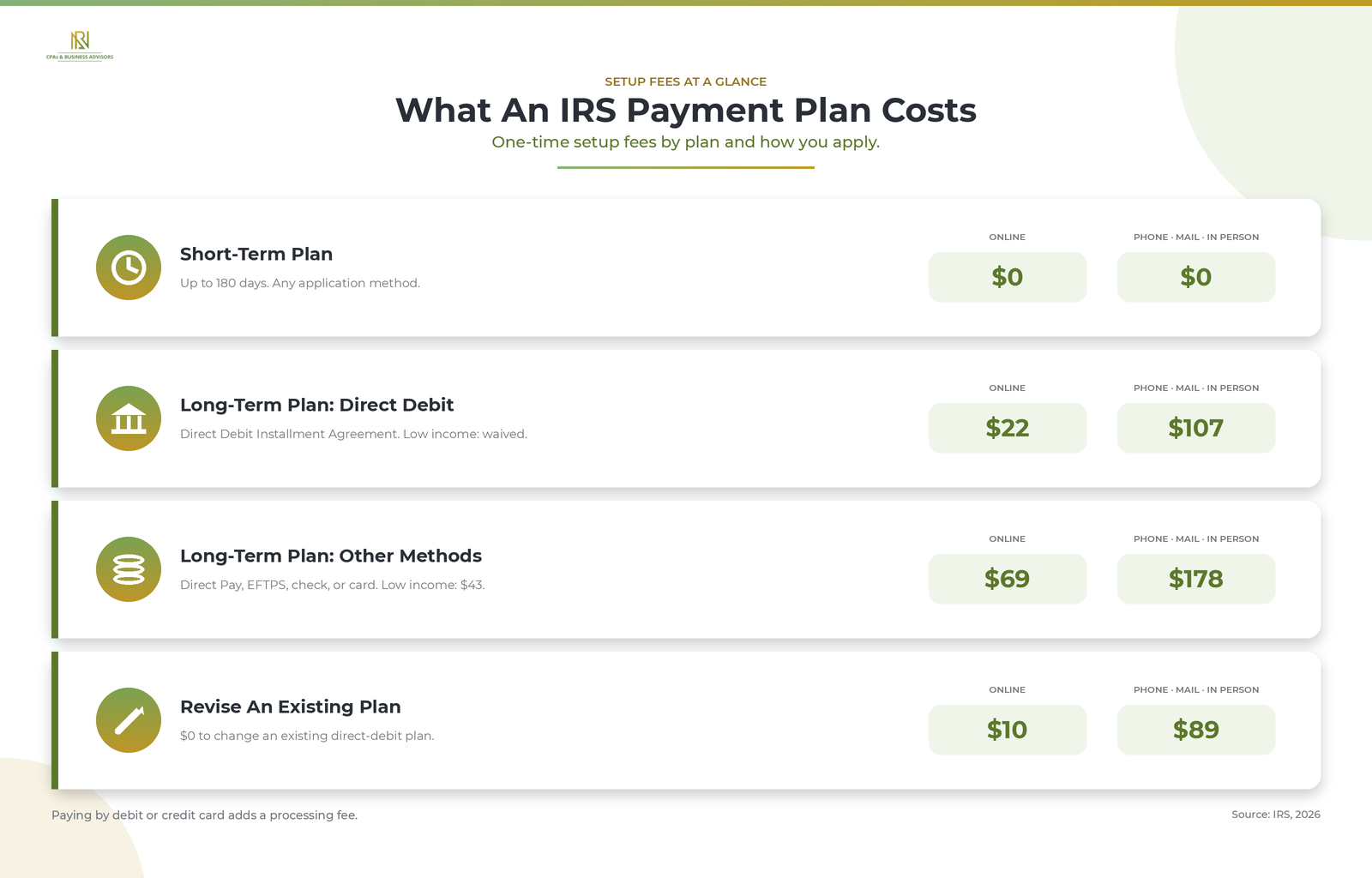
Paying by debit or credit card adds a processing fee. The IRS waives or reduces the user fee for low-income taxpayers, defined as having income at or below 250% of the federal poverty level, and you can apply for that status with Form 13844.
What's The Minimum Monthly Payment?
There is no fixed minimum monthly payment for smaller balances. According to the IRS, if you owe $10,000 or less you generally set your own monthly amount, as long as it clears the balance within the collection period. For larger balances, the IRS will expect a payment large enough to pay the debt off before the roughly ten-year collection statute expires, so a quick estimate is your balance divided by the number of months you have left. If you cannot afford the amount the IRS calculates, you can submit Form 433-F or Form 433-H to propose a lower payment based on your finances.
Does The IRS Charge Interest On A Payment Plan?
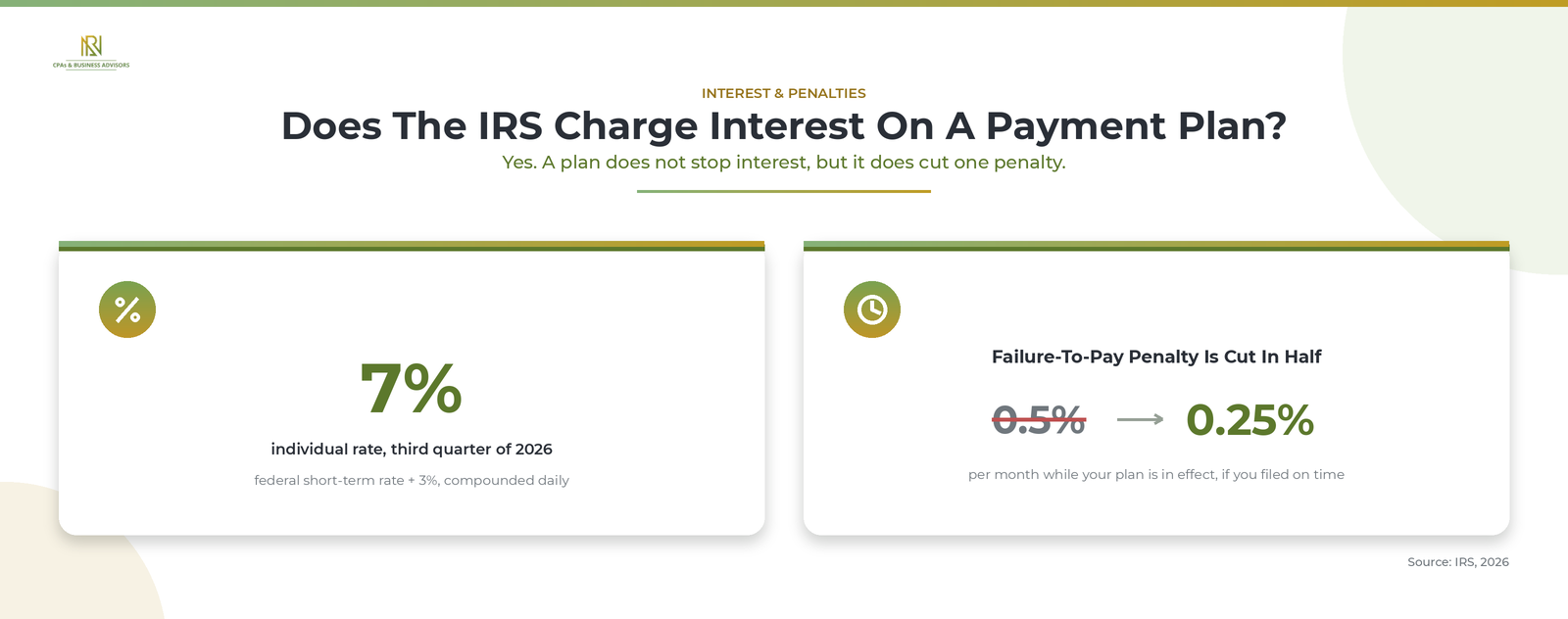
Yes. Getting on a payment plan does not stop interest or penalties. According to the IRS, interest is the federal short-term rate plus 3 percentage points, set every quarter and compounded daily, and for individuals it is 7% for the third quarter of 2026. There is one break: the IRS cuts the failure-to-pay penalty in half, from 0.5% to 0.25% per month, while an installment agreement is in effect, as long as you filed your return on time. Because the interest compounds daily, paying more than the minimum each month always costs you less in the end.
Which IRS Payment Plan Is Right For You?
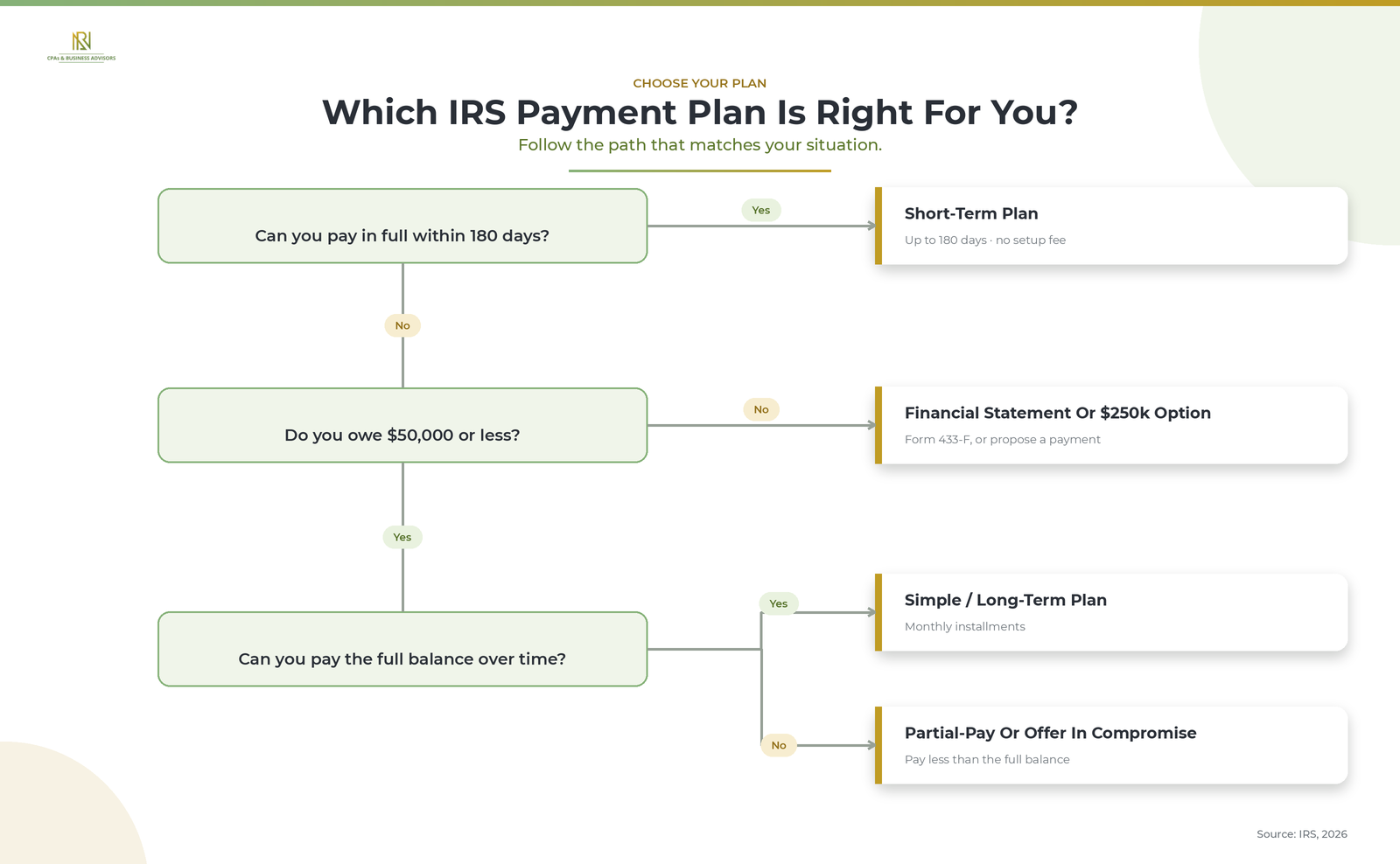
The right plan depends on how much you owe and how much you can realistically pay each month. As a guide:
- If you can pay the full balance within 180 days, choose a short-term plan and skip the setup fee.
- If you owe $50,000 or less and need monthly payments, the Simple Payment Plan is usually the simplest route.
- If you cannot pay the full balance even over several years, look at a partial-pay installment agreement or an Offer in Compromise.
- If you owe more than $50,000, prepare a financial statement or use the $250,000 proposal option.
When you are not sure, start with whether you can get current on your filings, because nothing moves forward until you have.
How To Change, Pause, Or Cancel A Payment Plan
You can change an IRS payment plan at any time, and the cheapest way is online. According to the IRS, you can use your online account to change your monthly payment amount or due date, switch to direct debit, update your bank information, or reinstate a plan after default. If you miss payments or stop filing, the IRS can terminate the plan, and reinstating it may carry a fee. To stay in good standing, the IRS says to pay at least your minimum each month, file and pay future taxes on time, and remember that any refunds you are owed will be applied to your balance. If you default, the IRS generally holds off on enforced collection for 30 days, and if you appeal a termination, it holds off while the appeal is pending.
How A Payment Plan Affects Tax Liens And Your Credit
A payment plan does not automatically remove or prevent a federal tax lien. According to the IRS, an unpaid balance can still prompt a Notice of Federal Tax Lien, though setting up a direct-debit agreement can help you get a lien withdrawn once you meet the conditions. The better news is for your credit: the IRS no longer reports tax debt to the credit bureaus, so the payment plan itself will not appear on your credit report. A lien that has already been filed is public record, which is one more reason to resolve the balance and, where possible, request a withdrawal.
Payment Plans For Businesses
Businesses can set up IRS payment plans too, but the rules differ from those for individuals. According to the IRS, business taxpayers generally cannot apply online and should call 800-829-4933 or visit a local Taxpayer Assistance Center. The balance limits are lower: a business with trust-fund taxes generally qualifies for a Simple Payment Plan with $25,000 or less, while an out-of-business sole proprietorship can qualify with $50,000 or less. Businesses that owe payroll taxes may also use an In-Business Trust Fund Express agreement, which can run up to 24 months.
Should You Set Up A Payment Plan Yourself Or Hire A Professional?
You can set up an IRS payment plan yourself, and most people should. The Simple Payment Plan and the short-term plan are built to be self-service, and the IRS does not require you to pay anyone to apply. Professional help earns its cost in harder situations: a large balance, a partial-pay agreement, business or trust-fund taxes, or a case where the IRS has already begun levying or filing liens. In those situations, a firm offering IRS tax resolution services can prepare the financial analysis correctly and deal with the IRS for you. Be careful who you hire, though. The Federal Trade Commission warns that most taxpayers will not qualify for the dramatic settlements that tax-relief mills advertise, and that some of these companies collect large upfront fees without ever filing your paperwork. In our experience, the people who resolve their balances fastest are the ones who get current on filing first and choose a payment they can actually sustain.
Frequently Asked Questions
How much will the IRS accept for a payment plan? For most plans the IRS does not require a set amount; you propose a monthly payment that clears your balance within the collection period, and for balances over $50,000 the IRS reviews your finances to set it.
How hard is it to get a payment plan with the IRS? It is generally straightforward, since the IRS says more than 90% of individuals qualify for a Simple Payment Plan, and most applications submitted online are approved immediately.
What if I owe the IRS and can't pay anything? If you cannot manage even a monthly payment, you may qualify for a partial-pay installment agreement or to be placed in currently-not-collectible status while you get back on your feet.
How many months will the IRS give you to pay? Under current rules you can pay over the length of the collection period, which the IRS generally has ten years to enforce, though a longer term costs more in interest.
What happens if you owe more than $25,000? As an individual owing between $25,000 and $50,000, the IRS requires you to pay by direct debit, and above $50,000 you will generally need to provide a financial statement.
How do I contact the IRS to set up a plan? You can apply online through the Online Payment Agreement tool, or call 800-829-1040 for individuals and 800-829-4933 for businesses.
An IRS payment plan turns a bill you cannot pay today into a series of payments you can manage, and most people can set one up online in a few minutes. The balance still accrues interest until it is gone, so the real goal is to pay it down as fast as your budget allows. Whether you choose a short-term plan, a Simple Payment Plan, or a partial-pay agreement, the path starts the same way: file everything you owe, then pick the payment you can keep.

.avif)
.avif)


Tax and Financial Insights
by NR CPAs & Business Advisors


Does Toyota Sienna Qualify for Section 179?
Yes, a Toyota Sienna qualifies for the Section 179 deduction, if the specific vehicle carries a gross vehicle weight rating (GVWR) above 6,000 pounds and is used more than 50% of the time for business. The Sienna is a passenger minivan, which places it inside the statutory sport utility vehicle category under IRC Section 179(b)(5). That classification caps the Section 179 deduction at $32,000 for 2026, per Revenue Procedure 2025-32. The remaining basis is then absorbed by 100% bonus depreciation, which the One Big Beautiful Bill Act made permanent for qualifying property acquired after January 19, 2025. A $52,000 Sienna used entirely for business produces a $52,000 first-year deduction through that combination, and a Sienna rated at or below 6,000 pounds produces a first-year deduction of $20,300.
The sections below cover the Sienna's actual weight rating and why the trim matters, why a minivan is treated as an SUV under the statute, exactly how much a business can write off in year one, when the deduction applies and what placed in service means, the business-use percentage and the records that support it, whether the vehicle must be titled in the business name, how used and leased Siennas are treated, which other Toyota models fall into which weight class, what qualifies for 100% bonus depreciation, and how long the vehicle must stay in business use before the deduction is safe from recapture.
Key Takeaways
- A Toyota Sienna qualifies for Section 179 when its GVWR exceeds 6,000 pounds and business use exceeds 50%. Recent all-wheel-drive trims carry a door-jamb rating near 6,170 pounds.
- GVWR is the manufacturer's maximum loaded weight, not curb weight. The 2026 Sienna curb weight runs 4,610 to 4,725 pounds, which is well under the threshold and is the wrong number to use.
- A minivan meets the statutory definition of a sport utility vehicle under IRC Section 179(b)(5)(B), which caps the Section 179 deduction at $32,000 for 2026.
- 100% bonus depreciation absorbs the basis remaining after Section 179, with no dollar cap and no business income limitation, which is what produces a full first-year write-off.
- A Sienna rated at or below 6,000 pounds is a passenger automobile subject to the Section 280F ceilings of $20,300 in year one with bonus depreciation, or $12,300 without, per Revenue Procedure 2026-15.
- The vehicle must be purchased and placed in service by December 31 of the tax year. Ordering, paying, and titling are not the same as placing in service.
- Business use of exactly 50% does not qualify. Use must exceed 50%, and the deduction is proportional to the business-use percentage.
- Vehicles are listed property under IRC Section 280F(d)(4), which means a contemporaneous mileage log is the substantiation standard rather than a year-end reconstruction.
- Business use falling to 50% or below during the five-year recovery period triggers recapture of the excess deduction as ordinary income.
Does the Toyota Sienna Qualify for Section 179?
The Toyota Sienna qualifies for Section 179 when four conditions are met at once: the GVWR exceeds 6,000 pounds, business use exceeds 50%, the vehicle is placed in service during the tax year, and the business has enough taxable income to absorb the election. Those conditions come from IRC Section 179(d)(1) and IRC Section 179(b)(3), and failing any one of them changes the answer.
The first condition does most of the work. Vehicles rated at or below 6,000 pounds GVWR are passenger automobiles subject to the Section 280F depreciation ceilings, which limit the first-year deduction to $20,300 regardless of what the vehicle cost. Vehicles rated above 6,000 pounds escape those ceilings entirely and move into the Section 179 weight tiers, where the deduction is measured against the purchase price rather than against a fixed statutory cap. A single pound of GVWR separates those two outcomes.
Business owners frequently assume the Sienna cannot qualify because it is a minivan rather than a work truck. The statute contains no such distinction. Section 179 reaches tangible personal property used in the active conduct of a trade or business, and a minivan used by a mobile service business, a caterer, a medical transport operation, or a contractor hauling crew and materials is exactly that. Confirming eligibility before the purchase rather than at filing is the part of tax planning that decides whether the deduction lands in the year it was expected.
Is the Toyota Sienna Over 6,000 Pounds?
Recent Toyota Sienna trims carry a gross vehicle weight rating of approximately 6,170 pounds, which clears the 6,000-pound threshold, though the rating varies by trim and drivetrain and the certification label on the specific vehicle is the only authoritative source. The label sits on the inside edge of the driver's side door, on the B-pillar, and it states the GVWR in pounds and kilograms. All-wheel-drive configurations carry the higher ratings. Front-wheel-drive and lower-content trims sit closer to the line.
The certification label matters because GVWR and curb weight are different measurements, and mixing them up produces the wrong answer every time. Curb weight is what the vehicle weighs empty with fluids and a full tank. GVWR is the manufacturer's maximum permissible loaded weight, including passengers, cargo, and accessories. The 2026 Sienna carries a curb weight of 4,610 to 4,725 pounds, according to Kelley Blue Book, which is roughly 1,400 pounds below its GVWR. A buyer who checks curb weight concludes the vehicle fails the test. A buyer who checks the placard on an all-wheel-drive trim concludes it passes.
Trim variation is the reason a blanket answer does not work for this model. The 2026 Sienna is offered across a range running from $41,915 to $59,305 in manufacturer pricing, per Kelley Blue Book, and that range spans several drivetrain and content configurations with different weight ratings. Reading the placard on the exact vehicle identification number being purchased, before signing, is the only reliable method. Once that number is confirmed above 6,000 pounds, the next question is which weight-class rule the vehicle falls under.
Is a Minivan Treated as an SUV Under Section 179?
A minivan is treated as a sport utility vehicle under Section 179, because IRC Section 179(b)(5)(B) defines the term to include any four-wheeled vehicle primarily designed to carry passengers over public streets with a GVWR between 6,001 and 14,000 pounds. The definition is written by function and weight rather than by body style or marketing category. A Sienna, a Tahoe, and a Sequoia land in the same statutory bucket.
Three exclusions carve vehicles out of that bucket, and a Sienna satisfies none of them. The statute excludes vehicles designed to seat more than nine passengers behind the driver's seat, which a seven-seat or eight-seat minivan does not reach. It excludes vehicles with a cargo area of at least six feet in interior length that is not readily accessible from the passenger compartment, which describes a long-bed pickup rather than a minivan with an open rear cabin. It excludes vehicles with an integral enclosure fully enclosing the driver compartment and load-carrying device, with no seating behind the driver, which describes a cargo van with the rear seats deleted. A standard passenger Sienna fails all three tests and stays inside the SUV category.
Falling inside that category carries one specific consequence: the $32,000 Section 179 cap for 2026 under Revenue Procedure 2025-32. This is where most published guidance on Toyota vehicles goes quiet, because model lists tend to name trucks and large SUVs and skip the minivan entirely. The cap is not a disqualification. It sets the ceiling on the Section 179 portion of the deduction, and a second provision handles everything above it.
How Much Can You Write Off on a Toyota Sienna?
A business can write off the full purchase price of a Toyota Sienna in the first year when the GVWR exceeds 6,000 pounds, by combining a $32,000 Section 179 election with 100% bonus depreciation on the remaining basis. IRS Publication 946 prescribes the ordering: Section 179 is elected first, bonus depreciation under IRC Section 168(k) applies to whatever basis survives that election, and regular MACRS depreciation handles any balance left after both. For a vehicle acquired after January 19, 2025, the bonus rate is 100% under Section 70401 of the One Big Beautiful Bill Act, which leaves nothing for MACRS to recover.
The gap between the two weight outcomes is where the real money sits. The table below runs a $52,000 Sienna at 100% business use through both scenarios, using the 2026 figures from Revenue Procedure 2025-32 and Revenue Procedure 2026-15.
ScenarioGVWR Above 6,000 lbsGVWR At or Below 6,000 lbsTax classificationSport utility vehicle, IRC 179(b)(5)Passenger automobile, IRC 280FPurchase price$52,000$52,000Section 179 deduction$32,000 (SUV cap)$12,300 (within 280F ceiling)Bonus depreciation$20,000 (100% of remaining basis)$8,000 add-on onlyYear 1 total deduction$52,000$20,300Basis remaining after Year 1$0$31,700Recovery of the balanceNone needed$19,800 (Yr 2), $11,900 (Yr 3), $7,160 per year after
That $31,700 difference on an identical vehicle explains why the certification label deserves a photograph before the paperwork is signed. The figures also scale down with business use rather than disappearing. A Sienna used 80% for business carries a depreciable basis of $41,600 on a $52,000 purchase, which supports a $32,000 Section 179 election plus $9,600 of bonus depreciation for a $41,600 first-year deduction. Business use of 60% produces a $31,200 basis, which the Section 179 cap absorbs entirely with nothing left for bonus.
Can You Write Off 100% of a Business Vehicle?
You can write off 100% of a business vehicle in the first year when the vehicle is rated above 6,000 pounds GVWR, is used entirely for business, and the business has enough taxable income to support the Section 179 portion. The 100% result is produced by two provisions working in sequence rather than by either one alone, and the second provision carries no cap at all.
Taxable income is the constraint that most often interrupts that result. Section 179 cannot exceed the taxpayer's aggregate taxable income from the active conduct of a trade or business, and it cannot create or increase a net operating loss under IRC Section 179(b)(3). Bonus depreciation carries no such limitation and can push a business into a loss that carries forward. A business with $18,000 of taxable income buying a $52,000 Sienna elects $18,000 of Section 179, carries the disallowed $14,000 forward indefinitely, and claims bonus depreciation on the $20,000 of basis remaining after the full $32,000 cap is applied. Working that allocation before year end is standard business consulting arithmetic, and it depends on a projected return rather than a finished one.
When Does the Section 179 Deduction Apply to a Vehicle?
The Section 179 deduction applies to a vehicle in the tax year the vehicle is placed in service, which means the vehicle must be purchased and put to business use on or before December 31 of that year. The deduction is then claimed on the federal return filed for that operational year, on Part I of Form 4562, and the election must appear on a timely filed return including extensions.
December 31 is a harder deadline than it appears, because the calendar date that matters is the date of business use rather than the date of the transaction. A Sienna ordered in November, paid for in December, and delivered in January belongs to the following tax year. A Sienna delivered on December 28 and driven on a business errand on December 29 belongs to the current one. Dealer inventory timing at year end is therefore a tax variable, not just a logistics question, and building the purchase into a year-end tax strategy rather than treating it as a December impulse is what keeps the deduction in the intended year.
What Does Placed in Service Mean for a Vehicle?
Placed in service means the vehicle is ready and available for its assigned business function, not that it was ordered, paid for, financed, titled, or insured. IRS Publication 946 sets that standard, and it turns on availability for use rather than on the completion of any single transaction step. A vehicle sitting on a dealer lot awaiting a delivery appointment is not placed in service. A vehicle in the owner's possession, registered, and available for business trips is placed in service even if no business trip has occurred yet.
Availability for use is also what starts the depreciation clock. The half-year convention under MACRS treats a vehicle placed in service at any point during the year as though it entered service at the midpoint, which is why a December 29 purchase produces the same first-year treatment as a February purchase. Once the vehicle is in service, the next variable is how much of its mileage the business can actually claim.
What Business-Use Percentage Does the Sienna Need?
The Sienna needs business use greater than 50% to qualify for Section 179 or bonus depreciation, and the deduction is then limited to the exact business-use percentage. Use of exactly 50% fails the test. Use of 50.1% passes it and supports a deduction on 50.1% of the purchase price. Business use is measured as business miles divided by total miles driven during the year.
A minivan carries more personal-use exposure than almost any other business vehicle, which raises the documentation stakes rather than the eligibility bar. We see this regularly with owner-operators in Miami who run one household vehicle and use it for both school runs and service calls. The vehicle can still support a deduction. The percentage simply has to be measured honestly and recorded as the miles are driven, because a Sienna claimed at 95% business use invites a question that a Sienna claimed at 68% does not.
Commuting miles are the most common source of overstatement. Travel between home and a regular workplace is personal mileage under Treasury Regulation Section 1.262-1(b)(5), regardless of whether the vehicle carries tools or the driver takes calls along the way. Travel between job sites, from a home office to a client, and to temporary work locations is business mileage. Sorting the two correctly at the time of each trip is what separates a defensible percentage from an estimate.
What Records Do You Need to Claim a Vehicle Deduction?
The records needed to claim a vehicle deduction are a contemporaneous mileage log plus the purchase and use documentation that supports it, because IRC Section 280F(d)(4) classifies vehicles as listed property and applies a stricter substantiation standard than ordinary business assets. Contemporaneous means written at or near the time of each trip. A spreadsheet assembled in March from memory and calendar entries does not meet the standard.
The log entries each need four elements, and the supporting file needs several more:
- Date of the trip. Recorded per trip rather than per week or per month.
- Destination. The actual address or identifiable location, not "client site."
- Business purpose. A short statement of why the trip was made and for whom.
- Miles driven. Odometer readings at the start and end, or the trip distance.
- Total annual mileage. Odometer readings on January 1 and December 31, which produce the denominator for the business-use percentage.
- Purchase documentation. The bill of sale, the financing or lease agreement, and the title.
- The certification label. A photograph of the door-jamb placard showing the GVWR, which is the evidence behind the weight classification.
- Placed-in-service evidence. The delivery receipt and the first documented business trip, which together fix the date.
Mileage-tracking applications that timestamp trips automatically satisfy the contemporaneous requirement more reliably than a paper notebook, and they export in a format that reconciles against the year-end financial statements without a rebuild. The records also answer the ownership question that follows, because the title and the log frequently point in different directions.

Can You Take Section 179 on Leasehold Improvements?
Yes, you can take a Section 179 deduction on leasehold improvements, provided the work qualifies as qualified improvement property (QIP): an improvement to the interior of a nonresidential building, placed in service after the building was first placed in service by anyone, and used in the active conduct of a trade or business. Interior build-out work such as flooring, lighting, interior partitions, ceilings, plumbing, and electrical upgrades qualifies. Enlargements of the building, elevators, escalators, and changes to the internal structural framework do not. Two limits govern how much of the improvement you can expense in year one: the 2026 dollar cap of $2,560,000 under Revenue Procedure 2025-32, and the business income limitation in IRC Section 179(b)(3), which prevents the deduction from creating a net loss.
The sections below cover what leasehold improvements are, what qualified improvement property means and where its boundaries sit, which improvements are excluded from Section 179 entirely, how long leasehold improvements are depreciated when they are not expensed, how Section 179 and 100% bonus depreciation interact after the One Big Beautiful Bill Act, what happens in a loss year, whether the landlord or the tenant claims the deduction, how leases and rental property are treated under the active trade or business test, how the election is made on Form 4562, how often Section 179 can be used, when declining the election produces a better result, and what happens to the remaining basis when a lease ends early.
Key Takeaways
- Leasehold improvements qualify for Section 179 when they meet the definition of qualified improvement property (QIP) under IRC Section 168(e)(6): interior work on a nonresidential building, placed in service after the building was first placed in service.
- The 2026 Section 179 deduction limit is $2,560,000, with the dollar-for-dollar phase-out beginning at $4,090,000 of qualifying property and reaching zero at $6,650,000, per Revenue Procedure 2025-32.
- QIP carries a 15-year recovery period instead of the 39-year life that applies to the nonresidential building structure itself.
- Enlargements, elevators, escalators, and modifications to the internal structural framework are excluded from QIP by statute, regardless of who pays for them.
- Roofs, HVAC systems, fire protection systems, alarm systems, and security systems on nonresidential buildings qualify for Section 179 under the IRC Section 179(f) carve-out, even though they sit outside the QIP definition.
- Section 179 cannot create or increase a net operating loss. The disallowed amount carries forward indefinitely under IRC Section 179(b)(3).
- 100% bonus depreciation is permanent for qualifying property acquired after January 19, 2025, under the One Big Beautiful Bill Act, and it has no dollar cap and no business income limitation.
- Whoever pays for and owns the improvement claims the deduction. A landlord-funded tenant improvement allowance generally puts the depreciable basis on the landlord's books, not the tenant's.
- Recapture applies when business use of the improvement drops to 50% or less before the end of the recovery period.
Can You Take Section 179 on Leasehold Improvements?
You can take Section 179 on leasehold improvements when the improvement meets four conditions: the building is nonresidential, the work is interior, the improvement is placed in service after the building was first placed in service, and the property is used in the active conduct of a trade or business. Those four conditions come directly from IRC Section 179(d)(1) and IRC Section 168(e)(6), and all four have to hold at once. An interior renovation in a residential rental building fails the first condition. A build-out completed as part of original construction fails the third.
The active conduct of a trade or business condition is the one that catches the most filers by surprise. IRS Publication 946 limits Section 179 to property acquired for use in a trade or business, which excludes property held only for the production of income. A commercial landlord who runs leasing as an active business satisfies the test. An investor who holds a single passive property and collects rent generally does not.
The dollar limits arrive after eligibility is settled. For tax years beginning in 2026, Revenue Procedure 2025-32 sets the maximum Section 179 deduction at $2,560,000, with the phase-out starting at $4,090,000 of total qualifying property placed in service during the year. A tenant spending $400,000 on a restaurant build-out sits well below both figures, which means the practical constraint for most build-outs is the business income limitation rather than the dollar cap. Getting the classification right before the first invoice is paid is what separates a full first-year write-off from a 15-year recovery schedule.
What Are Leasehold Improvements?
Leasehold improvements are permanent modifications made to a leased commercial space to fit the needs of the tenant occupying it, including flooring, interior lighting, HVAC distribution, interior partitions and walls, ceilings, plumbing rough-ins, electrical upgrades, built-in casework, and accessibility features. These modifications attach to the building rather than to the tenant, which is what separates a leasehold improvement from furniture, equipment, or removable fixtures that travel with the business when the lease ends.
The attachment to the building is also what drives the tax treatment. Removable business personal property such as desks, appliances, and equipment is Section 1245 property with a 5-year or 7-year recovery period. Leasehold improvements are Section 1250 real property, which under the pre-2018 rules meant a 39-year write-off stretched across a lease term that often ran ten years or less. Congress addressed that mismatch by creating a shorter-lived category for interior improvement work, and that category is where leasehold improvements now sit.
The category has changed names. From 2001 through 2017, the Internal Revenue Code recognized qualified leasehold improvement property (QLIP), which required the improvement to be made under or pursuant to a lease and to be placed in service more than three years after the building was first placed in service, according to the Congressional Research Service summary of the American Jobs Creation Act. The Tax Cuts and Jobs Act replaced QLIP with qualified improvement property, dropped the lease requirement entirely, and dropped the three-year waiting period. A tenant improvement today reaches the same favorable treatment without the lease-specific conditions that governed the old category, and mapping each line item of a build-out to the right category early is the part of tax planning that determines the size of the year-one deduction.
What Qualifies as Qualified Improvement Property?
Qualified improvement property is any improvement made by the taxpayer to an interior portion of a building that is nonresidential real property, placed in service after the date the building was first placed in service. That definition sits in IRC Section 168(e)(6), and it is deliberately broad. The improvement does not have to be made under a lease. It does not have to wait three years after the building opens. It does not have to be made by a tenant.
The breadth of the QIP definition is what makes it the primary path for leasehold improvement deductions. A medical office converting exam rooms, a restaurant rebuilding a kitchen line, a retail tenant installing new interior storefront glazing, and an agency reconfiguring an open-plan floor all produce QIP. Each of those projects generates a mix of components, and separating the components accurately is where a cost segregation study earns its cost, because a single construction invoice often contains 5-year personal property, 15-year QIP, and 39-year structural work billed as one number.
What Improvements Do Not Qualify as QIP?
Four categories of improvement are excluded from qualified improvement property by statute, regardless of who pays for the work or how the lease is written. IRC Section 168(e)(6)(B) names three of them, and the interior requirement supplies the fourth:
- Enlargement of the building. Adding square footage, extending a wall outward, or building out an addition is excluded even when the new space is interior once complete.
- Elevators and escalators. Installation or replacement of either system is excluded by name.
- Internal structural framework. Load-bearing columns, beams, girders, trusses, and foundation work are excluded, which means a build-out that moves a structural column has a portion that cannot reach QIP treatment.
- Exterior work. Parking lots, sidewalks, landscaping, exterior lighting, and fencing are land improvements rather than interior improvements, and they are excluded from Section 179 entirely.
Each excluded item still depreciates, just on a longer schedule and through a different provision. Structural framework work and building enlargements follow the 39-year nonresidential schedule. Land improvements follow a 15-year schedule and reach a full first-year deduction through bonus depreciation rather than Section 179. The exclusion changes which provision produces the deduction, not whether a deduction exists.
Can You Take Section 179 on a Roof or HVAC System?
Yes, you can take Section 179 on a roof, an HVAC system, a fire protection system, an alarm system, or a security system installed on a nonresidential building, even though none of those items meets the QIP definition. IRC Section 179(f), added by the Tax Cuts and Jobs Act in 2017, extends Section 179 eligibility to those five categories by name. The improvement must be placed in service after the building was first placed in service, and the building must be nonresidential.
The Section 179(f) carve-out matters most for tenants and landlords doing full-system replacements. A rooftop HVAC unit serving a leased suite is a structural component of the building with a 39-year recovery period, which puts it outside bonus depreciation because bonus depreciation reaches only property with a recovery period of 20 years or less. Section 179 is therefore the only route to a first-year write-off on that unit. Separating the HVAC distribution ductwork inside the tenant space, which is QIP, from the rooftop unit itself, which is a 179(f) carve-out item, produces two different deduction paths on one construction contract.
What Is Not Eligible for Section 179?
Property not eligible for Section 179 includes land, land improvements, the building structure itself (residential and nonresidential), residential rental property of every kind, property with a recovery period longer than 20 years outside the Section 179(f) carve-outs, property used 50% or less for business, property acquired from a related party, property acquired by gift or inheritance, and property used predominantly outside the United States. The related-party exclusion in IRC Section 179(d)(2) reaches further than most filers expect, and it disallows the election when a tenant buys out improvements from an entity under common control.
Residential rental property deserves its own note, because apartment build-outs are a frequent source of confusion. QIP applies only to nonresidential real property, which means an interior renovation inside an apartment unit does not qualify as QIP and does not qualify for Section 179. The same renovation inside a ground-floor commercial suite in the same building does qualify, since that portion of the building is nonresidential. Mixed-use buildings therefore require the improvement cost to be allocated between the residential and nonresidential portions before any election is made.
How Long Do You Depreciate Leasehold Improvements?
Leasehold improvements that meet the QIP definition are depreciated over 15 years using the straight-line method and the half-year convention, and improvements that fall outside QIP are depreciated over 39 years as nonresidential real property. The 15-year recovery period comes from IRC Section 168(e)(6) as corrected by the CARES Act, which fixed a drafting error in the Tax Cuts and Jobs Act that had left QIP stranded at 39 years from 2018 through early 2020.
The 15-year classification does two things at once. It shortens the schedule for any portion of the improvement that is not expensed in year one, and it brings QIP under the 20-year ceiling that bonus depreciation requires. That second effect is what makes a build-out eligible for a full first-year write-off through either Section 179 or bonus depreciation. The 2025 rule change under the One Big Beautiful Bill Act, signed into law on July 4, 2025, restored the 100% bonus rate permanently for qualifying property acquired after January 19, 2025.
The lease term has no effect on the recovery period. A tenant with a seven-year lease still depreciates unexpensed QIP over 15 years, because the recovery period is set by the property's statutory classification rather than by the length of the occupancy. That mismatch between a 15-year schedule and a shorter lease is exactly why a first-year election matters so much for tenants, and it is also why the disposition rules at the end of a lease carry real dollars.
Can You Take 179 and Bonus Depreciation on the Same Asset?
You can apply both Section 179 and bonus depreciation to the same asset, but not to the same dollars. The ordering is fixed: Section 179 is applied first, the elected amount reduces the asset's basis, and 100% bonus depreciation then applies to whatever basis remains. A $500,000 build-out with a $200,000 Section 179 election leaves $300,000 of basis, and bonus depreciation absorbs that $300,000 in the same year.
The two provisions differ on nearly every constraint that matters, and the differences decide which one a tenant should lead with. The comparison below reflects the 2026 figures published in Revenue Procedure 2025-32 and the permanent bonus rate established by the One Big Beautiful Bill Act.
AttributeSection 179100% Bonus Depreciation2026 dollar cap$2,560,000No capSpending phase-outBegins at $4,090,000; zero at $6,650,000NoneBusiness income limitationYes, capped at taxable business incomeNoCan create a net operating lossNoYesElection granularityPer asset, and a partial amount may be electedApplies automatically to an entire asset class unless elected outDisallowed amountCarries forward indefinitelyNot applicableApplies to roofs and HVAC (39-year)Yes, under the 179(f) carve-outNo, recovery period exceeds 20 yearsState conformityBroad, though several states cap the amountNarrower, many states decouple entirely
Election granularity is the attribute that most often decides the answer. Section 179 can be elected on one asset and skipped on another, and it can be elected for a partial amount on a single asset. Bonus depreciation is an all-or-nothing choice made at the asset class level, which means electing out of bonus for the 15-year class removes it from every 15-year asset placed in service that year. A tenant who wants to expense the build-out but preserve depreciation on a separate 15-year asset needs Section 179 to do the surgical work, and that flexibility is what makes the business income limitation worth planning around rather than avoiding. Applying the elections in the right order is a core part of tax strategy in any year with significant capital spending.
Can You Take Section 179 If You Have a Loss?
You cannot take a Section 179 deduction that creates or increases a loss, because IRC Section 179(b)(3) caps the deduction at your aggregate taxable income from the active conduct of any trade or business during the year. The amount disallowed by that cap is not lost. It carries forward indefinitely and becomes available in the first future year with enough business income to absorb it.
Business income for this purpose is broader than net profit from the single activity. It includes W-2 wages earned by the taxpayer, income from other active businesses, and, on a joint return, the spouse's earned income. A consultant with $40,000 of net business profit and $150,000 of W-2 wages has $190,000 of business income available to absorb a Section 179 election, which is a figure many filers underestimate when they assume the build-out cannot be expensed.
Bonus depreciation is the answer when the business income simply is not there. A tenant who completes a $350,000 build-out in a startup year with $60,000 of business income can elect $60,000 under Section 179, carry the rest forward, or take 100% bonus depreciation on the full $350,000 and generate a net operating loss that offsets future income. The better path depends on projected income across the next three to five years and on the marginal rate expected in each of them, which is the kind of multi-year modeling our Virtual CFO engagements run before a construction contract is signed.
Who Claims the Deduction, the Landlord or the Tenant?
The party that pays for the improvement and owns it claims the depreciation deduction, which is the tenant when the tenant funds the build-out directly and the landlord when the landlord funds it through a construction allowance. Ownership follows the money and the lease language together, and a lease that assigns ownership of the improvements to the landlord on completion can shift the depreciable basis even when the tenant wrote the checks.
Tenant improvement allowances are where the analysis gets specific. A landlord who pays a construction allowance and retains ownership of the resulting improvements capitalizes the cost and depreciates it, and the tenant excludes the allowance from gross income under IRC Section 110 when the lease is a short-term lease of retail space and the allowance is used for qualified construction. An allowance that falls outside Section 110 is generally taxable income to the tenant, and the tenant then capitalizes and depreciates the improvements it funded. Two economically similar deals can therefore produce opposite tax outcomes based on lease drafting alone.
We raise this with commercial tenants in Miami before the lease is executed rather than after, because the allowance structure is negotiable while the tax treatment of a signed lease is not. The same conversation covers who owns the improvements at expiration, whether the tenant is obligated to restore the space, and how the allowance is documented. Those three points determine the depreciation answer for both parties, and pulling them forward into the negotiation is one of the more concrete places business consulting work changes a financial outcome.
Does Section 179 Work for Leases?
Section 179 works for leased space, because the current QIP rules contain no lease requirement at all. The improvement must be interior, nonresidential, and placed in service after the building opened. Whether the taxpayer owns the building, leases it, or subleases it does not affect QIP eligibility, which is the single largest simplification the Tax Cuts and Jobs Act delivered in this area.
Lease payments themselves follow a separate rule. Rent paid for business space is an ordinary and necessary business expense deductible in full in the year paid or accrued under IRC Section 162, and it is never capitalized or depreciated. The distinction is between occupancy cost, which is expensed, and improvement cost, which is capitalized and then expensed through an election. A restaurant paying $8,000 a month in rent deducts $96,000 of rent for the year and separately treats the $300,000 kitchen build-out as QIP, and that split is one of the recurring adjustments we make in restaurant accounting files where construction costs were coded to rent expense.
Repairs sit on the same boundary and get misclassified just as often. Routine maintenance, painting, patching, and fixture replacement that keeps the space in ordinary operating condition is a current deduction rather than a capitalized improvement. Work that betters the property, restores it, or adapts it to a new use is capitalized under the tangible property regulations in Treasury Regulation Section 1.263(a)-3. The de minimis safe harbor in those same regulations allows items below a set per-invoice threshold to be expensed outright, which removes small fixtures from the capitalization analysis entirely.