IRS CP14 Notice: Your First Bill For Unpaid Taxes

An IRS CP14 notice is the IRS's first bill, a letter telling you that you owe money on unpaid taxes and asking you to pay within 21 days. According to the IRS, it is not an audit; it means your return was processed and your account shows a balance due, including any interest and penalties. If you already paid, you may not owe anything, so it is worth verifying before you send a payment.
What Is An IRS CP14 Notice?
A CP14 is the IRS's first billing notice, formally the Notice of Tax Due and Demand for Payment, sent when your account shows an unpaid balance. According to the IRS, it is issued after your tax return is processed and the records show you owe money on unpaid taxes. The notice lays out the tax year, the amount you owe in tax, interest, and penalties, and a deadline to pay. Receiving one does not mean you are being audited or that a lien or levy has started. It is the opening step in resolving a balance, and the IRS sends millions of them each year.
Is A CP14 Notice Bad?
A CP14 is serious but routine, and it is fixable. It is the IRS's standard first request for payment, not a penalty notice in itself and not a sign of an audit, though the balance it shows can include penalties and interest on top of the tax. What matters is acting on it rather than ignoring it, because the amount only grows while it sits. Handled promptly, most CP14 balances are straightforward to pay or dispute.
Why Did You Get A CP14 Notice?
You received a CP14 because the IRS processed a return showing a balance due that was not paid in full by the deadline. According to the IRS, the two basic triggers are filing a return with a balance due and not paying the taxes owed by the due date. Common underlying causes include underpaid estimated taxes, an extension that postponed your filing date but not your payment due date, or a balance left after the IRS adjusted your return. Sometimes it is simply a timing issue, where you paid but the payment had not yet posted to your account when the notice was generated.
How Much You Owe And When It's Due
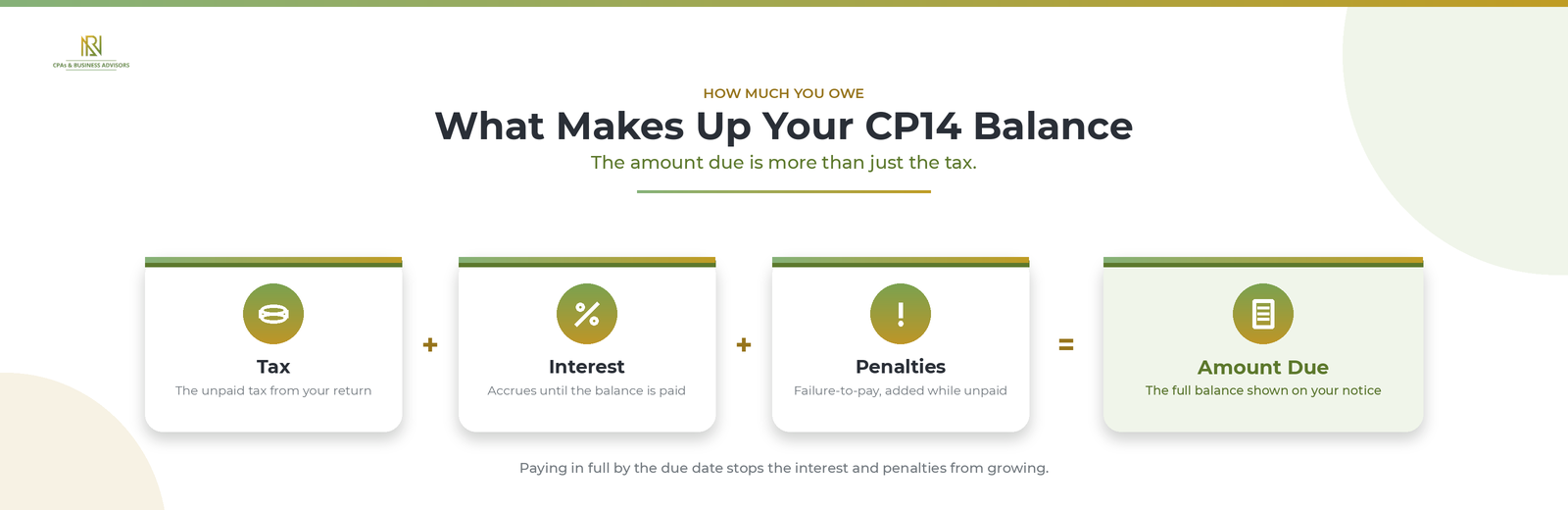
The CP14 shows your full balance, tax plus interest and penalties, and asks you to pay within 21 days of the notice date. According to the IRS, interest accrues on the unpaid amount and a failure-to-pay penalty is added while the balance goes unpaid, so paying in full by the date on the notice stops further interest and penalties from building. The Taxpayer Advocate Service notes that if the balance is not fully paid within about 60 days, the IRS can move forward with collection. The 21-day request is the window to act, not a hard cutoff after which nothing else happens.

What If You Already Paid?
If you already paid in full, don't pay again; verify your account first, because the IRS has acknowledged sending CP14 notices in error. According to the IRS, some taxpayers who paid on time, electronically or by check, received a CP14 because the payment had not finished processing or posted with an error, and it advised those taxpayers not to respond or pay a second time while it corrects the accounts, with penalties and interest adjusted automatically once the payment is applied. To confirm where you stand, sign in to your IRS Online Account and review your tax account transcript, checking that each payment posted to the right year and amount. A misapplied payment, a still-processing amended return, or an estimated payment credited to the wrong period are common reasons a balance shows when you don't actually owe it. If your records don't match the notice, dispute it in writing to the address on the notice, including your name, the tax year, and copies of your proof such as cancelled checks or payment confirmations, and keep your originals.

How To Pay Your CP14
If the amount is correct, the fastest resolution is to pay it. According to the IRS, you can pay online, and paying by the due date on the notice limits the interest and penalties you owe. Include the notice's reference details with your payment so it is applied to the right year, and keep a record of the confirmation. Paying the full balance closes the notice; if you can't pay all of it, you still have options.
What If You Can't Pay In Full?
If you can't pay the whole balance, you have several options, and you can set most of them up yourself. According to the IRS, the main paths are:
- A payment plan, or installment agreement, that lets you pay the balance in monthly amounts over time, available online for many individual balances.
- An offer in compromise, which settles the debt for less than the full amount when you qualify.
- First-time penalty abatement or reasonable-cause relief, which can remove the failure-to-pay penalty if you have a clean recent history or a valid reason.
- A temporary delay of collection, sometimes called currently not collectible status, if paying would create real hardship.

Even if you choose a plan, paying as much as you can now reduces the interest that keeps accruing on the remaining balance. Setting up an installment agreement with your response also signals to the IRS that you intend to resolve the balance.
What Happens If You Ignore A CP14 Notice?
Ignoring a CP14 doesn't stop the balance; it grows the debt and moves you toward collection. According to the IRS, interest and the failure-to-pay penalty keep accruing on the unpaid amount, and if you don't resolve the balance the account advances through further notices demanding payment. Left unaddressed, that path leads to enforced collection, which can include a federal tax lien or a levy on wages or bank accounts. Because the CP14 is the first and easiest point to deal with the balance, responding now, by paying, arranging a plan, or disputing it, is far cheaper than waiting.

Should You Handle It Yourself Or Get Help?
You can handle most CP14 notices yourself, especially when the balance is correct and you can pay or set up a plan online. According to the IRS, you can resolve a debt and manage your account without calling. Consider professional help when the balance is large, when you believe the notice is wrong and need to build a documented dispute, or when paying would cause hardship. A CPA or enrolled agent can pull your transcripts, verify the amount, and deal with the IRS for you, and a firm offering IRS tax resolution services can manage the response end to end. If cost is a barrier, a Low Income Taxpayer Clinic may help for free or a small fee. Either way, if you're not sure what your letter is asking, start with our overview of the general steps for any IRS letter.
Frequently Asked Questions
What is a CP14 notice? It is the IRS's first bill, telling you that you owe money on unpaid taxes and asking for payment within 21 days.
Is a CP14 notice bad? It is serious but routine and fixable. It is not an audit, and acting on it promptly keeps interest and penalties from growing.
How do I respond to a CP14 notice? Verify the balance against your records, then pay it, set up a payment plan if you can't pay in full, or dispute it in writing if the amount is wrong.
Is notice CP14 a civil penalty? No. The CP14 is a demand for payment of tax you owe, though the balance can include penalties and interest in addition to the tax.
What if I paid my taxes but received a CP14? Don't pay twice. Check your IRS account to confirm the payment posted, and if you paid in full and on time, the IRS has said affected taxpayers should not respond while it corrects the account.
A CP14 notice is the IRS letting you know about a balance and asking you to settle it, not a penalty or an audit. Confirm the amount is right, pay it or arrange a plan if it is, and dispute it with proof if it isn't. Dealt with inside the window it gives you, a CP14 is one of the simpler IRS notices to put behind you.
Tax and Financial Insights
by NR CPAs & Business Advisors


Does Ford F150 Qualify for Section 179 and When Does It Apply?
A Ford F-150 qualifies for Section 179 when its gross vehicle weight rating exceeds 6,000 pounds and the truck is used more than 50% for business, which describes most F-150 configurations on the road. Qualifying and being fully deductible are two separate questions. An F-150 with a cargo bed shorter than six feet is treated as a sport utility vehicle under the tax code and carries a $32,000 Section 179 ceiling for 2026, while the same truck with a 6.5-foot or 8-foot bed carries no such ceiling.
The sections below cover the 2026 dollar limits, where the F-150 lands on the weight threshold by configuration, why bed length changes the answer more than weight does, how bonus depreciation closes the gap left by the SUV cap, how the Raptor and Lightning are treated, which Ford SUVs qualify, the business-use and ownership requirements, when the deduction actually applies, and how the election gets made on your return.
Key Takeaways
- Most F-150 configurations exceed 6,000 pounds GVWR, with ratings running roughly 6,010 to 7,050 pounds depending on cab, bed, and powertrain.
- Bed length, not weight, determines whether the $32,000 heavy SUV cap applies. A cargo bed of at least six feet removes the cap entirely.
- The 2026 Section 179 maximum is $2,560,000, phasing out dollar for dollar once total qualifying purchases pass $4,090,000.
- The SuperCrew with a 5.5-foot bed, the highest-volume F-150 configuration, falls under the SUV cap. So do the Raptor and the Lightning, which are built on that same short bed.
- The cap limits Section 179 only. Bonus depreciation at 100% covers the remaining basis in 2026, so a capped truck can still reach a full first-year deduction.
- Business use must exceed 50% in the year the truck is placed in service, and dropping to 50% or below in a later year triggers recapture as ordinary income.
- No universal rule requires the title to be in the business name. The answer depends on your entity type.
Does a Ford F-150 Qualify for Section 179?
A Ford F-150 qualifies for Section 179 in nearly every configuration Ford currently builds, because the truck clears the 6,000-pound gross vehicle weight rating threshold that governs vehicle eligibility. Weight is the entry test, and the F-150 passes it comfortably across the lineup.
Passing the entry test settles less than most buyers expect. The tax code contains a second test that applies after the weight test, and that second test splits the F-150 lineup down the middle. Configurations with a cargo bed of at least six feet receive the full Section 179 treatment. Configurations with a shorter bed are reclassified and capped, even though the truck is identical in weight, price, and work capability.
The distinction is worth several tens of thousands of dollars in first-year deduction on a single purchase, and it is decided by a specification most buyers select for cab room rather than tax outcome. Deliberate tax planning before the order is placed is what keeps that decision from being made by accident.
What Is the Section 179 Deduction?
Section 179 is the provision of the Internal Revenue Code that lets a business deduct the full cost of qualifying equipment in the year it is placed in service, rather than depreciating that cost across several years. Vehicles, machinery, computers, and off-the-shelf software all fall inside the definition of qualifying property.
Immediate expensing changes cash flow rather than total deduction. A truck depreciated under standard rules produces deductions across five or six tax years. The same truck expensed under Section 179 produces the entire deduction now, which reduces the current year's tax bill and leaves the cash in the business instead of with the Treasury.
The provision became far more generous in 2025. The One Big Beautiful Bill Act raised the Section 179 baseline to $2.5 million permanently for tax years beginning after December 31, 2024, replacing a limit that had sat near $1.16 million. Guidance published before that change still circulates widely, which is why figures from 2023 and 2024 continue to appear on pages that look current.
What Is the Section 179 Limit for 2026?
The Section 179 limit for 2026 is $2,560,000, with the deduction phasing out dollar for dollar once total qualifying property placed in service exceeds $4,090,000 and disappearing entirely at $6,650,000. Those figures come from IRS Revenue Procedure 2025-32.
Phase-out rarely constrains a single truck purchase. A business placing $4.2 million of equipment in service in one year loses $110,000 of its Section 179 allowance, which affects fleets and capital-intensive operations rather than an owner buying one pickup. The limit that actually binds on a vehicle purchase is the heavy SUV cap covered further below, and the taxable income limitation covered near the end.
Is a Ford F-150 Over 6,000 lbs?
A Ford F-150 is over 6,000 pounds in most configurations, with gross vehicle weight ratings running from roughly 6,010 pounds at the light end of the lineup to about 7,050 pounds on heavier builds. The F-150 Lightning sits higher still, between roughly 6,500 and 8,250 pounds, because the battery pack adds substantial mass.
Gross vehicle weight rating measures something different from what the truck weighs on a scale. GVWR is the manufacturer's maximum rating for the vehicle fully loaded, combining curb weight, passengers, cargo, fuel, and tongue weight. A truck weighing 5,200 pounds empty can carry a 7,000-pound GVWR, and the rating rather than the curb weight is what the tax code uses.
The lightest F-150 builds sit close enough to the line that the rating deserves verification rather than assumption. A configuration coming in at 5,950 pounds falls under the passenger automobile rules entirely, where the 2026 first-year depreciation ceiling is $20,300 with bonus depreciation applied, according to IRS Revenue Procedure 2026-15.
F-150 ConfigurationTypical GVWRClears 6,000 lbs2026 Section 179 TreatmentRegular Cab, 8-foot bed6,100 to 6,800 lbsYesNo SUV cap, full expensing availableRegular Cab, 6.5-foot bed6,010 to 6,600 lbsUsuallyNo SUV cap, full expensing availableSuperCab, 8-foot bed6,500 to 7,050 lbsYesNo SUV cap, full expensing availableSuperCab, 6.5-foot bed6,300 to 6,900 lbsYesNo SUV cap, full expensing availableSuperCrew, 6.5-foot bed6,600 to 7,050 lbsYesNo SUV cap, full expensing availableSuperCrew, 5.5-foot bed6,400 to 7,000 lbsYes$32,000 SUV cap appliesRaptor (SuperCrew, 5.5-foot bed)6,200 to 6,800 lbsYes$32,000 SUV cap appliesLightning (SuperCrew, 5.5-foot bed)6,500 to 8,250 lbsYes$32,000 SUV cap applies
Sources: IRC Section 179(b)(5); IRS Revenue Procedure 2025-32 (2026 inflation adjustments); manufacturer gross vehicle weight rating data. GVWR varies by model year, powertrain, axle ratio, and equipment. Verify the rating on the specific vehicle before relying on it.
How Do You Find Your F-150's GVWR?
You find your F-150's GVWR on the certification label affixed to the driver's side door jamb, where the manufacturer prints the rating alongside the front and rear axle weight ratings. That label is the authoritative figure for tax purposes.
Three secondary sources carry the same number. The window sticker on a new truck lists it, the owner's manual reproduces it by configuration, and a dealer can pull it from the VIN. Marketing material and third-party model pages frequently round or generalize, so the door jamb label is the one to photograph and keep with your purchase records.
Does Bed Length Change the Deduction on an F-150?
Bed length changes the deduction on an F-150 more than weight does, because a cargo bed of at least six feet exempts the truck from the heavy SUV cap while a shorter bed subjects it to that cap. The exemption sits in Section 179(b)(5)(B) of the tax code.
Section 179(b)(5)(B) exempts three categories of heavy vehicle from the SUV limitation. A vehicle with an open cargo area of at least six feet in interior length that is not readily accessible from the passenger compartment is the category that covers pickups. A vehicle seating nine or more passengers behind the driver is the second. A vehicle with a fully enclosed cargo compartment and no seating behind the driver's row is the third, which is why cargo vans escape the cap.
Interior length is what the test measures, taken from the inside of the bulkhead to the inside of the closed tailgate. A 5.5-foot bed misses the threshold by six inches, and those six inches move the truck from unlimited Section 179 treatment into a capped category built for luxury sport utility vehicles.
What Is the Heavy SUV Limit for Section 179?
The heavy SUV limit for Section 179 is $32,000 per vehicle for tax years beginning in 2026, applying to vehicles rated between 6,001 and 14,000 pounds GVWR that are primarily designed to carry passengers. The cap is prorated by business-use percentage like every other vehicle deduction.
Congress created the cap two decades ago after heavy sport utility vehicles became a widely publicized expensing strategy, and it has been indexed for inflation since. The figure was $28,900 in 2023, $30,500 in 2024, $31,300 in 2025, and $32,000 in 2026. Vehicles above 14,000 pounds GVWR sit outside the cap entirely and receive commercial treatment.
Does a Ford F-150 SuperCrew Qualify for Section 179?
A Ford F-150 SuperCrew qualifies for Section 179, but the version with a 5.5-foot bed is subject to the $32,000 cap while the version with a 6.5-foot bed is not. Both trucks clear 6,000 pounds. Only one of them clears the bed-length test.
The distinction matters more than it first appears because the SuperCrew short bed is the highest-volume F-150 configuration sold. A buyer choosing the 5.5-foot bed for a shorter turning radius or a tighter parking footprint has made a tax decision without being told one was on the table. Pages published by vehicle sellers routinely list this configuration as fully eligible with no mention of the cap.
The same trap catches two halo models. The Raptor and the Lightning are both built exclusively on the SuperCrew short-bed body, which places both under the $32,000 ceiling despite the Lightning carrying one of the highest gross weight ratings in the lineup. Weight does not rescue a short bed.
Can You Write Off 100% of a 6,000 lb Vehicle?
You can write off 100% of a 6,000-pound vehicle in the first year, because bonus depreciation covers whatever basis the Section 179 cap leaves behind. The One Big Beautiful Bill Act restored bonus depreciation to 100% for qualified property acquired and placed in service after January 19, 2025.
Bonus depreciation and Section 179 are separate provisions that stack rather than compete. Section 179 is an election with a dollar limit, a phase-out, and a taxable income ceiling. Bonus depreciation applies automatically to eligible property unless you elect out, carries no dollar limit, and can create or increase a business loss. Applying them in the correct order is what produces the full first-year write-off on a capped vehicle.
The order runs as follows on a 100% business-use vehicle:
- Confirm the GVWR clears 6,000 pounds. Below that line, the passenger automobile ceilings under Section 280F govern and the stacking analysis stops.
- Determine whether the SUV cap applies. A cargo bed of at least six feet removes it. A shorter bed imposes the $32,000 ceiling for 2026.
- Apply Section 179 first. Take the full cost on an uncapped truck, or $32,000 on a capped one, subject to the taxable income limitation.
- Apply 100% bonus depreciation to the remaining basis. On a capped vehicle, this is the step that closes the gap to a full deduction.
- Depreciate anything left under MACRS. With bonus at 100%, there is generally nothing remaining at this step.
- Prorate the entire result by business-use percentage. A truck used 80% for business produces 80% of the figure the prior steps generated.
A worked illustration makes the stacking concrete. Take a $78,000 SuperCrew with a 5.5-foot bed used entirely for business. Section 179 delivers $32,000, bonus depreciation delivers the remaining $46,000, and the first-year deduction reaches the full $78,000. The identical truck with a 6.5-foot bed reaches $78,000 through Section 179 alone. Same deduction, different mechanics, and the mechanics matter because bonus depreciation availability is set by legislation that has changed repeatedly.
What Is the Difference Between Section 179 and Bonus Depreciation?
The difference between Section 179 and bonus depreciation is that Section 179 is an elective deduction with dollar caps and an income ceiling, while bonus depreciation applies automatically with no caps and can generate a net operating loss. Businesses frequently use both in the same year on the same asset.
Three practical distinctions follow from that split. Section 179 cannot push a business into a loss, because the deduction is capped at aggregate business taxable income. Bonus depreciation can. Section 179 is elected asset by asset, so you can expense one truck and depreciate another. Bonus depreciation applies to an entire class of property unless you elect out of that class. And several states allow Section 179 in some form while disallowing bonus depreciation completely, which the state section below addresses.
Bonus depreciation percentages have also moved repeatedly under recent legislation, dropping to 60% for part of 2024 before returning to 100%. The current bonus depreciation rules are what make a full first-year write-off possible on a capped vehicle, and a strategy built entirely on that provision carries more legislative exposure than one that clears under Section 179 alone.
The same stacking logic drives depreciation planning on buildings rather than vehicles, where a cost segregation study reclassifies building components into shorter recovery periods so bonus depreciation can reach them. The provisions are the same. Only the asset changes.
What Pickup Trucks Qualify for Section 179?
Pickup trucks qualify for Section 179 when they exceed 6,000 pounds GVWR and are used more than 50% for business, and they escape the $32,000 SUV cap when the cargo bed measures at least six feet. Across the Ford lineup, that produces three distinct groups.
The Super Duty range clears both tests in every configuration Ford builds. The F-250, F-350, F-450, and F-550 all carry gross weight ratings well above the threshold, and the bed options all meet or exceed six feet. Full Section 179 expensing applies up to the $2,560,000 annual limit, with no vehicle-level ceiling.
The F-150 splits by bed length, as covered above. Long-bed and 6.5-foot configurations receive full treatment while 5.5-foot configurations face the cap.
Compact and mid-size pickups sit in the third group and require verification rather than assumption. Several Ranger and Maverick configurations carry gross weight ratings below or near 6,000 pounds, which places them under the passenger automobile ceilings where the 2026 first-year limit is $20,300 with bonus depreciation applied. Contractors and restaurant owners shopping the smaller trucks for delivery and service routes frequently assume truck treatment and receive car treatment.
Does a Ford Raptor Qualify for Section 179?
A Ford Raptor qualifies for Section 179 and clears the 6,000-pound threshold comfortably, but it is subject to the $32,000 cap because it is built exclusively on the SuperCrew 5.5-foot bed platform. No long-bed Raptor exists, so no Raptor configuration escapes the cap.
Reaching a full first-year deduction on a Raptor therefore depends on bonus depreciation rather than Section 179. That distinction carries real risk exposure, since bonus depreciation sits at 100% under current law but has phased down before and could again. A truck whose deduction depends entirely on the second provision is more exposed to legislative change than one that clears on the first.
Does the F-150 Lightning Qualify for Section 179?
The F-150 Lightning qualifies for Section 179 with gross weight ratings running from roughly 6,500 to 8,250 pounds, and it is also subject to the $32,000 cap because it is only offered with a 5.5-foot bed. Battery weight raises the rating without changing the bed-length analysis.
Electric trucks carry one additional wrinkle. Any clean vehicle credit claimed on the purchase reduces the depreciable basis, which shrinks the amount available for Section 179 and bonus depreciation. Modeling the credit and the deduction together, rather than claiming each in isolation, is where the actual after-tax cost of an electric work truck gets determined.
Do Ford SUVs Qualify for Section 179?
Ford SUVs qualify for Section 179 when they exceed 6,000 pounds GVWR, and they are subject to the $32,000 cap in every case because no sport utility vehicle satisfies the six-foot cargo bed exemption. The cap is the default for this entire category rather than an exception within it.
The Expedition and Expedition MAX carry gross weight ratings comfortably above the threshold in all configurations. Both are capped at $32,000 under Section 179, with the remaining basis eligible for 100% bonus depreciation in 2026 when business use supports it.
Smaller Ford SUVs require the same verification the compact pickups do. Ratings vary by trim and powertrain, and models sitting under 6,000 pounds fall into the passenger automobile ceilings rather than the heavy vehicle rules.
Does the Ford Explorer Qualify for Section 179?
The Ford Explorer qualifies for Section 179 in configurations rated above 6,000 pounds GVWR, subject to the $32,000 heavy SUV cap. Explorer ratings sit close to the threshold and move with trim, drivetrain, and equipment, so the door jamb label decides the answer rather than the model name.
An Explorer landing above 6,000 pounds enters the heavy vehicle rules and takes $32,000 under Section 179 plus bonus depreciation on the balance. An Explorer landing below it enters the passenger automobile rules and caps at $20,300 in the first year for 2026 with bonus applied, according to IRS Revenue Procedure 2026-15. The gap between those two outcomes on the same nameplate is substantial.
Does the Ford Bronco Qualify for Section 179?
The Ford Bronco qualifies for Section 179 in configurations rated above 6,000 pounds GVWR, again subject to the $32,000 cap. Four-door Broncos in higher trims are the configurations most likely to clear the threshold, while two-door models and the smaller Bronco Sport generally do not.
Verification matters more on the Bronco than on almost any other model in the lineup, because the spread between configurations straddles the threshold rather than sitting above it. Two Broncos on the same lot can receive entirely different tax treatment.
How Much Business Use Does the IRS Require?
The IRS requires more than 50% business use in the year the vehicle is placed in service, and the deduction is reduced proportionally by the personal-use share. A truck used 70% for business produces 70% of the deduction the purchase price would otherwise support.
Business use means use in your trade or business, measured by mileage. Hauling materials to a job site counts. Driving to a client meeting counts. Commuting between your home and your regular workplace does not count, which surprises many owners and is the single most common source of an overstated business-use percentage.
Falling at exactly 50% fails the test, since the statute requires use to exceed half. A vehicle at or below that line loses the Section 179 election entirely and depreciates under the alternative depreciation system instead.
What Happens If Business Use Drops Below 50%?
If business use drops to 50% or below in a year after the deduction was claimed, Section 280F(b)(2) requires you to recapture the excess depreciation as ordinary income on that year's return. Recapture reverses the benefit rather than merely stopping it.
The recaptured amount equals the depreciation actually taken minus what straight-line depreciation would have produced over the same period. A truck expensed at $70,000 in year one and dropped to 40% business use in year three can generate a five-figure income pickup in that third year, arriving at a moment the owner is typically not expecting additional taxable income.
Two situations create this risk more than any other. A business that winds down or changes direction leaves a truck that was heavily used now sitting mostly idle. And an owner who buys a replacement work vehicle often shifts the older truck into personal or family use without recognizing that the shift has a tax consequence attached. Ongoing business consulting catches that transition before the return is filed rather than after a notice arrives.
Does the Truck Have to Be Titled in the Business Name?
The truck does not have to be titled in the business name in every case, because the correct answer depends on your entity structure rather than on a universal rule. Guidance stating otherwise appears frequently and is wrong for a large share of small business owners.
A sole proprietor filing Schedule C is the same taxpayer as the business, so a truck titled personally and used more than 50% in the business supports the deduction on that owner's return. A single-member LLC treated as a disregarded entity reaches the same result for the same reason.
Corporations and partnerships are different taxpayers from their owners, and there the title question carries weight. A vehicle titled personally but used by an S corporation is generally handled through an accountable plan reimbursement or a documented lease to the entity, rather than by the corporation claiming Section 179 on an asset it does not own. Getting this wrong on a corporate return is a documentation problem that surfaces during examination, and it is decided at the moment of entity selection rather than at the dealership.
How Does Section 179 Work for an S Corporation or Partnership?
Section 179 for an S corporation or partnership is applied at both the entity level and the owner level, with the dollar limit and the taxable income limitation tested twice. The entity elects the deduction and passes it through, and the owner then tests it again against their own limits.
Double testing produces outcomes owners rarely anticipate. An entity can pass through a Section 179 amount the owner cannot fully use in that year, because the owner's own aggregate business taxable income is lower than the passed-through figure. The unused portion carries forward at the owner level indefinitely. Basis limitations apply on top of that, since a shareholder cannot deduct beyond their stock and debt basis in the entity. Early-stage companies working through startup advisory engagements hit this constraint often, because basis is thin in the years when equipment spending is heaviest.
Does a Used or Financed F-150 Qualify?
A used F-150 qualifies for Section 179 as long as the truck is new to your business and acquired from an unrelated party, and financing the purchase does not reduce the deduction at all. Both points run contrary to widespread assumption.
The used-vehicle rule turns on novelty to the taxpayer rather than novelty to the world. A three-year-old F-150 bought from a dealer qualifies in full. The same truck acquired from a related party, inherited, or received as a gift does not, and neither does a vehicle you previously owned personally and later moved into the business.
Financing changes nothing about the deduction. A truck purchased with a loan and placed in service in December supports the same first-year deduction as a truck paid for in cash, even though almost none of the purchase price has been paid out yet. That mismatch between deduction timing and cash outlay is the single largest cash-flow advantage the provision offers, and it is a standard input in the models we build during CFO support work.
Leasing follows separate rules entirely. A true operating lease produces deductible lease payments rather than a Section 179 deduction, since you do not own the asset. A finance lease structured as a conditional sale can support the deduction, and which category a given contract falls into depends on the terms rather than on what the document is titled.
When Does the Section 179 Deduction Actually Apply?
The Section 179 deduction applies in the tax year the vehicle is placed in service, meaning the year it is ready and available for its intended business use. Purchase date and delivery date are not the operative dates. Availability is.
A truck delivered on December 28 and available for work supports a deduction on that year's return even if the first job runs in January. A truck ordered in November and delivered in February supports a deduction in the following year. For a calendar-year taxpayer the deadline is December 31, and factory order lead times make late-year planning a scheduling exercise rather than a purchasing one. Working the timing in October rather than late December is the difference, which is why year-end planning for equipment starts well before the fourth quarter.
One limitation constrains the deduction independently of timing. Section 179(b)(3) caps the deduction at your aggregate business taxable income for the year, so a business with $40,000 of taxable income cannot generate a $78,000 Section 179 deduction. The disallowed portion carries forward indefinitely to future years with income to absorb it, and bonus depreciation remains available in the meantime because it carries no equivalent income ceiling.


What Is Tax-Loss Harvesting and How Much Can You Claim?
Tax-loss harvesting is the practice of selling an investment that has fallen below what you paid for it, so the realized capital loss can offset taxable capital gains elsewhere in your portfolio. Capital losses offset capital gains dollar for dollar with no annual ceiling. Once your gains are fully absorbed, up to $3,000 of leftover loss reduces ordinary income each year, and anything past that carries forward indefinitely.
The sections below cover how the mechanics work, exactly how much you can claim in a single year, how long unused losses survive, the wash sale rule that disallows a loss you harvest carelessly, how the rules land on cryptocurrency and retirement accounts, which cost basis method produces the largest deduction, what the peer-reviewed research says the strategy is actually worth, and how the treatment changes for a business entity rather than an individual filer.
Key Takeaways
- Capital losses offset capital gains with no dollar limit. The $3,000 cap applies only to the leftover loss you push against ordinary income.
- The $3,000 annual limit ($1,500 for married taxpayers filing separately) has been frozen since 1978 and has never been indexed for inflation.
- Unused losses carry forward indefinitely for individuals, keeping their short-term or long-term character each year.
- The wash sale rule disallows a harvested loss if you buy the same or a substantially identical security inside a 61-day window, spanning 30 days before and 30 days after the sale.
- A disallowed loss is deferred rather than destroyed. It attaches to the cost basis of the replacement position.
- Peer-reviewed research puts the annual after-tax benefit at roughly 0.5% to 1.3%, and the size of that benefit depends heavily on your own tax rates and behavior.
- Tax-loss harvesting works only inside taxable brokerage accounts. Losses realized inside an IRA or 401(k) produce no deduction.
What Is Tax-Loss Harvesting?
Tax-loss harvesting is the deliberate sale of a depreciated position in a taxable account to convert a paper loss into a realized capital loss the tax code recognizes. The paper loss on a position you still hold carries no tax value at all. The sale is the event that turns a decline in value into a deduction.
A realized capital loss functions as a credit against realized capital gains. Realized capital gains arrive from selling appreciated stock, closing a profitable fund position, receiving a capital gain distribution from a mutual fund, or disposing of a digital asset at a profit. Each of those events adds taxable gain to your return, and a harvested loss subtracts from that total before any capital gains tax is calculated.
The strategy does not require you to leave the market. Most investors who harvest a loss immediately reinvest the proceeds into a comparable position that fills the same role in the portfolio, which preserves market exposure while banking the deduction. Preserving that exposure is the difference between tax-loss harvesting and simply selling in a panic.
How Does Tax-Loss Harvesting Work?
Tax-loss harvesting works by realizing a loss, netting that loss against your realized gains, applying any remainder to ordinary income up to the annual cap, and carrying the rest forward. The sequence runs the same way on every return, regardless of portfolio size.
Consider a straightforward year. You sell one position at a $30,000 loss and another at a $25,000 gain. The loss wipes out the entire gain, so your capital gains tax on that pair of transactions drops to zero, and $5,000 of loss remains. You apply $3,000 of that remainder against your wages or business income this year and carry the final $2,000 into next year. Nothing evaporates in that sequence, because the code preserves every dollar of loss until you use it.
How Much Can You Write Off With Tax-Loss Harvesting?
You can write off an unlimited amount of capital gains with harvested losses, plus up to $3,000 of ordinary income per year, or $1,500 if you are married filing separately. Those two limits behave very differently, and confusing them is the most common error in this area.
The gain offset carries no ceiling whatsoever. A taxpayer with $400,000 in realized gains and $400,000 in realized losses reports a net capital gain of zero and owes no federal capital gains tax on those transactions. The $3,000 figure never enters that calculation, because the cap governs only the portion of loss that survives after every gain has been absorbed.
The ordinary income offset is where the ceiling bites. According to IRS Topic No. 409, once your capital losses exceed your capital gains, the deductible excess equals the lesser of $3,000 or your total net loss. That $3,000 applies to the return rather than to each spouse, so a married couple filing jointly receives one $3,000 deduction between them. Deliberate tax planning throughout the year is what determines whether a given loss lands against a 37% ordinary income bracket or gets stranded behind an already-empty gain column.
What Is the $3,000 Loss Rule?
The $3,000 loss rule is the statutory limit under Internal Revenue Code Section 1211(b) on how much net capital loss an individual can deduct against ordinary income in a single tax year. Ordinary income here covers wages, self-employment earnings, interest, and non-qualified distributions.
The number has a history worth knowing. According to the Congressional Research Service, the $3,000 limit has stood unchanged since 1978, when Congress raised it from $1,000. Nearly five decades of inflation have passed without a single adjustment, and analysts who index the original figure to consumer prices put its equivalent value above $13,000 today. Over sixty provisions in the tax code adjust automatically each year for cost of living. This one does not.
The practical consequence falls hardest on investors holding large carryforward balances. A taxpayer sitting on $90,000 of unused loss and no future gains would need thirty years to absorb it at $3,000 per year. That arithmetic is precisely why the gain offset, which has no cap, deserves far more planning attention than the ordinary income offset.
Can You Write Off 100% of Stock Losses?
You can write off 100% of stock losses against capital gains, but you cannot write off 100% of stock losses against ordinary income in the same year. The full loss is always deductible eventually. The question is only how many tax years the deduction takes to run its course.
A single scenario makes the split obvious. An investor realizing $50,000 in stock losses and $50,000 in stock gains deducts the entire loss immediately, because gains absorb losses without limit. Change the facts so the same investor has $50,000 in losses and no gains at all, and the deduction stretches across seventeen tax years at $3,000 annually. Identical losses, radically different timing, driven entirely by whether realized gains exist to absorb them.
How Long Do You Have to Write Off Stock Losses?
You have an unlimited amount of time to write off stock losses, because capital loss carryforwards never expire for individual taxpayers. According to IRS Publication 550, the unused portion carries forward year after year until it is fully absorbed.
Carried-forward losses retain their original character. A long-term loss stays long-term when it arrives in next year's netting calculation, and a short-term loss stays short-term. Character preservation matters because the netting order treats the two categories separately before combining them, which the next section walks through step by step.
Recordkeeping is the practical constraint rather than the statute. The carryforward figure moves from one year's Schedule D to the next through the Capital Loss Carryover Worksheet, and a single skipped year breaks the chain. Taxpayers who switch software or preparers frequently lose track of six-figure carryforward balances simply because the number never got transcribed.
What Happens to Capital Loss Carryovers When You Die?
Capital loss carryovers expire at death and cannot be transferred to your heirs or to your estate. Any unused balance is deductible on the decedent's final individual return and then disappears permanently.
Permanent expiration reframes what a large carryforward actually represents. An investor in their late seventies carrying $200,000 in unused losses and no realized gains holds an asset that will almost certainly never be used. Recognizing appreciated positions deliberately during life, so gains exist for the carryforward to absorb, converts a wasting balance into real tax savings. Coordinating that sequence across a family's holdings is standard work inside a family office engagement.
How Do Short-Term and Long-Term Losses Get Netted?
Short-term and long-term losses get netted against gains of the same type first, and only the surviving remainder crosses over to offset the other category. The ordering rule is mechanical, and it determines how much tax a given loss actually saves.
The rate spread is what gives the ordering its weight. Short-term capital gains, from assets held one year or less, are taxed as ordinary income at rates from 10% to 37%, according to the IRS. Long-term capital gains, from assets held more than one year, are taxed at 0%, 15%, or 20%. In 2026, the 0% tier reaches taxable income of $49,450 for single filers and $98,900 for joint filers, and the 20% tier begins above $545,500 and $613,700 respectively, under IRS Revenue Procedure 2025-32. A loss that cancels a short-term gain therefore saves substantially more tax than the identical loss applied against a long-term gain.
The netting calculation runs in this order on your return:
- Separate every transaction by holding period. One year or less is short-term. More than one year is long-term.
- Net short-term losses against short-term gains. This pairing is the most valuable, because short-term gains carry ordinary rates.
- Net long-term losses against long-term gains. Same-category netting always happens before any crossover.
- Cross the surviving remainder over. Excess short-term loss offsets net long-term gain, and excess long-term loss offsets net short-term gain.
- Apply up to $3,000 of any remaining net loss to ordinary income. The figure drops to $1,500 for married taxpayers filing separately.
- Carry the balance forward. The remainder moves into next year with its short-term or long-term character intact.
One additional rate layer sits above this grid. The net investment income tax adds 3.8% to investment income once modified adjusted gross income passes $200,000 for single filers or $250,000 for joint filers. Fidelity reports that the surtax pushes the effective top rate to 40.8% on short-term gains and 23.8% on long-term gains, which raises the value of every harvested loss for taxpayers above those thresholds.
What Is the Wash Sale Rule?
The wash sale rule is the provision under Internal Revenue Code Section 1091 that disallows a capital loss when you acquire the same or a substantially identical security within 30 days before or 30 days after the sale that produced the loss. Counting both sides of the sale date creates a 61-day window in total.
The window catches purchases made before the sale as readily as purchases made after it. An investor who buys additional shares on March 1 and then sells the older lot at a loss on March 20 has triggered the rule, even though the purchase preceded the harvest. Sequence provides no protection. Only distance from the sale date does.
The rule also reaches across accounts rather than sitting inside a single brokerage statement. Purchases in a second taxable account, in a retirement account, and in a spouse's account all count toward the same 61-day test, whether or not the spouses file jointly.
What Counts as a Substantially Identical Security?
A substantially identical security is one with essentially the same economic characteristics and rights as the position you sold, which generally means the same issuer and the same class of stock. Common stock in a company and common stock in the same company is the clearest case.
Different issuers in the same industry are generally not substantially identical. Selling one large technology company at a loss and purchasing a different large technology company does not trigger the rule, even though the two positions may move together. The same logic extends to funds. Selling an index fund tracking one benchmark and buying a fund tracking a different benchmark with a similar objective is widely treated as a valid replacement, while selling a fund and repurchasing the same fund in a different share class is not.
Can You Buy Back a Stock After Selling at a Loss?
You can buy back a stock after selling at a loss and keep the deduction, provided you wait at least 31 days from the sale date. Waiting past the window removes the disallowance entirely and requires no election, form, or disclosure.
Waiting carries its own cost, since a position that rebounds during the 31 days rebounds without you. Investors who want continuous exposure typically buy a comparable but distinguishable replacement immediately, then either hold the replacement permanently or rotate back after the window closes. Choose the replacement before you place the sale, if the position occupies a meaningful share of the portfolio.
How Do You Avoid Triggering a Wash Sale?
You avoid triggering a wash sale by controlling every purchase of the security across every account you and your spouse own during the full 61-day window. The trades that create problems are rarely the deliberate ones. They are the automated and forgotten ones listed below.
- Automatic recurring investments. A monthly transfer into the same fund you just harvested disallows a proportional share of the loss. Pause the contribution before the sale.
- Purchases inside an IRA or 401(k). Buying the security in a retirement account during the window disallows the loss in the taxable account permanently, with no basis adjustment available to recover it.
- A spouse's separate account. The rule treats spouses as one purchaser regardless of filing status, so an uncoordinated trade in a partner's account defeats the harvest.
- Dividend reinvestment. A reinvested dividend is a purchase. A position set to reinvest automatically can trigger the rule days after you thought the harvest was complete.
- Equity compensation events. A vesting date or an employee stock purchase plan execution inside the window counts as an acquisition of company stock.
What Happens to a Disallowed Loss?
A disallowed loss is not destroyed, because the amount attaches to the cost basis of the replacement shares and remains available when you eventually sell that position. The wash sale rule defers the deduction rather than eliminating it.
The basis adjustment works arithmetically. Buy a stock at $50, sell it at $30 for a $20 loss, then repurchase at $25 inside the window. The $20 loss is disallowed for the current year, and your basis in the repurchased shares becomes $45 rather than $25. Selling those shares later at $60 produces a $15 gain instead of a $35 gain, which recovers the full benefit of the original loss.
Two conditions break this consolation. A disallowed loss caused by a purchase in a retirement account is lost outright, because there is no taxable basis for the adjustment to attach to. And the holding period of the disallowed position carries over to the replacement shares, which can convert what looks like a short-term position into a long-term one.
Does the Wash Sale Rule Apply to Crypto?
The wash sale rule does not currently apply to directly held cryptocurrency, because Section 1091 governs stock and securities while the IRS classifies digital assets as property. Selling a token at a loss and repurchasing it immediately preserves the deduction under current federal law.
Two carve-outs sit inside that general answer. Spot crypto exchange-traded products and equity in crypto-related companies are securities, so the 61-day rule applies to them in full. And the exemption is a function of current statute rather than a permanent feature, since proposals to extend Section 1091 to digital assets have appeared in draft legislation repeatedly since 2021 without passing.
Reporting has already moved ahead of the rule. Brokers began reporting gross proceeds on Form 1099-DA for transactions effected on or after January 1, 2025, and basis reporting became mandatory for covered digital assets acquired on or after January 1, 2026, according to the IRS. Form 1099-DA also contains a field for wash sale losses disallowed, which means the reporting infrastructure exists before the substantive rule does. Assets held in self-custody or acquired before the covered date remain the taxpayer's responsibility to substantiate, and reconstructing that history across exchanges and wallets is the bulk of the work in a crypto tax engagement.
Can You Tax-Loss Harvest in an IRA or 401(k)?
You cannot tax-loss harvest in an IRA or 401(k), because gains and losses inside tax-advantaged accounts produce no current tax consequence at all. Selling a position at a loss inside a retirement account generates nothing you can report on Schedule D.
Retirement accounts convert investment results into a different tax character entirely. Traditional account withdrawals arrive as ordinary income regardless of whether the underlying growth came from capital appreciation, and qualified Roth withdrawals arrive untaxed. Neither structure has a mechanism for recognizing a capital loss along the way.
The asymmetry creates a trap worth naming clearly. A retirement account cannot generate a usable loss, and yet a purchase inside that same account can destroy a loss harvested in your taxable brokerage account. The account gives you no upside on the harvest and full downside on the wash sale, which is why the pause-the-contributions step matters more for retirement accounts than for any other holding.
Which Cost Basis Method Produces the Largest Loss?
Specific identification produces the largest harvested loss, because the method lets you designate the highest-cost lots for sale rather than accepting a default the broker selects for you. Every share purchase creates a separate tax lot with its own basis and acquisition date, and the method you elect determines which lot leaves the account.
The difference between methods is measured in real dollars. An investor who bought the same fund at $40, $60, and $80 per share and now sells at $50 realizes a $30 loss per share under specific identification targeting the $80 lot, and a $10 gain per share under first in first out. Same sale, same market price, opposite tax outcomes.
Cost Basis MethodHow Shares Are SelectedEffect on Harvested LossRecordkeeping BurdenSpecific identificationYou designate the exact lots at the time of saleLargest available lossHighest, requires lot-level election before settlementHighest in, first outThe most expensive lots sell first automaticallyNear-largest loss without manual selectionLow, applied by the broker as a standing instructionFirst in, first outThe oldest lots sell firstSmallest loss on appreciated holdingsNone, this is the standard broker default for stockAverage costAll lots blend into one weighted basis figureModerate loss, no lot targeting possibleLow, available for mutual funds and dividend reinvestment plans
Sources: IRS Publication 550, Investment Income and Expenses; IRS Publication 551, Basis of Assets; IRS regulations on broker basis reporting under Section 6045.
The election has a deadline. Specific identification requires you to identify the lots at or before the sale settles, and a lot designation made after settlement is not valid. Set the account default before you need it, rather than during a volatile week.
When Is the Best Time to Tax-Loss Harvest?
The best time to tax-loss harvest is whenever a position drops meaningfully below its basis, rather than in the final weeks of December. A loss available in March frequently disappears by November, and the December-only approach forfeits every opportunity the year presented earlier.
December still carries one hard constraint. All harvesting transactions must be executed and settled by the close of the calendar year, which normally means December 31, or the preceding business day when the date falls on a weekend. Settlement timing rather than trade timing controls, so trades placed in the final days of December can fail to count.
Late-year harvesting does offer better information, since you know your realized gains and your approximate income by then. The practical resolution is to monitor for harvestable losses continuously, execute when the opportunity appears, and reserve December for the final reconciliation rather than for discovery. That rhythm is exactly what year-round planning is built to produce.
Is Tax-Loss Harvesting Worth It?
Tax-loss harvesting is worth roughly 0.5% to 1.3% in additional annual after-tax return for investors with meaningful taxable holdings and a high marginal rate, according to peer-reviewed research. The benefit is real and measurable, and it is also far more variable than most published guidance suggests.
The most cited measurement comes from Chaudhuri, Burnham, and Lo, published in the Financial Analysts Journal in 2020. Their simulation across the 500 largest US securities from 1926 to 2018 produced a tax alpha of 1.08% per year before transaction costs, assuming long-term and short-term rates of 15% and 35%. Constraining the same strategy with the wash sale rule reduced that figure to 0.82% per year, which quantifies the cost of the rule with unusual precision.
Variability across market environments is substantial in the same study. The 1926 to 1949 sub-period delivered 2.29% annually, while the 1949 to 1972 sub-period delivered just 0.57%. Volatile markets with wide dispersion between individual securities generate harvestable losses. Steadily rising markets with narrow dispersion do not.
Vanguard's own 2024 research reaches a compatible conclusion from a different angle, placing tax-loss harvesting alpha between 0.47% and 1.27% annually and attributing roughly one-third of the variation each to investor characteristics, investor behavior, and market environment. The single behavior that mattered most was reinvesting the tax savings rather than spending them. A separate 2021 study by Vanguard researchers in the Financial Analysts Journal found that investor profiles alone drove close to 60% of the variation in outcomes, and Vanguard's Advisor's Alpha framework values the strategy at up to 150 basis points for the investors positioned to use it.
What Is the Downside of Tax-Loss Harvesting?
The downside of tax-loss harvesting is that it lowers your cost basis, which converts today's deduction into a larger taxable gain later. Every harvest is a deferral, and the deferral only pays off if your rate at the eventual sale is equal to or lower than your rate today.
Three conditions turn a harvest against you, and each has a direct response. Selling into a permanently higher future bracket erodes the benefit, so investors expecting a large liquidity event ahead should model the exit before harvesting aggressively today. Replacing a position with a poorly matched substitute introduces tracking difference, so the replacement should share the sold position's role in the portfolio. And accumulating carryforwards you have no realistic path to using produces effort without payoff, which is the situation the deliberate gain-recognition approach described earlier is designed to prevent.
Do Capital Losses Reduce State Taxes?
Capital losses reduce state taxes only in states that impose an income tax on capital gains, and the treatment varies significantly from one state to the next. Federal treatment is uniform across the country. State treatment is not.
Nine states levy no state capital gains tax at all, and Florida is among them. For a Miami investor, a harvested loss delivers federal savings and nothing else, because there is no state capital gains liability for the loss to offset. The same harvested loss in a state with a top rate above 10% carries a meaningfully larger combined benefit. Residency at the moment of sale therefore changes the value of the strategy itself, not merely the size of the tax bill.
Carryforward treatment diverges as well. Some states allow indefinite loss carryforwards that mirror the federal rules, while others limit or disallow them entirely, which reduces the value of harvesting beyond the current year's gains. The federal surtax layer compounds the calculation for higher-income households, and the Bipartisan Policy Center reports that 8.1 million returns paid more than $39 billion in net investment income tax in 2023, more than double the number of returns that paid it in the tax's first year.

%201.avif)


.png)
.png)