Do Uber Drivers Qualify for QBI Deduction and When Does It Apply

Yes, Uber drivers qualify for the QBI deduction when driving profit appears on Schedule C and taxable income stays under the limit. The qualified business income (QBI) deduction is worth up to 20% of net profit. The 2026 limit is $201,750 for single filers and $403,500 for joint filers, according to IRS Revenue Procedure 2025-32. Drivers with a loss claim nothing.
Key Takeaways
- Uber drivers are independent contractors, so driving profit on Schedule C counts as QBI.
- The QBI deduction equals up to 20% of net profit after expenses and half of self-employment tax.
- Taxable income caps the deduction, so a $40,000 profit earns $4,215, not $8,000.
- Rideshare driving is not a specified service trade, so the 2026 phase-in range is $75,000 wide.
- Mileage runs 72.5 cents per mile before July 1, 2026, and 76 cents per mile after.
Do Uber Drivers Qualify for QBI Deduction and When Does It Apply?
Uber drivers qualify for the QBI deduction because the IRS treats their driving income as sole proprietor business income. The deduction applies in any year with positive net profit and taxable income above zero. According to the Internal Revenue Service (IRS), the deduction equals up to 20% of QBI. Drivers claim it whether they itemize or take the standard deduction.
Four conditions decide when the deduction applies, and the numbered list below names each one in order.
- The driver is an independent contractor, not an employee of a company.
- Schedule C shows a net profit after business expenses.
- Taxable income after the standard deduction is above zero.
- Taxable income stays within the 2026 threshold, or the driver accepts a phase-out.
Drivers who meet all four conditions claim the deduction on Form 1040, line 13a. Self-employed gig tax planning starts with the first condition, because employee income never qualifies.
That first condition depends on how the IRS classifies the income, which the next section explains.
Is Uber Income Qualified Business Income?
Uber income is qualified business income when the driver is an independent contractor who reports earnings on Schedule C. QBI is the net of qualified income, gain, deduction and loss from a trade or business. According to the IRS, wage income and income earned through a C corporation are not eligible.
According to the Federal Reserve, 9% of U.S. adults gave rides or did other short-term tasks for gig pay in 2024. Each of those drivers who is not an employee reports on Schedule C. The profit line on that schedule becomes the starting point for the deduction.
The answer to "do uber drivers qualify for qbi deduction and when does it apply" starts with income type. Platforms report driver income on two forms, and the table below compares the forms and thresholds.
| Form | What it reports | Threshold | Where it lands |
|---|---|---|---|
| 1099-K | Gross card and app payments | $20,000 and 200 transactions | Schedule C gross receipts |
| 1099-NEC | Fees paid to a contractor | $2,000 for 2026 payments | Schedule C gross receipts |
| No form | Cash fares and tips | None | Schedule C gross receipts |
The One Big Beautiful Bill Act (OBBBA) raised the 1099-NEC threshold from $600 to $2,000 for payments made in 2026. A missing form never removes income from the return, because every dollar of driving revenue is taxable. Net earnings of $400 or more also trigger self-employment tax, according to the IRS.
Driving revenue is only the starting figure. The next section lists income that never counts as QBI.
What Is Not Eligible for the QBI Deduction?
Five kinds of income are not eligible for the QBI deduction, according to the IRS, and the list below names each one.
- Wages earned as an employee.
- Income earned through a C corporation.
- Capital gains and interest not tied to the business.
- Reasonable compensation from an S corporation.
- Tip income covered by Section 224 for tax years 2025 through 2028.
A driver who is also a W-2 employee gets no QBI from the paycheck. The Schedule C profit still qualifies on its own. Readers who want the full exclusion list can compare the excluded trades that lose the deduction at higher incomes.
Specified service trades such as law and accounting face a harder phase-out than rideshare driving does. Passenger transport is not on the IRS list of specified service trades. The deduction therefore shrinks gradually for drivers above the threshold and never vanishes at once.
Once income type is settled, the next step is the profit number itself.
How Do I Determine My QBI as an Uber Driver?
Determine QBI as an Uber driver by subtracting business expenses, then half of self-employment tax, from gross driving revenue. QBI is net profit reduced by three items the IRS names. Those items are the deductible half of self-employment tax, self-employed health insurance and retirement plan contributions.
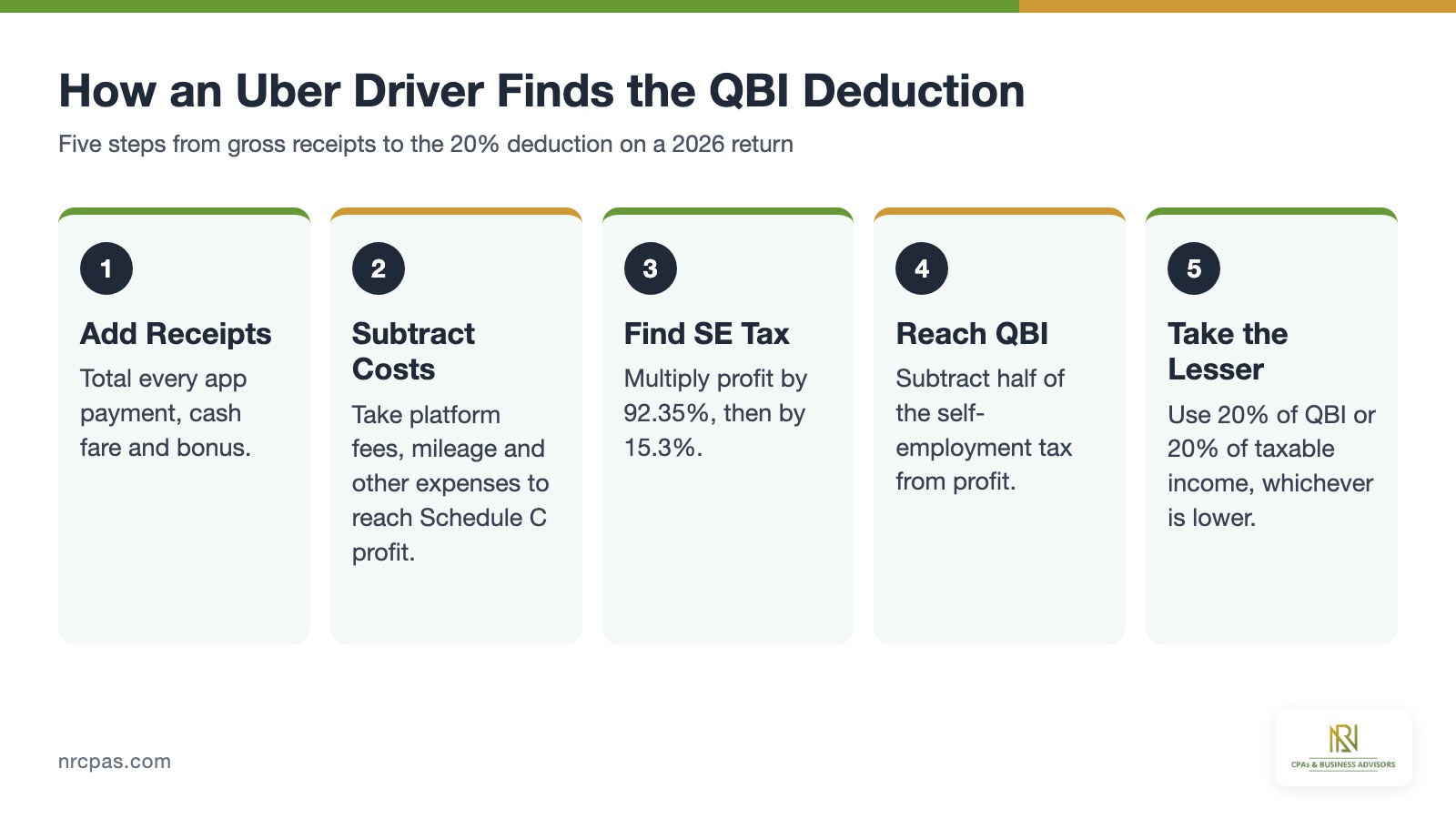
The steps below follow the order of the return for a single driver with no other income.
- Add gross receipts from every app, cash fare and bonus.
- Subtract platform fees, vehicle costs and other business expenses to reach Schedule C net profit.
- Multiply net profit by 92.35% and then by 15.3% to find self-employment tax.
- Subtract half of that tax, plus any health insurance and retirement deductions, to reach QBI.
- Take 20% of QBI and compare it with 20% of taxable income.
According to the IRS, self-employment tax is 15.3%, made of 12.4% Social Security and 2.9% Medicare. The graphic below draws the five steps from receipts to the deduction.
Expenses sit in step 2, so every deduction a driver misses inflates profit and tax. The deductions themselves come next.
What Deductions Can Uber Drivers Claim?
Uber drivers can claim any ordinary and necessary business expense, and vehicle costs are the largest. Mileage is a major deduction, and it covers more than passenger miles. The table below lists six common deductions and the rule for each.
| Deduction | How it works | Records needed | Method note |
|---|---|---|---|
| Business mileage | 72.5 cents per mile before July 1, 2026; 76 cents after | Mileage log | Replaces actual vehicle costs |
| Platform fees | Service and booking fees on the year-end summary | Tax summary | Deductible in either method |
| Tolls and parking | Full cost while online | Receipts | Added to standard mileage |
| Phone and data | Business-use percentage of the bill | Bills and usage notes | Personal share is excluded |
| Passenger supplies | Water, snacks, cleaning items | Receipts | Business use only |
| Actual vehicle costs | Fuel, insurance, repairs, depreciation, lease | All receipts | Business share only |
According to the IRS, the 2026 business mileage rate is 72.5 cents per mile, and 35 cents of it covers depreciation. The IRS raised the rate to 76 cents per mile for travel on or after July 1, 2026. A driver with 10,000 miles before July and 10,000 miles after deducts $7,250 plus $7,600, or $14,850.
Mileage covers three online stages: waiting for a request, driving to the pickup and carrying the passenger. Trips to the car wash and to buy supplies count as business miles too. Clean expense tracking turns those miles into a defensible deduction.
Can Uber Drivers Write Off a Car Payment?
Uber drivers cannot write off the principal on a car payment, but the vehicle still produces deductions. Standard mileage already includes 35 cents per mile for depreciation. Drivers who choose actual expenses can deduct the business share of loan interest, plus depreciation or lease payments.
The first-year choice matters. Owners who pick standard mileage in the first year keep the option to switch methods later. Drivers who start with accelerated depreciation cannot go back, so read car depreciation rules before the first return.
Deductions lower profit, and profit sets the size of the QBI deduction, as the next section shows.
How Much Is the QBI Deduction for an Uber Driver?
The QBI deduction for an Uber driver equals the lesser of two numbers: 20% of QBI or 20% of taxable income. The cap often decides the amount. A driver with $40,000 of net profit receives a $4,215 deduction. The table below runs four 2026 profit levels for a single filer with no other income.
| Net profit | Self-employment tax | QBI after half of the tax | QBI deduction |
|---|---|---|---|
| $20,000 | $2,826 | $18,587 | $497 |
| $40,000 | $5,652 | $37,174 | $4,215 |
| $60,000 | $8,478 | $55,761 | $7,932 |
| $100,000 | $14,130 | $92,935 | $15,367 |
Each row uses the 2026 standard deduction of $16,100 from IRS Revenue Procedure 2025-32. At $40,000, taxable income before the deduction is $21,074, and 20% of that figure is $4,215. Twenty percent of the $37,174 QBI would be $7,435, so the lower taxable income cap wins.
The deduction at $40,000 cuts taxable income to $16,859. A driver at the 12% rate saves about $506 of income tax. Quarterly payments then shrink, because estimated tax pays both income tax and self-employment tax.
The dollar amounts rise with profit until the income limit applies, which is the next question.
When Does the QBI Deduction Phase Out for Uber Drivers?
The QBI deduction phases out for Uber drivers above $201,750 of taxable income for single filers in 2026. Joint filers phase out above $403,500. Taxable income at or below the threshold keeps the full 20% deduction. The table below sets the 2025 and 2026 limits side by side.
| Filing status | 2025 threshold | 2026 threshold | 2026 phase-in ends |
|---|---|---|---|
| Single and other filers | $197,300 | $201,750 | $276,750 |
| Married filing jointly | $394,600 | $403,500 | $553,500 |
According to IRS Revenue Procedure 2025-32, the 2026 phase-in range is $75,000 for single filers and $150,000 for joint filers. The OBBBA widened those ranges from $50,000 and $100,000. The graphic below shows how the limits compare.

Above the threshold, wage and property limits apply. A solo driver pays no W-2 wages, so the deduction shrinks across the phase-in range. Drivers below those income levels keep the full 20% deduction.
The OBBBA also made Section 199A permanent, so the deduction no longer expires after 2025. A minimum deduction now sits under it, covered in the next section.
Does the $400 Minimum QBI Deduction Apply to Uber Drivers?
The $400 minimum QBI deduction applies to Uber drivers with at least $1,000 of QBI. The driver must also materially participate in the business. The minimum begins with tax years after 2025. According to the IRS, an active business is one where the owner meets any one of the material participation tests.
A driver who works alone does substantially all the work in the business. That fact satisfies one of the seven tests. The minimum helps a part-time driver whose 20% calculation falls under $400.
A driver with $20,000 of net profit still receives $497, so the floor adds nothing there. The floor matters for small profits, such as $1,500 of weekend earnings.
Tips follow a separate rule, and they affect the profit figure.
How Do Tips Affect the QBI Deduction for Uber Drivers?
Tips affect the QBI deduction for Uber drivers in one way. Tip income covered by Section 224 is not QBI for tax years 2025 through 2028. The no tax on tips deduction allows up to $25,000 of qualified cash tips. According to the IRS, the deduction phases out when modified adjusted gross income passes $150,000, or $300,000 for joint filers.
Taxi and rideshare drivers appear on the occupation list in the final regulations issued in April 2026. A self-employed driver cannot deduct more than the net income of the business that earned the tips. Both deductions then work together on one return.
- The tips deduction lowers taxable income directly.
- The QBI deduction uses the remaining profit as its base.
- Tip income covered by Section 224 leaves the QBI base.
Tips and QBI raise related side questions, and the final section answers them.
What Else Do Uber Drivers Ask About the QBI Deduction?
Uber drivers also ask about delivery work, missing deductions, estimated taxes, entity choices and the form to file. The sections below answer each topic in short form.
Do Delivery Drivers Qualify for QBI?
Delivery drivers qualify for QBI on the same terms as Uber drivers, because both report contractor profit on Schedule C. Food and package delivery is not a specified service trade. App-based delivery workers also appear in the revised tip occupation categories.
Why Am I Not Getting a QBI Deduction?
A driver gets no QBI deduction when net profit is zero, taxable income is zero or the income is wages. A $16,100 profit leaves no taxable income for a single filer in 2026, so the cap erases the deduction. A loss year creates no deduction, and the negative QBI carries forward.
Software errors also cause misses. Form 8995 must be attached, and the amount belongs on Form 1040, line 13a.
Which Form Reports the QBI Deduction?
Form 8995 reports the QBI deduction for taxable income at or below the threshold. According to the IRS, Form 8995-A covers taxable income above it. Both forms feed Form 1040, line 13a.
Does QBI Lower Self-Employment Tax?
No, QBI does not lower self-employment tax, because Schedule SE is calculated before the deduction. The 2026 Social Security wage base is $184,500 per the Social Security Administration (SSA). Self-employment tax is 15.3% of 92.35% of profit, so the bill can exceed the income tax. Single owners who want the full picture can read about LLC driver taxes for entity-level effects.
Should Uber Drivers Pay Estimated Taxes?
Uber drivers should pay estimated taxes when they expect to owe $1,000 or more at filing, according to the IRS. Safe harbor payments equal 90% of current-year tax or 100% of prior-year tax. The QBI deduction lowers the income tax part of each quarterly payment.
Underpaid quarters create penalties that grow each period. A balance that has already grown may need IRS debt help before it is paid down.
Can Uber Drivers Use Section 179 on a Vehicle?
Uber drivers can use Section 179 on a vehicle bought for business, subject to the business-use test and the SUV cap. Business use must exceed 50% of total miles. A driver who takes Section 179 cannot use the standard mileage rate on that vehicle.
Used cars qualify when the driver buys them for business. The rules for used car write-offs cover the details.
Should Uber Drivers Form an LLC or S Corporation?
Uber drivers should consider an LLC for liability, and an S corporation only at higher profit. An S corporation salary is not QBI, and payroll adds cost. The S corp pros and cons are covered there.
The entity choice is best made before the first profitable year. A late switch brings new filings and a short-year return. A new LLC also needs a clean bank account for driving income. Early business setup avoids those costs.
Where Can Uber Drivers Learn the Full QBI Rules?
The full QBI rules cover the 20% calculation, the thresholds and the minimum for every self-employed trade. Drivers can compare the Section 199A rules for any other income source.
Who Can Check an Uber Driver's QBI Numbers?
A CPA can check an Uber driver's QBI numbers by running Schedule C, Schedule SE and Form 8995 together. We prepare these figures for gig workers and sole proprietors before estimated payments are set.
The team at NR accountants is led by founder Nischay Rawal, CPA, EA, and the office line is (305) 872-3096. Drivers still asking do uber drivers qualify for qbi deduction and when does it apply can bring one Schedule C to us.
Every driver can start with a driver tax strategy review of profit, mileage and quarterly payments.