Learning Center for Tax and Financial Insights

Stay updated with clear, actionable articles on tax rules, deadlines, deductions, and financial decisions that impact individuals and businesses.

No items found.

The Profit Paradox: Why Successful Businesses Still Run Out of Cash

In the vibrant business environment of Coral Gables, revenue and gross margins are the metrics most owners track. Yet, behind the scenes, many entrepreneurs ask the same frustrating question: "If we are profitable, why does our cash still feel so tight?" It is a fair point and incredibly common. Profit and cash flow are related, but they are not the same thing. At NR CPAs & Business Advisors, we find that confusing the two is the fastest way a healthy business ends up under constant pressure.

Profit Looks Back; Cash Flow Lives in Real Time

Profit is a historical figure that tells you what already happened. Cash flow, however, tells you what is happening now—and whether your firm can keep operating comfortably. You can be profitable and still struggle if customers pay slowly, expenses hit before revenue arrives, or growth requires significant upfront investment. On paper, things look fine. In real life, daily financial decisions feel stressful. That timing gap is where most cash flow problems reside.

Image 2

Cash Flow is a Timing Problem, Not a Math Problem

At its core, cash flow reflects how money moves in and out of your business over time. This is why growing businesses often feel more strained than struggling ones. More sales mean more payroll to fund before collections arrive and more vendors to pay upfront. Growth amplifies these timing issues, and without visibility, it creates a pressure that feels confusing. This is usually the moment owners realize that doing better than ever can actually feel harder without professional oversight.

Why Liquidity Becomes Fragile as You Scale

The larger your business grows, the more sensitive your cash flow becomes. A delay that didn't matter at $500,000 in revenue can become painful at $2 million. This is where CFO-level thinking from Nischay Rawal and our team changes the outcome. Managing cash flow isn't just checking a bank balance; it is about understanding timing gaps, how growth impacts liquidity months in advance, and which activities consume cash without creating leverage.

Image 1

The Goal: Predictable Cash Flow

Healthy cash flow does not mean just stockpiling money. It means knowing exactly when cash will arrive and when it will leave. When cash becomes predictable, stress drops and growth becomes intentional rather than reactive. If your numbers look good but things still feel tight, it is a signal to act. Our fractional CFO and business consulting services turn confusion into clarity so you can actually use the money you make. Schedule a consultation with NR CPAs & Business Advisors to secure your financial future.

To achieve this predictability, business owners must look beyond the static balance sheet and dive into the mechanics of the Cash Conversion Cycle (CCC). This metric is vital for industries flourishing in Coral Gables and across South Florida, from real estate to professional services. The time elapsed between paying for labor and receiving payment from a client can create a significant gap. A Fractional CFO tracks metrics like Days Sales Outstanding (DSO) to identify where the friction lies. If your DSO is creeping upward, it means your capital is effectively being used to provide interest-free financing to your customers. By shortening these windows, we help businesses unlock trapped cash for growth.

Navigating the Phantom Profit Trap and Scaling Risks

The 'Phantom Profit' trap occurs when accrual accounting shows a healthy bottom line due to invoiced projects. However, if those funds have not cleared your bank account by the time payroll or tax deadlines arrive, you face a liquidity crisis. Strategic tax planning is the antidote to this stress. At NR CPAs & Business Advisors, we work to align your tax strategy with your real-time cash position, ensuring you are not blindsided by a substantial tax bill during a month when reserves are low.

Image 3

Scaling often requires significant upfront outlays. Without a clear forecast, these investments can lead to a growth squeeze where the business is technically more valuable but practically more vulnerable. Our team provides the depth of a large firm with the agility of a boutique practice, modeling expansion scenarios months in advance. This allows you to grow knowing how expansion affects liquidity. This proactive approach turns cash flow from a source of anxiety into a tool for long-term sustainability.

Explore More
No items found.

It’s Tax Time - Beware of Scams

Tax season is a busy time for taxpayers. It is also a busy time for criminals as they ramp up efforts to trick people into sharing sensitive personal information. Identity thieves use this information to try filing false tax returns and stealing refunds, plus scam you financially in other ways.

You may think you are harp on a lot about protecting yourself against identity theft and tax scams. It because having your identity stolen becomes an absolute financial nightmare, sometimes taking years to straighten out. Identity thieves are clever, relentless, and always coming up with new schemes to trick you. And all you have to do is slip up just once to compromise your identity and your nightmare begins.

Awareness - Identity thieves and scammers often imitate the IRS name, logo or web site to convince taxpayers that the scam is a genuine communication from the IRS. Scammers may use other federal agency names, such as the U.S. Department of the Treasury.

In an identity theft scam, a fraudster, often posing as a trusted government, financial or business institution or official, tries to trick a victim into revealing personal and financial information, such as credit card numbers and passwords, bank account numbers and passwords, Social Security numbers and more. Generally, identity thieves use someone’s personal data to steal his or her financial accounts, run up charges on the victim’s existing credit cards, or apply for new loans, credit cards, services, or benefits in the victim’s name and even file fraudulent tax returns.

Scams come in many forms and are usually initiated by a letter, fax, email or with a phone call or text. When scam artists use email to lure its victims, it is referred to as “phishing” scams.

Seniors Are Frequent Targets -Scammers frequently target people over age 65 or nearing retirement for personal or financial information or money. Often, once seniors give them money, they ask for more. When a person is scammed out of tax-deferred retirement funds, the lost funds may be considered a taxable distribution, subject to ordinary income tax and potential early withdrawal penalties if the account owner is under age 59½. While victims might claim a theft loss deduction if the scam was profit-motivated and recovery is unlikely, this process is complex.

Encourage your elderly family members to discuss any suspicious messages or offers with you or another trusted individual before taking any action, as this can help them avoid falling victim to scams. Regular conversations about new scam tactics can empower them to make informed decisions and protect their financial well-being.

How to Spot a Scam –Phishing emails and smishing texts, often share common characteristics that can help in identifying them. Typically, they create a sense of urgency, pressuring potential victims to act swiftly without much deliberation—whether it's claiming you're in trouble, that you've won an unexpected prize, or that there's a problem needing immediate attention. Be wary of unsolicited communications, especially those requesting personal information or payment over the phone or through unexpected emails and texts. Scammers may also pose as legitimate companies or government entities, using official-sounding language to gain trust. Additionally, if an offer seems too good to be true, it likely is. Verify suspicious communications by contacting the company or individual through official channels and consult with someone you trust before proceeding with unfamiliar requests. Here are some signs to watch for, such as an email that:

  • Requests detailed or an unusual amount of personal and/or financial information, such as name, SSN, bank or credit card account numbers or security-related information, such as your mother’s maiden name, either in the email itself or on another site to which a link in the email sends the recipient.
  • Dangles bait to entice the recipient to respond to the email, such as mentioning a tax refund or offering to pay the recipient to participate in an IRS survey.
  • Threatens a consequence for not responding to the email, such as additional taxes or blocking access to the recipient’s funds.
  • Gets the Internal Revenue Service or other federal agency names wrong.
  • Uses incorrect grammar or odd phrasing (many of the email scams originate overseas and are written by non-native English speakers).
  • Uses a long address in any link contained in the email message or one that does not start with the actual IRS web site address (www.irs.gov). To see the actual link address or URL, move the mouse over the link included in the text of the email.
  • When trying to spot a potential scam, taking a closer look at the sender's email address can provide valuable clues. Scammers often use email addresses that slightly deviate from real company domains, perhaps with misspellings or extra characters. Additionally, if the domain or extension appears unusual or originates outside the U.S., it should immediately raise red flags.

Common Phishing Emails: Scammers use emails to install malware or direct victims to fake websites that mimic official sites to steal credentials.

  • Phony Tax Refunds - Emails stating you qualify for a large refund and must click a link to access it.
  • False Legal/Criminal Charges - Messages threatening immediate legal action or arrest for alleged tax fraud, pressuring you to act without thinking.
  • Underreported Income Notices - Emails claiming to be a notice of underreported income and containing an attachment or link to a bogus "tax statement". Opening the attachment or clicking the link can download malware to your computer.
  • "Update Your Account" Requests - Emails with suspicious links, such as "IRSgov" (missing the dot), instructing you to update your IRS online account or IP PIN immediately.
  • Offers of Third-Party Help - Scammers posing as a "helpful" third party offering to create your IRS Online Account to steal your personal information.

Common Smishing Texts: These text messages often use alarming language or promise financial assistance to trick you into clicking malicious links.

  • Account on Hold/Unusual Activity - Texts claiming, "Your account has now been put on hold," or "Unusual Activity Report," with a link to "restore" your account.
  • Unexpected Refunds/Payments - Messages mentioning an unexpected tax refund or economic impact payment and providing a suspicious link.
  • Urgent Action Demands - Texts with an urgent tone, pressuring you to open a link or attachment to avoid penalties or take advantage of a credit.
  • Callback Numbers - Messages that include a phone number to call back, which connects you directly to a scammer.

How to Protect Yourself:

  • Do not click links or open attachments in unsolicited emails or texts claiming to be from the IRS or other tax-related entities.
  • The IRS will never demand immediate payment, demand a specific payment method (like gift cards or wire transfers), or threaten arrest or deportation.
  • Verify contact directly with the agency using official contact numbers listed on the IRS website or by logging into your secure IRS Online Account if you have previously established one.
  • Report suspicious messages by forwarding the email to phishing@irs.govand the text message details (sender number, content, date/time) to the same email address with "Text" in the subject line.
  • Obtain an identity protection PIN (IP PIN), which is a unique six-digit number assigned by the IRS to prevent identity thieves from filing fraudulent federal income tax returns using your Social Security number (SSN) or Individual Taxpayer Identification Number (ITIN).

It acts as an authentication tool. If a return is filed without the correct IP PIN, the IRS will reject it, preventing someone else from claiming a refund in your name. An IP PIN is valid for one calendar year. A new PIN is generated every year for security. It is used only for federal tax forms in the 1040 series.

Those who have been victims of tax-related identity theft and have had their issues resolved are automatically enrolled and receive a new IP PIN by mail annually. Any taxpayer with an SSN or ITIN who can verify their identity can voluntarily join the program to add a layer of security at the IRS Get an IP PIN tool.

Social media: Misinformation about taxes is rampant on social media, and misleading advice can have serious repercussions for taxpayers, particularly surrounding credit or refund eligibility. Influencers, who often lack formal tax training, might encourage individuals to falsify information on their tax forms, claiming it will maximize their refunds or credits. Worse, they may propagate unfounded claims that the IRS is concealing certain tax credits from the public. Such misinformation not only jeopardizes tax compliance but can also invite audits and penalties. Additionally, these misleading social media posts often serve as gateways for scammers, who exploit the guise of tax advice to gain trust and ultimately steal sensitive personal information. It's crucial for taxpayers to seek professional guidance for accurate tax information.

Conclusion: Be aware the IRS will never contact you via email, text messages, or social media to request personal or financial information; instead, they typically reach out by sending official notices through the U.S. Postal Service.

If you have questions or need assistance with any of the issues discussed in this article, please contact this office.

Explore More
No items found.

Strategic Pricing: Why Your Rates Are a Cash Flow Decision, Not a Sales Tactic

If we sat down with ten business owners in Coral Gables today and asked how they set their prices, nine of them would likely give us a variation of the same answer:

“I looked at what the competitors were charging and tried to stay in the middle.”

It sounds logical. You don’t want to be the most expensive option and scare away volume, but you don’t want to be the cheapest and leave money on the table. However, this approach ignores the single most important factor in the equation: Your business’s unique financial physiology.

Pricing is rarely a marketing problem. It is almost always a structural financial problem. It determines whether your business merely survives month-to-month or actually builds the capital reserves necessary to weather storms and fund expansion.

At NR CPAs & Business Advisors, when we step into a Fractional CFO role, pricing is often the first lever we examine—not because we want to charge your clients more, but because we need to ensure your business model is actually viable.

The Intersection of Margin and Cash Flow

Bad pricing often disguises itself as other operational failures. You might think you have a staffing shortage, a productivity issue, or a cash flow gap. But often, those are just symptoms of a pricing structure that is disconnected from reality.

If your rates are not calculated based on the true cost of service delivery—including the invisible costs of administration, technology, and future capital requirements—you are essentially subsidizing your clients out of your own pocket.

Business advisors discussing pricing strategy in a meeting

When prices are misaligned:

  • Margins compress: You work harder for every dollar of profit.
  • Cash flow becomes erratic: You rely on new sales to pay for past work.
  • Growth becomes a liability: Scaling up just creates a bigger cash hole because your unit economics are broken.

The Trap of "Competitive" Pricing

Anchoring your fees to a competitor is dangerous because you do not have access to their P&L statement. You don’t know if they are drowning in debt, underpaying their staff, or on the verge of bankruptcy. Matching the market average is often a fast track to average results—or worse, financial distress.

Your pricing must reflect your cost structure, your talent level, and the specific value your firm delivers. What works for a high-volume, low-touch competitor will absolutely cripple a boutique, high-touch service provider.

The CFO Perspective: Reverse-Engineering Your Rates

As advisors led by Nischay Rawal, we don’t look at pricing as a static number. We view it as a formula for sustainability.

When we conduct a financial analysis or engage in business consulting, we shift the question from “What will the client pay?” to “What does the business require?”

This involves understanding:

  • True Labor Burden: Not just salary, but taxes, benefits, and the non-billable time required to support that role.
  • Cash Timing: Does your pricing model account for the lag between when you pay expenses and when you collect revenue?
  • Opportunity Cost: By accepting low-margin work, are you blocking capacity for high-margin projects?
Data analysis showing financial growth metrics

Pricing Power Creates Options

The ultimate goal of strategic pricing is optionality. When your margins are healthy and your cash flow is predictable, you stop operating in survival mode. You gain the freedom to:

  • Invest in better technology to streamline operations.
  • Hire top-tier talent without hesitating over salary.
  • Selectively decline clients who are not the right fit for your culture.

This is the difference between a business that consumes your life and a business that supports it.

Moving From Rate Adjustments to Strategic Clarity

Changing your prices can be uncomfortable. It requires conviction in the value you provide and clarity on the numbers that drive your business.

If you find that your business is growing but your bank account isn’t reflecting that success, it is time to stop looking at expenses and start looking at your pricing model.

At NR CPAs & Business Advisors, we combine the depth of a large firm with the agility of a boutique partner. We help you look past the emotion of pricing and focus on the data.

If you are ready to evaluate whether your current structure is built for long-term sustainability, contact us today to schedule a consultation. Let’s ensure your business is priced for profit, not just for busyness.

Explore More
No items found.

Navigating Wash Sale Woes: Common Pitfalls, Tax Implications, and Strategic Avoidance

A wash sale occurs when an investor sells a security at a loss and then repurchases the same or a “substantially identical” security within a 30-day period before or after the sale. Congress enacted the wash sale rule in the mid-1950s to prevent investors from claiming a tax deduction for a security sold at a loss and then immediately repurchasing the same security. Understanding the intricacies of this rule is crucial for traders and tax advisors alike.

Understanding the Wash Sale Rule: The wash sale rule is detailed within Section 1091 of the Internal Revenue Code. Its primary purpose is to disallow the deduction of capital losses on sales of securities if the seller purchases the same, or substantially identical, securities within a 61-day window (30 days before and after the sale). This rule ensures that investors cannot claim tax benefits from a security while still indirectly maintaining ownership.

For instance, if an investor sells shares of ABC Corporation at a loss, and then buys the same number of shares of ABC within a 30-day timeframe, the IRS will classify this transaction as a wash sale, nullifying any capital loss deduction for tax purposes.

Tax Implications of Wash Sales

When a wash sale is triggered, the disallowed loss is not lost forever. Instead, it is added to the cost basis of the repurchased security. This adjustment serves two primary purposes: it defers the recognition of the loss until the security is finally sold, and it potentially reduces future taxable gains or increases deductible losses.

Consider an investor who buys shares of XYZ Corp at $100 each, sells them at $80 for a $20 per share loss, and then repurchases them at $75 within the wash sale period. The $20 loss is added to the new purchase, setting the adjusted cost basis at $95 per share. This adjustment plays a crucial role in future transactions, impacting realized gains or losses.

Common Pitfalls and Mistakes - Many investors inadvertently trigger wash sales, typically through:

  • Frequency of Trading: Frequent buying and selling, especially within short periods, dramatically increases the likelihood of triggering wash sales. For traders who frequently adjust their portfolios, constant attention is required to ensure compliance with the wash sale rule. The automated rebalancing strategies that many use might also overlap transactions that fall within the wash sale window, leading to disallowed losses.
  • Automatic Reinvestment Plans: Dividend Reinvestment Plans (DRIPs) automatically reinvest earnings, potentially purchasing shares within the wash sale period. Investors participating in DRIPs should be vigilant because these programs buy additional shares effortlessly. If an investor sells a security at a loss, but reinvests dividends within 30 days, it results in a wash sale, delaying the tax benefit of the loss.
  • Misinterpretation of "Substantially Identical" Securities: Investors might mistakenly believe they are avoiding wash sales by purchasing different securities that are deemed "substantially identical." The IRS defines "substantially identical" in a broad manner that can encompass different share classes, options, and derivatives related to the sold security. For instance, selling a company's stock at a loss and buying convertible bonds, which can then be exchanged for shares of the same stock, may trigger the wash sale rule.

The lack of clarity about what constitutes "substantially identical" securities adds another layer of complexity. Generally, options, convertibles, and even some ETFs tied to the same indices as the previously sold security could be considered "substantially identical" under certain conditions.

  • Last-Minute Tax Planning: Scrambling to harvest tax losses near year-end can lead to inadvertent wash sales. In the rush to optimize tax positions before the year ends, investors might hastily sell and repurchase stocks without considering the 30-day wash sale period. This mistake nullifies the loss as a current year's deduction.
  • Mutual Funds and ETFs Confusion: Failing to recognize that swapping mutual funds or exchange-traded funds (ETFs) with similar assets can trigger the wash sale rule. Even though mutual funds or ETFs track different indices, if they are too similar in composition, the IRS might consider them substantially identical, especially if their tracked indexes or sector focuses have significant overlap.
  • Lack of Record-Keeping: Without diligent tracking, it’s challenging to monitor trades and prevent wash sales proactively. After the fact, brokers will identify wash sales on the year-end 1099 tax reporting statement sent to the IRS and the investor, which will be helpful in preparing the taxpayer’s income tax return.
  • Cryptocurrency: Cryptocurrency is not currently subject to U.S. wash sale rules because the IRS classifies it as property, not a "security". This classification allows investors to use tax-loss harvesting strategies that are not available with traditional securities.
  • Tax-Loss Harvesting: Investors can sell cryptocurrency at a loss and immediately buy it back (even on the same day) to realize the tax loss for the current year, which can then offset other capital gains and up to $3,000 of ordinary income annually. Any remaining losses can be carried forward indefinitely.
  • Crypto ETFs: It is important to note that exchange-traded funds (ETFs) that hold cryptocurrency as an underlying asset are treated as securities and are subject to the wash sale rules. The exemption only applies to direct holdings of the digital assets themselves.

Multiple legislative proposals have been introduced in Congress to close this "loophole" and apply wash sale rules to digital assets. Tax policy experts widely expect that the rules will eventually change, though it is currently unclear when new legislation might pass or if it would be applied retroactively.

Strategies to Avoid Wash Sales: To mitigate the tax impact of wash sales, traders can employ several strategies:

  • Timing Awareness: Keeping mindful of the 61-day window for wash sales can help prevent disallowed losses.
  • Strategic Trade Planning: Mapping purchases and sales to mitigate overlap within the wash sale period, possibly through calendar reminders and transaction reviews, can be beneficial.
  • Alternative Securities: Investing in securities that are similar but not considered "substantially identical," such as different funds within the same sector or index, can help maintain market exposure while avoiding wash sales.

Contact this office with questions or a personalized strategizing appointment.

Explore More
No items found.

2026 Tax Update: The Vehicle Loan Interest Deduction Explained

New OBBBA Vehicle Deductions

Effective from 2025 through 2028, the One Big Beautiful Bill Act (OBBBA) allows taxpayers to deduct up to $10,000 annually in qualified passenger vehicle loan interest. At NR CPAs & Business Advisors, we want to ensure you do not miss this temporary planning window.

Vehicle loan interest deduction planning

Income Eligibility Limits

Be aware of the phase-outs: eligibility decreases when modified AGI exceeds $100,000 ($200,000 for joint filers). Watch the video below for full details on optimizing this deduction for your specific situation.

Explore More
No items found.

From Minor Errors to Major Penalties: Insights from the IRS Top 10 Cases of 2025

When the IRS Criminal Investigation (CI) Division releases its annual list of top tax crimes, it often reads like a Hollywood script. We see massive embezzlement, elaborate fraud schemes, and stunning prison sentences. But for the average business owner or taxpayer here in Coral Gables, these headlines serve a more practical purpose: they are a stark reminder of what happens when financial transparency fails.

The IRS recently published its Top 10 Tax Crime Cases of 2025. While most taxpayers will never come close to committing these levels of fraud, the underlying lesson is about the danger of letting small compliance slides turn into avalanches. (IRS Top 10 Cases of 2025)

What the IRS Prioritized in 2025

This year’s list highlights that the IRS is using sophisticated data analytics to catch discrepancies in pandemic relief, tax preparation, and general income reporting. Here are a few notable examples from the official report:

  • The “Feeding Our Future” Scheme: One of the most significant pandemic fraud cases in history resulted in a 28-year sentence for the ringleader. It demonstrates the federal government’s aggressive stance on recovering relief funds.
    (Feeding Our Future case)
  • Massive Preparer Fraud in the Bronx: A tax preparer filed over 90,000 false returns, generating an estimated $145 million in tax loss. This reinforces the importance of vetting who you trust with your financial data.
    (False return preparer case)
  • Corporate Embezzlement: A casino accounts payable manager embezzled millions and failed to report the stolen income, turning a theft crime into a federal tax crime.
    (Embezzlement and tax fraud case)
  • Public Corruption and COVID Relief: A former county official was caught in a bribery scheme involving relief funds, proving that no position is immune to scrutiny.
    (Public corruption case)
Abstract financial complexity background

The Slippery Slope: Escalation is the Real Risk

At NR CPAs & Business Advisors, we often remind clients that legitimate businesses don’t usually wake up one day and decide to commit tax fraud. Trouble often starts with disorganization.

It begins with a missed payroll deposit during a cash flow crunch. It continues with misclassifying an employee as a contractor to save on administrative costs. It compounds when a vague IRS notice arrives and gets buried under a stack of papers because you are too busy running the business to deal with it.

The IRS looks for patterns. When errors repeat and correspondence is ignored, the agency moves from assuming you made a "mistake" to suspecting "willfulness." That is the dangerous bridge between a civil penalty and a criminal investigation.

Separating Civil Issues from Criminal Intent

Many taxpayers believe there is a bright line separating audit issues from criminal cases. In reality, the line is defined by your reaction to the problem. The difference between a stressful month and a legal nightmare is often proactive communication.

A proactive Fractional CFO or tax advisor will stop you before:

  • Payroll liabilities roll over into a second quarter.
  • Personal expenses start bleeding into business accounts.
  • Income reporting fails to match bank deposits.

How to Protect Your Peace of Mind

The outcomes in the 2025 Top 10 list are severe, but they are preventable. Smart tax planning and compliance act as your insurance policy.

If you receive a notice, or if you realize you’ve made an error in a previous filing, the best move is to address it immediately. Using the agility of a boutique firm like ours allows you to correct course quickly before the IRS escalates their tactics.

Whether you need help untangling a payroll issue or simply want a second set of eyes on your books, NR CPAs is here to help you stay compliant and confident. Don’t wait for a notice to become a problem.

Explore More
No results found.
Thank you! Your submission has been received!
Oops! Something went wrong while submitting the form.

Want tax & accounting tips & insights?Sign up for our newsletter.

Thank you! Your submission has been received!
Oops! Something went wrong while submitting the form.

Why Work With Us?

We combine deep tax expertise, financial strategy, and practical business insight to help you manage complexity, stay compliant, and make confident financial decisions.
A dollar sign, representing financial advice or discussion at NR CPAs & Business Advisors.

Experienced CPA and Enrolled Agent Leadership

Guidance led by licensed professionals with deep expertise in tax strategy, compliance, and complex financial matters.
White bar chart with an upward arrow on green circular background representing growth or progress at NR CPAs &. Business Advisors

Support for Growing Businesses and Startups

We understand the financial challenges of growth stage businesses and provide structured guidance to support expansion.
A white hand holding a dollar symbol and ascending bar chart on a green circular background representing financial growth or investment at NR CPAs & Business Advisors..

Strategic Financial Advisory

Our team helps you evaluate financial decisions with greater clarity, supported by practical insights and long term planning.

Fractional CFO Support

Access experienced financial leadership without the commitment and cost of hiring a full time Chief Financial Officer.

Proactive Tax Planning Approach

We focus on identifying tax opportunities throughout the year rather than reacting only during filing season.

Clear and Reliable Financial Reporting

Accurate financial statements and reporting that help you better understand performance and make informed decisions.
White IRS building icon with pillars and a dollar sign above on a green circular background.

Professional IRS Representation

Experienced support in resolving IRS notices, disputes, and compliance matters while protecting your financial interests.

Personalized Client Focus

Every client receives thoughtful attention and tailored financial solutions based on their specific needs and business goals.
Financial matters often involve important decisions. Working with experienced advisors can help you approach them with greater clarity and confidence in your choices.

Need Help With Your Tax or Financial Decisions?

Discuss your situation with our advisors to get clear guidance on tax planning, IRS matters, and the financial decisions ahead.
Business consulting at NR CPAs & Business Advisors.

Request Your Consultation

Fill out the form to discuss your tax concerns, financial questions, or advisory needs with our team. We will review your details and respond shortly.

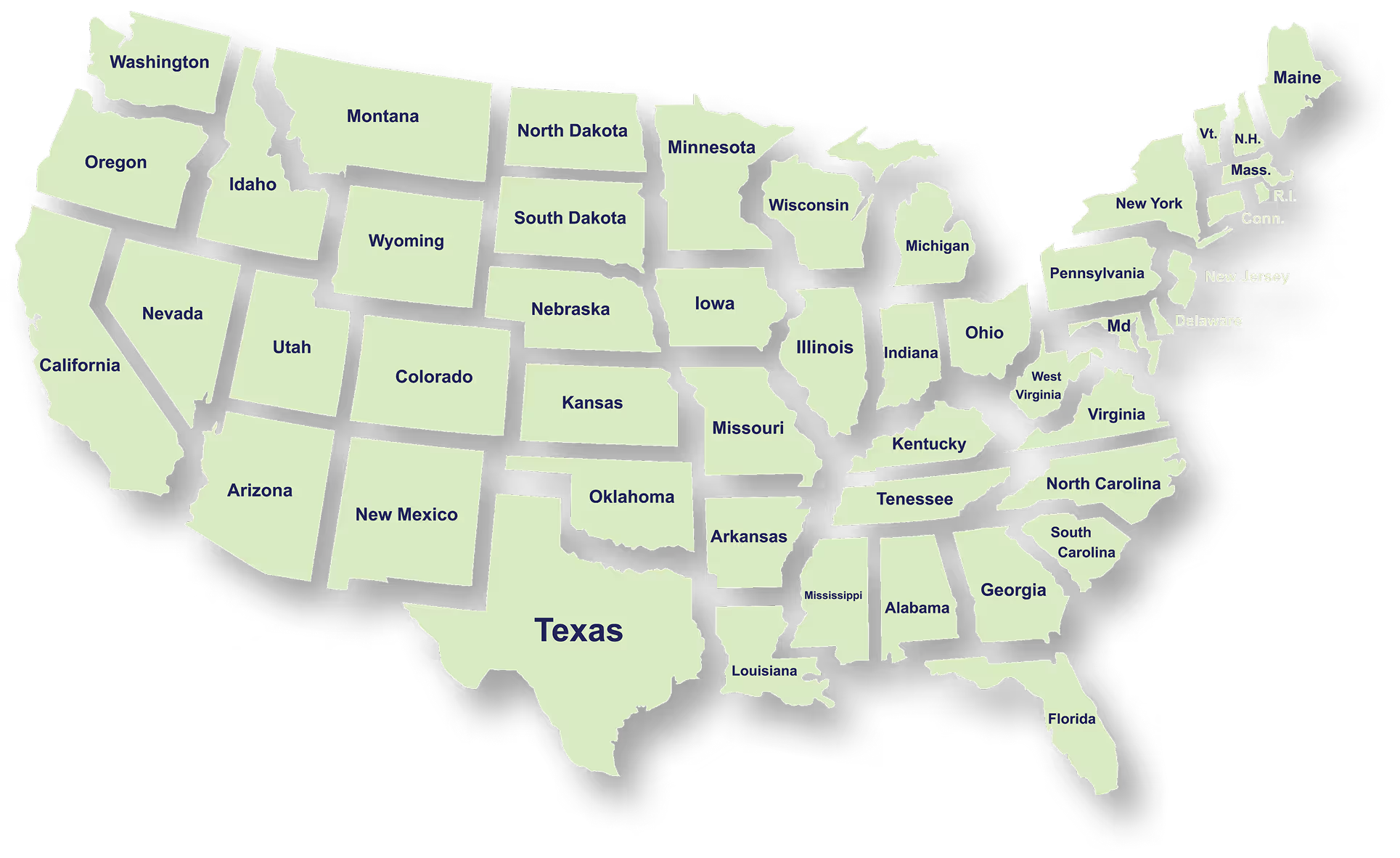
Serving Businesses & Individuals Across USA

We handle accounting, tax filing, and planning with defined timelines and accurate reporting for businesses and individuals across all states.

Frequently Asked Questions

What services does NR CPAs & Business Advisors provide?
What is tax planning and why is it important for businesses?
How can a Virtual CFO help my business?
When should a business consider IRS tax resolution services?
What financial statements does a business typically need?
How can startup advisory services help new businesses?
What is strategic business planning?
What is a Virtual Family Office and who can benefit from it?