Learning Center for Tax and Financial Insights

Stay updated with clear, actionable articles on tax rules, deadlines, deductions, and financial decisions that impact individuals and businesses.

No items found.

New Auto Loan Interest Deduction: A 2025 Guide for Taxpayers

At NR CPAs & Business Advisors in Coral Gables, we rarely see new tax deductions introduced for personal expenses. However, proposed regulations under the One Big Beautiful Bill Act are looking to change that for vehicle owners. The IRS has outlined rules for a temporary deduction on interest paid for qualified passenger vehicles, effective for loans originated after December 31, 2024.

This relief is slated for tax years 2025 through 2028 and is specifically designed to support domestic manufacturing. Here is what our clients need to know about this potential opportunity.

Understanding the Financial Benefits

This is a "below-the-line" deduction, meaning it reduces your taxable income directly. Crucially, you do not need to itemize to claim it; it is available even if you take the standard deduction. It will be filed on a new schedule (Schedule 1-A) with your Form 1040.

  • Annual Cap: You can deduct up to $10,000 per tax return. Married taxpayers filing separately are also capped at $10,000 each.
  • Income Limits: The benefit phases out for taxpayers with a modified AGI exceeding $150,000 (or $250,000 for married filing jointly).

Does Your Vehicle Qualify?

To be eligible, the vehicle must be a new passenger vehicle (car, SUV, minivan, pickup, or motorcycle) with a gross vehicle weight rating under 14,000 pounds. Most importantly, final assembly must occur in the United States.

You can verify the assembly location of a potential purchase using the VIN here: Welcome to VIN Decoding : provided by vPIC

Advisor discussing auto loan deduction eligibility

Personal Use and Mixed-Use Rules

To qualify, you must anticipate using the vehicle for personal purposes more than 50% of the time when you buy it. If you use the car for both business and personal reasons—common for our self-employed clients and business owners—you must be careful.

You can still claim a business expense deduction for the business portion of the interest. This will proportionally reduce the amount you can claim on Schedule 1-A. However, future adjustments are not required even if your personal use drops below 50% in later years.

Financing and Loan Restrictions

Not all financing methods qualify. The loan must be secured by the vehicle and originate from an independent lender, such as a bank or credit union.

  • No Family Loans: Interest paid on loans from family members is not deductible.
  • No Leases: Interest paid on lease financing does not qualify.
  • Eligible Expenses: You can deduct interest on the financed price, plus interest linked to service plans, sales tax, and fees.

Lenders will eventually file a new Form 1098-VLI if interest exceeds $600, though for 2025, a simple statement of interest paid will suffice.

Navigating these new regulations requires precision. Whether you are a business owner in Florida or an individual taxpayer, reach out to Nischay Rawal and the team at NR CPAs to ensure you are maximizing this temporary benefit.

Explore More
No items found.

The 15% Danger Zone: Why Your Best Client Might Be Your Biggest Valuation Risk

There is a specific feeling of relief when you land a "whale." You close a massive account, revenue spikes, and suddenly, cash flow concerns seem to evaporate. For many business owners here in Coral Gables and across Florida, this feels like the ultimate win.

But if you look at that same scenario through the lens of a Fractional CFO or a potential buyer, the picture changes dramatically.

When a single customer accounts for more than 15% to 30% of your total revenue, you haven't just built success; you have built concentration risk. While you see stability, an acquirer sees a fragile house of cards. This risk factor is one of the primary reasons deals fall apart or valuations get slashed during due diligence.

The Valuation Paradox

It seems counterintuitive. How can having a loyal, high-paying client be a negative? The issue isn't the revenue itself; it is the predictability of that revenue under new ownership.

Institutional buyers and smart investors do not buy past performance; they buy future cash flow. If a significant chunk of that cash flow is tied to one relationship, they have to ask uncomfortable questions:

  • What happens if this client follows the founder out the door?
  • Does this client have enough leverage to squeeze margins whenever they want?
  • Is the business actually scalable, or is it just a service arm for one giant account?

Research in M&A consistently shows that diversification drives multiples. A business with $2 million in revenue spread across 100 clients is generally worth significantly more than a business with $2 million in revenue where $1 million comes from a single source.

City skyline representing business growth

The Unofficial "Haircut" Thresholds

While every deal is unique, we often see acquirers apply mental (and financial) brakes once you cross certain thresholds. This is the "unwritten rule" of deal structure:

  • 15% Concentration: The buyer's antenna goes up. Due diligence will be deeper regarding that specific relationship.
  • 30% Concentration: This is the red zone. Buyers will likely lower the valuation multiple or restructure the deal to protect themselves.

This doesn't make your business unsellable. However, it changes how you get paid. Instead of cash at closing, a buyer might insist on a heavy earnout structure. Essentially, they are saying, "We will pay you for this revenue only if the client stays for the next three years." You end up carrying the risk even after you have sold.

Contracts Are Not a Silver Bullet

A common rebuttal we hear from clients is, "But we have a three-year contract!"

Contracts help, but they rarely eliminate the valuation hit entirely. In the world of Audit and assurance services, we know that the strength of a contract lies in its transferability and enforceability.

The Contract Reality Check

A long-term contract mitigates risk if:

  • It limits early termination without cause.
  • It is priced at fair market rates (not legacy "friend" pricing).
  • It assigns easily to a new owner without requiring client consent.

However, contracts do not solve dependency. If your operation is built entirely around the whims of one client—using their software, following their unique protocols, and ignoring broader market needs—you are still at risk. A buyer will look at that and wonder how expensive it will be to retool the business if that contract ends.

The "Comfort Trap"

The most dangerous aspect of a massive client isn't just the financial risk; it is the behavioral change it triggers in the business owner. Big accounts create a sense of safety. When the large deposits hit the bank, the urgency to prospect for new business fades. Marketing budgets get trimmed. Sales efforts lose their edge.

This is the trap. By the time you are ready to exit, you may find that your growth engine has rusted over because you haven't needed to use it in years.

Truck driver representing ongoing operations

How to De-Risk Before the Sale

At NR CPAs & Business Advisors, we believe the best time to fix concentration risk is years before you intend to sell. This isn't just about operations; it is about strategic tax planning and wealth preservation. Maximizing your sale price has a far greater impact on your net proceeds than almost any last-minute tax strategy.

If you have a whale client, use the revenue they provide to fund your independence. Your strategy should include:

  • Aggressive Lead Gen: Reinvest profits into marketing channels that attract different types of clients.
  • Process Standardization: Ensure your team isn't bending over backward to serve the whale in a way that doesn't scale to others.
  • Transitioning Relationships: If the client is loyal to you personally, start handing that relationship off to key employees. Make the account sticky to the firm, not the founder.

The Key Question for Every Owner

Ask yourself a difficult question: If your largest client gave notice tomorrow, would your business survive? More importantly, would it still be an attractive asset to buy?

If the answer makes you hesitate, you have work to do. But that is a good thing—identifying the risk now gives you the runway to fix it.

Client concentration doesn't mean you have failed; it means you have grown. The next step is maturing that growth into something durable. If you need a partner to look at your financials with a buyer's eye, or to discuss how this impacts your long-term planning, contact NR CPAs & Business Advisors. Let’s ensure your business value is as solid as your hard work.

Explore More
No items found.

Strategic Guide to 2025 Tax Law Changes: Essential Updates for Taxpayers

As we navigate the complexities of 2025 tax return preparation, taxpayers in Coral Gables and across the country must account for significant regulatory shifts. These changes, primarily introduced by the One Big Beautiful Bill (OBBBA) legislation alongside various delayed effective dates from previous acts, will influence nearly every category of tax filer. At NR CPAs & Business Advisors, we believe that staying ahead of these developments is the key to minimizing liabilities and maintaining compliance. This guide provides a comprehensive breakdown of the essential modifications affecting individual and business returns for the 2025 tax year.

Understanding Modified Adjusted Gross Income (MAGI)

Throughout this guide, you will frequently see references to Modified Adjusted Gross Income (MAGI). This figure is the cornerstone for determining your eligibility for various credits, deductions, and tax benefits. To calculate your MAGI, we start with your Adjusted Gross Income (AGI)—which is your total gross income minus specific allowable exclusions—and then add back certain types of excluded income. Because many phase-outs for the 2025 tax year are tied to MAGI, understanding where you stand is vital for effective tax planning.

Enhanced Deductions for Seniors

Beginning in 2025 and scheduled to remain in effect through 2028, taxpayers aged 65 or older are eligible for a new deduction opportunity. This $6,000 deduction is designed to be accessible to a wide range of individuals, as it can be claimed by those who itemize as well as those who take the standard deduction. However, this benefit is subject to income limitations. The deduction begins to phase out once a senior’s MAGI reaches $75,000 for single filers or $150,000 for married couples filing jointly.

Tax Relief for Tip Income and Overtime Earnings

For individuals in the service industry, a new provision allows employees in customary tip-receiving roles to deduct up to $25,000 of their tip income from their taxable earnings. This relief is currently set to apply from 2025 through 2028.

Furthermore, the 2025 tax year introduces a deduction for overtime (OT) pay. Employees can deduct the portion of their wages that exceeds their regular pay rate, specifically for hours worked beyond 40 per week. This is generally limited to the premium portion of the OT on up to time-and-a-half pay. These deductions are capped at $12,500 for individuals and $25,000 for joint filers. Like the senior deduction, these benefits phase out for high-income earners, specifically those with a MAGI over $150,000 (single) or $300,000 (joint).

Important Compliance Warning Regarding Overtime

Because the legislation creating the OT deduction was enacted mid-year in 2025 and applied retroactively, many employers may not have maintained the granular payroll data required to calculate the exact deductible amount. Consequently, the burden of proof falls on the taxpayer and their tax preparer. We recommend that our clients in Coral Gables gather all pay stubs and relevant documentation to verify OT hours and premium rates.

Detailed financial chart

It is important to remember that only hours exceeding 40 per week qualify, and the deduction is limited to 50% of the regular pay rate. If your OT premium exceeds this percentage, adjustments will be necessary. We encourage you to reach out to Nischay Rawal and our team to discuss the documentation needed for your specific situation.

New Incentives for Vehicle Owners

A notable shift for the 2025 tax year involves interest deductions for vehicle loans. Taxpayers who acquire new, personal-use vehicles assembled in the U.S. after 2024 may be able to deduct up to $10,000 in interest annually. This applies to vehicles weighing less than 14,000 pounds and is available to both itemizers and non-itemizers. To claim this, the Vehicle Identification Number (VIN) must be included on the return. The deduction begins to phase out at a MAGI of $100,000 for singles and $200,000 for joint filers.

Updated Family and Education Credits

Supporting family growth remains a priority in the tax code. The Adoption Credit has increased to $17,280, with $5,000 of that amount being refundable. The phase-out for this credit begins at a MAGI of $259,190. Additionally, the Child Tax Credit has been expanded to $2,200 per child, with a refundable portion of $1,700. Phase-outs for the Child Tax Credit begin at $200,000 for individuals and $400,000 for joint filers.

The Shifting SALT Deduction Landscape

For the years 2025 through 2029, the limit for deducting state and local taxes (SALT) when itemizing has been set at $40,000. This limit begins to phase down once MAGI reaches $500,000, eventually hitting a $10,000 floor at $600,000. While these limits and phase-outs will adjust annually through 2029, the limit is currently scheduled to revert to $10,000 in 2030.

Expiration of Environmental Incentives

Taxpayers should be aware that several green energy incentives are sunsetting. Residential clean energy credits, including those for solar and home efficiency improvements, will no longer be available after December 31, 2025. Furthermore, electric vehicle credits expired for any purchases made after September 30, 2025.

Business strategy vision

Retirement and Education Funding Flexibility

For those focused on long-term savings, the 2025 tax year offers enhanced flexibility. Individuals aged 60 through 63 can now make "Super Catch-Up" contributions to qualified plans like 401(k)s and SIMPLE plans. For 2025, this enhanced catch-up limit is $11,250 ($5,250 for SIMPLE plans), significantly higher than the standard $7,500 catch-up for those aged 50-59.

Regarding 529 Plans, distributions made after July 4, 2025, can now cover expenses for elementary and secondary schooling, as well as various credentialing programs, providing more utility for education-focused savings.

The Trump Account Election

A new option, known as the Trump Account, acts as an IRA-equivalent for children from birth through age 17. The government will seed accounts for children born between 2025 and 2028 with a $1,000 contribution. While the accounts will not begin accepting contributions until July 4, 2026, taxpayers can make the election to establish these accounts on their 2025 tax return. As with any new financial vehicle, there are potential downsides to consider before opting in.

Key Business Tax Updates for 2025

Business owners in Florida must adapt to several permanent and temporary changes in the tax code:

  • Bonus Depreciation: 100% bonus depreciation has been made permanent for assets placed in service after January 19, 2025. For the brief window between January 1 and January 19, the rate was 40%.
  • Interest Deduction Limits: The business interest deduction limit is now determined using EBITDA instead of EBITA. However, small businesses with average gross receipts under $31 million over the last three years remain exempt from this limitation in 2025.
  • Section 179 Expensing: The limit for Section 179 expensing has risen to $2.5 million, with a dollar-for-dollar phase-out beginning once equipment purchases exceed $4 million.
  • R&D Expenditures: Domestic research and experimental costs are now immediately deductible. Foreign research costs must still be amortized over 15 years.

Qualified Small Business Stock (QSBS) and Reporting

For those investing in domestic C corporations, the QSBS rules have evolved. For shares acquired after July 4, 2025, the capital gains exclusion rates are tied to the holding period: 50% after three years, 75% after four years, and 100% after five years. The exclusion cap is set at $15 million, and the corporation's asset limit has been raised to $75 million.

In terms of reporting, the IRS has returned the 1099-K threshold to its previous level: $20,000 in gross payments and 200 transactions. This move is intended to reduce the administrative burden on small businesses and casual sellers.

Required Minimum Distributions (RMDs) for Beneficiaries

Ongoing confusion surrounding the 10-year rule for inherited IRAs has led the IRS to waive penalties for years prior to 2025. However, beneficiaries are expected to take their RMDs in 2025. If an RMD was missed in 2025, taxpayers must take both the 2025 and 2026 distributions in 2026 and request a penalty waiver for the prior year.

Conclusion: Proactive Planning with NR CPAs & Business Advisors

Navigating these extensive changes requires more than just awareness; it requires a proactive strategy. By organizing your documentation now—especially regarding overtime and vehicle interest—you can ensure a seamless filing process. Whether you are managing a family office or running a growing business in Coral Gables, Nischay Rawal and the team at NR CPAs & Business Advisors are here to act as your partner in tax efficiency. Contact our office today to schedule a consultation and ensure your 2025 tax strategy is fully optimized.

To provide additional clarity for our Coral Gables clients, it is worth examining the specific interplay between the new vehicle loan interest deduction and the Section 179 expensing rules. For business owners who utilize a vehicle for both personal and professional use, the 2025 tax year offers a unique dual-benefit possibility. If the vehicle is primarily for personal use, the $10,000 interest deduction applies. However, if that same vehicle is used more than 50% for business, you may be eligible to combine interest deductions with Section 179 expensing or bonus depreciation on the business-use percentage of the vehicle's cost. This requires precise mileage logs and an accurate breakdown of the interest paid versus the principal. Nischay Rawal and our advisory team can help you determine the most advantageous way to bifurcate these costs to maximize your total tax savings.

Moreover, the enhancements to the Adoption Credit and Child Tax Credit for 2025 reflect a broader legislative push toward supporting growing families. The increased refundability of these credits—specifically the $1,700 refundable portion of the Child Tax Credit—is designed to provide immediate liquidity to families who may not have a high enough tax liability to benefit from non-refundable credits. For residents in high-cost areas like South Florida, these adjustments can provide meaningful relief. We suggest that families expecting a new addition or planning for educational expenses review their Modified Adjusted Gross Income (MAGI) early in the fourth quarter to ensure they stay within the phase-out thresholds, particularly the $200,000 limit for individual filers.

In the realm of retirement planning, the introduction of the "Super Catch-Up" contributions for those aged 60 through 63 offers a final opportunity to bolster retirement savings before entering the RMD phase. For a high-earning professional in Coral Gables, the ability to contribute an additional $11,250 to a 401(k) can result in significant immediate tax deferral. This is particularly effective when paired with the expanded 529 Plan flexibility. By using 529 funds for credentialing and secondary schooling post-July 2025, families can leverage tax-advantaged growth for a much wider array of educational pursuits than was previously possible. These integrated strategies ensure that your wealth is working efficiently across multiple generations and financial goals.

Lastly, for the small business community, the shift to EBITDA for calculating interest deduction limits represents a significant technical change. This change generally allows for larger interest deductions for businesses with significant depreciation and amortization, providing a more favorable environment for capital-intensive industries. While the $31 million gross receipts exemption protects most boutique firms and local practices, growing businesses approaching that threshold must monitor their three-year average closely. Managing this transition requires robust bookkeeping and fractional CFO oversight to ensure that your financing costs remain fully deductible under the new OBBBA framework.

Explore More
No items found.

The QuickBooks Trap: Why Your Software Needs a Professional Pilot

QuickBooks has become the default operating system for millions of small businesses across the U.S. It is accessible, widely supported, and gives business owners a sense of control. In our Coral Gables office, we frequently meet clients who treat their QuickBooks dashboard as the ultimate financial authority.

However, there is a distinct difference between data entry and financial intelligence. As we often remind our clients at NR CPAs & Business Advisors: QuickBooks is only as smart as the data you feed it.

Understanding the distinction between what the software automates and where it requires professional oversight is the key to accurate tax planning and avoiding audit risks.

Where QuickBooks Shines

When configured correctly by a knowledgeable professional, QuickBooks is an excellent tool for maintaining a digital paper trail.

Small business open sign representing daily operations

1. The Daily Grind

The software excels at aggregating raw data. It captures the pulse of your daily operations, including:

  • Revenue from sales and invoices
  • Operational expenses via bank feeds
  • Payroll processing and related liabilities
  • Sales tax collections

For a busy owner, this visibility is helpful for checking balances or seeing who owes you money.

2. Standardized Reporting

At the click of a button, you can generate the "Big Three" reports: the Profit & Loss (P&L), Balance Sheet, and Cash Flow Statement. These are necessary for basic compliance and are often the first thing a lender will ask for when you apply for a line of credit.

3. Automation and Efficiency

The true strength of the platform is automation. By linking bank accounts and credit cards, you reduce the manual fatigue of typing in every coffee purchase or vendor payment. This efficiency is critical, but it can also lull you into a false sense of security.

The "Blind Spots" in Your Books

QuickBooks is a database, not a licensed CPA or a Fractional CFO. It lacks judgment, context, and knowledge of the ever-changing tax code.

This is why having Nischay Rawal and our team review your setup is not just a luxury—it is a safeguard.

1. It Accepts Errors Without Question

The software does not know your intent. It will happily allow you to:

  • Classify a personal vacation as a business travel expense
  • Record a client deposit as immediate income rather than a liability
  • Duplicate expenses if a bank feed syncs incorrectly

If the inputs are flawed, your financial reports will be fundamentally inaccurate, regardless of how professional they look on paper.

2. Categorization is Not Tax Strategy

Just because an expense fits into a category in QuickBooks does not make it deductible on your tax return. The IRS has nuanced rules regarding meals, vehicle use, and home offices that software simply cannot interpret.

For example, placing an asset into an "Equipment" expense category doesn't tell you whether you should take bonus depreciation immediately or capitalize it over time. That requires the insight of a tax planning expert.

Chess pieces representing financial strategy

3. It Records History, It Doesn't Plan the Future

QuickBooks tells you what happened last month. It does not tell you if your margins are eroding, if you are overpaying on estimated taxes, or if your entity structure is no longer optimized for your revenue level. That level of analysis requires a Fractional CFO to translate data into decisions.

Common Pitfalls We See

In our audit and assurance services, we frequently encounter clean-looking books that hide significant issues. Common mistakes include:

  • treating loans as revenue, artificially inflating income.
  • misclassifying owner transfers as expenses or income.
  • ignoring the balance sheet, where years of errors often accumulate.
  • leaving the "uncategorized" account full of transactions effectively hiding from the P&L.

Using the Tool Correctly

We believe in agility and responsiveness. For your business to be agile, your data must be reliable. The smartest way to use QuickBooks is as a foundation, not the architect.

We recommend that businesses:

  • Reconcile all bank and credit card accounts monthly—no exceptions.
  • Separate bookkeeping duties from high-level tax strategy.
  • Review financial statements with a professional quarterly, not just at tax time.

The Human Element

Even with the best software, the human element remains irreplaceable. Whether you are a solopreneur or a growing enterprise in Florida, your books tell a story. You need a partner who knows how to read it.

At NR CPAs & Business Advisors, we provide the depth of a large firm with the personal attention of a boutique practice. We can help you move from simply recording history to making history.

Is your QuickBooks file telling you the whole truth? Contact us today to schedule a review of your financial systems.

Explore More
No items found.

March 2026 Individual Tax Calendar: Key Dates & Action Items

With the April deadline looming on the horizon, March is a critical month for staying compliant and avoiding last-minute stress. At NR CPAs & Business Advisors in Coral Gables, we want to ensure our individual clients are prepared for the final stretch of tax season.

March 10: Tip Reporting Deadline

For our clients in the hospitality and service industries across Florida, this date is vital. If you received more than $20 in tips during February, you must report them to your employer by March 10 using IRS Form 4070.

You may use the official form or a personal statement that includes your signature, personal details, employer information, the period covered, and the total tips received. Your employer relies on this to withhold the correct FICA and income taxes. If your regular wages cannot cover these withholdings, the uncollected amount will appear in box 8 of your W-2, and you will be responsible for paying it when you file your annual return.

March 16: Schedule Your Tax Appointment

Clients discussing tax planning with advisor

We are roughly one month away from the individual filing due date. If you haven’t scheduled time with Nischay Rawal and our team yet, we strongly recommend calling now to secure your spot before the calendar fills up.

Please do not wait until your records are perfect. If you are missing documents, come in anyway. We can review what you have, create a checklist for the missing items, and keep the process moving. Even if an extension is necessary, preparing a preliminary return now allows us to estimate your liability, helping you minimize potential interest and penalties.

Standard Filing Rules

Weekends & Holidays: Per IRS regulations, if a due date falls on a weekend or legal holiday, it automatically moves to the next business day.

Disaster Area Relief: Living in Florida, we understand the impact of severe weather. When an area is designated as a federal disaster area, deadlines may be extended. Verify current declarations here:

Explore More
No items found.

Did the IRS Overcharge You? What the Kwong Ruling Means for Tax Penalty Refunds

For many business owners and individuals in Coral Gables and beyond, the pandemic years were a blur of operational pivots, remote work adjustments, and financial triage. In the chaos, tax deadlines sometimes slipped, resulting in penalties and interest. If you paid the IRS for failure-to-file or failure-to-pay charges during that time, you need to pay close attention to a recent development in the U.S. Court of Federal Claims.

A landmark decision in Kwong vs. United States has challenged how the IRS handled deadline extensions during the COVID-19 disaster declaration. This ruling implies that the IRS may have improperly assessed penalties for years, opening a window for taxpayers to potentially reclaim those funds. At NR CPAs & Business Advisors, we are closely monitoring this situation to help our clients recover overpayments where possible.

The Kwong Decision: A Breakdown

The core of the dispute involves Internal Revenue Code Section 7508A(d). In Kwong vs. U.S., the court determined that the 2019 version of this code mandates an automatic extension of tax deadlines during federally declared disasters. While the IRS argued that extensions were discretionary and limited to one year, the court disagreed.

The ruling effectively established that tax deadlines were automatically extended from the start of the pandemic declaration on January 20, 2020, through July 10, 2023.

Stressed taxpayer looking at documents

This is a significant shift. It suggests that penalties and interest accrued on late filings or payments during this three-year window may have been invalid because, legally, the deadline had not yet passed.

What This Means for Your Tax History

If this ruling holds, the legal deadline for paying taxes during that period was pushed all the way to July 10, 2023. Consequently, any "failure-to-file" or "failure-to-pay" penalties assessed against you or your business between 2020 and mid-2023 could be erroneous.

While we handle the complexities of audit and assurance services regularly, this specific issue requires a proactive review of your past transcripts. You may be entitled to a refund, but the IRS will not send it automatically.

Steps to Preserve Your Right to a Refund

Because the government is likely to appeal the Kwong decision, the situation is fluid. However, waiting for the appeal to conclude could cost you the opportunity to claim a refund due to the statute of limitations. Here is the strategy we recommend for our clients:

  1. Analyze Your Tax Transcripts: We need to identify any penalties or interest charged for deadlines falling between January 20, 2020, and July 10, 2023. You can access these records via the Get Transcript tool on IRS.gov. While you can request them by mail (Form 4506-T) or phone (800-908-9946), the online tool is immediate. If navigating IRS portals feels burdensome, our team can assist in pulling and analyzing these records.
  2. File a Protective Refund Claim: This is the most critical step. By filing a "Claim for Refund and Request for Abatement" (Form 843), you place a placeholder in the system. Even if the IRS appeals, your claim is on record before the statute of limitations expires. It essentially "stops the clock" while the courts finalize the legal battle.
  3. Request Penalty Abatement: If you have outstanding penalties from this period that you have not paid yet, the Kwong ruling can be cited as a justification for removing them.
  4. Utilize First-Time Abatement (FTA): As a backup strategy, remember that starting in 2026, the IRS intends to automate First-Time Abatement for eligible taxpayers with a clean three-year history. However, relying on this alone is less aggressive than filing a protective claim now.
Geometric abstract suggesting structure and planning

Important Deadlines

Time is a factor here. Under the ruling, claims related to this decision must be filed within three years of the recognized deadline. This sets a hard cutoff date of July 10, 2026. While that seems distant, the appeals process can drag on, and gathering documentation for tax years 2020–2022 takes time.

How NR CPAs Can Help

Navigating the IRS appeals process and filing protective claims requires precision. As a firm that combines the depth of a large organization with the agility of a boutique partner, we are uniquely positioned to handle this for you. Led by Nischay Rawal, our team understands both the granular details of tax law and the broader implications for your cash flow.

Don't leave money on the table due to a technicality. If you suspect you paid penalties during the pandemic era, contact our Coral Gables office today. We will review your history, file the necessary protective claims, and ensure your rights are preserved while the legal dust settles.

Explore More
No results found.
Thank you! Your submission has been received!
Oops! Something went wrong while submitting the form.

Want tax & accounting tips & insights?Sign up for our newsletter.

Thank you! Your submission has been received!
Oops! Something went wrong while submitting the form.

Why Work With Us?

We combine deep tax expertise, financial strategy, and practical business insight to help you manage complexity, stay compliant, and make confident financial decisions.
A dollar sign, representing financial advice or discussion at NR CPAs & Business Advisors.

Experienced CPA and Enrolled Agent Leadership

Guidance led by licensed professionals with deep expertise in tax strategy, compliance, and complex financial matters.
White bar chart with an upward arrow on green circular background representing growth or progress at NR CPAs &. Business Advisors

Support for Growing Businesses and Startups

We understand the financial challenges of growth stage businesses and provide structured guidance to support expansion.
A white hand holding a dollar symbol and ascending bar chart on a green circular background representing financial growth or investment at NR CPAs & Business Advisors..

Strategic Financial Advisory

Our team helps you evaluate financial decisions with greater clarity, supported by practical insights and long term planning.

Fractional CFO Support

Access experienced financial leadership without the commitment and cost of hiring a full time Chief Financial Officer.

Proactive Tax Planning Approach

We focus on identifying tax opportunities throughout the year rather than reacting only during filing season.

Clear and Reliable Financial Reporting

Accurate financial statements and reporting that help you better understand performance and make informed decisions.
White IRS building icon with pillars and a dollar sign above on a green circular background.

Professional IRS Representation

Experienced support in resolving IRS notices, disputes, and compliance matters while protecting your financial interests.

Personalized Client Focus

Every client receives thoughtful attention and tailored financial solutions based on their specific needs and business goals.
Financial matters often involve important decisions. Working with experienced advisors can help you approach them with greater clarity and confidence in your choices.

Need Help With Your Tax or Financial Decisions?

Discuss your situation with our advisors to get clear guidance on tax planning, IRS matters, and the financial decisions ahead.
Business consulting at NR CPAs & Business Advisors.

Request Your Consultation

Fill out the form to discuss your tax concerns, financial questions, or advisory needs with our team. We will review your details and respond shortly.

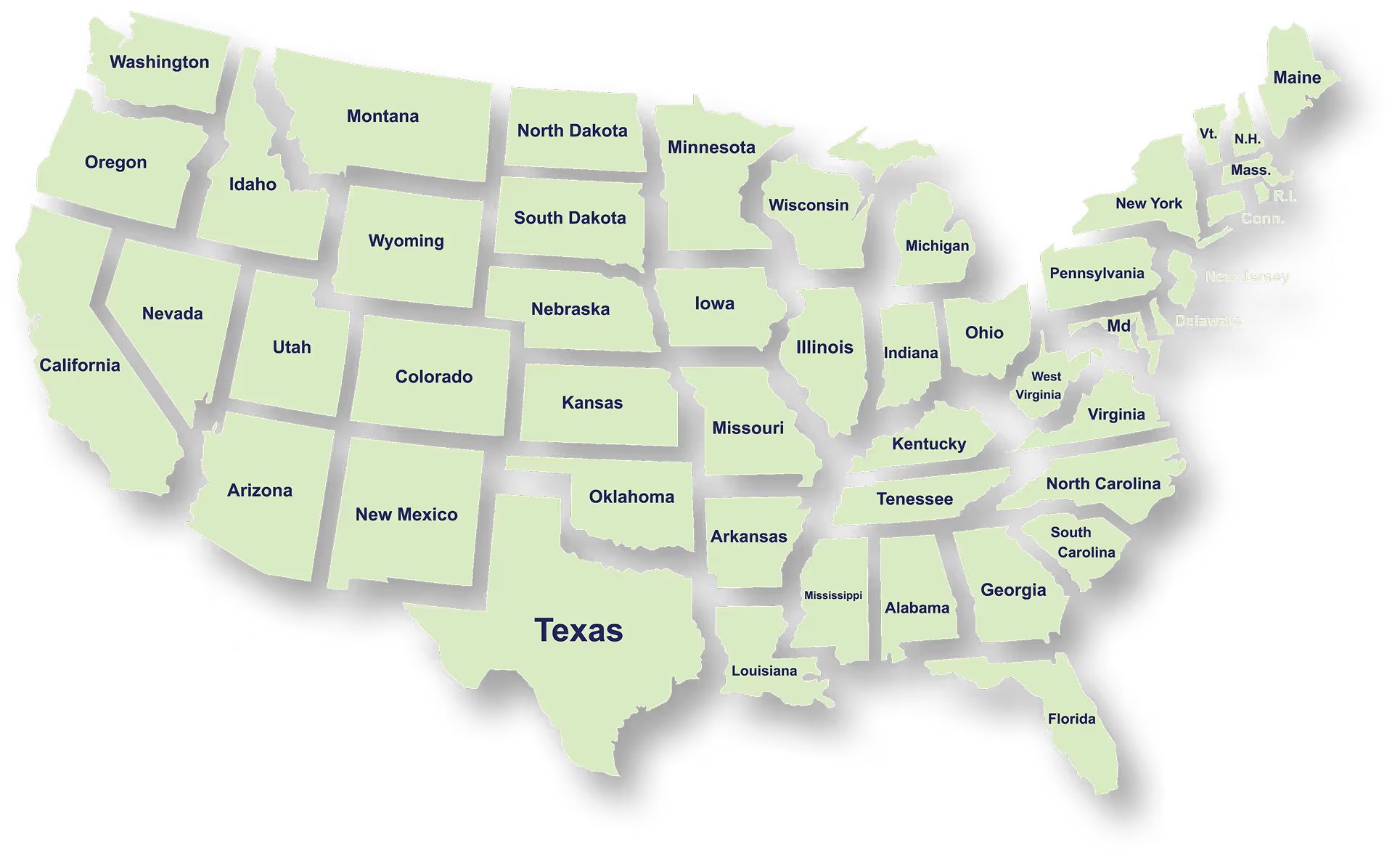
Serving Businesses & Individuals Across USA

We handle accounting, tax filing, and planning with defined timelines and accurate reporting for businesses and individuals across all states.

Frequently Asked Questions

What services does NR CPAs & Business Advisors provide?
What is tax planning and why is it important for businesses?
How can a Virtual CFO help my business?
When should a business consider IRS tax resolution services?
What financial statements does a business typically need?
How can startup advisory services help new businesses?
What is strategic business planning?
What is a Virtual Family Office and who can benefit from it?