Learning Center for Tax and Financial Insights

Stay updated with clear, actionable articles on tax rules, deadlines, deductions, and financial decisions that impact individuals and businesses.

No items found.

March 2026 Tax Calendar: Critical Deadlines for Business Owners

While January and February are often dominated by getting W-2s and 1099s out the door, March is when tax season truly arrives for pass-through entities. For our clients here in Coral Gables and across Florida, this month requires careful attention to detail to avoid late-filing penalties.

At NR CPAs & Business Advisors, we know that accurate filing is about more than just compliance—it's about financial health. Below is the breakdown of the critical deadlines hitting the calendar in March 2026.

March 2: The Paper Filing Deadline

If your business still files forms on paper rather than electronically, the first business day of the month is your cutoff for several information returns. Note: If you file these electronically, you generally have until the end of the month (see March 31).

Information Returns (1099s)
You must file government copies of forms 1096 and 1099 for payments made in 2025. This applies to most 1099 types, excluding the 1099-NEC (which was due earlier). Remember, different payments require distinct forms.

Gambling Winnings
For applicable businesses, file Form 1096 and Copy A of all Forms W-2G issued for 2025. If you file electronically, this deadline pushes to March 31.

ACA Reporting (Forms 1094/1095)
Applicable Large Employers (ALEs) filing paper forms must submit Forms 1094-C and 1095-C to the IRS. Other providers of minimum essential coverage must file Forms 1094-B and 1095-B. Again, e-filers get a reprieve until March 31.

Construction workers reviewing plans

Tip Reporting for Hospitality
Large food and beverage establishments must file Form 8027 (Employer’s Annual Information Return of Tip Income and Allocated Tips). If you have multiple locations, use Form 8027-T to summarize.

Farmers and Fishermen
File your 2025 Form 1040 or 1040-SR and pay any tax due. If you already paid your estimated tax by January 15, 2026, you have until April 15 to file the return.

Health Coverage Deliverables
regardless of how you file with the IRS, you must provide health coverage statements to individuals by this date. ALEs must provide Form 1095-C to full-time employees, and other providers must issue Form 1095-B to responsible individuals.

March 16: The Big Date for Partnerships & S Corps

This is arguably the most significant date of the month for many of our business clients. If you operate a calendar-year partnership or S Corporation, your tax returns are due. This is also when K-1s must be issued so your partners and shareholders can file their personal returns.

Partnerships (Form 1065)
File the 2025 return and provide Schedule K-1 (and Schedule K-3 if applicable) to each partner. If the books aren't quite closed, we can file Form 7004 to request an automatic 6-month extension. Note that an extension to file is not an extension to pay any state-level fees that might be due.

S Corporations (Form 1120-S)
File the 2025 income tax return and pay any tax due. Similar to partnerships, you must provide Schedule K-1s to shareholders. If you need more time, filing Form 7004 secures a 6-month extension. However, you must estimate and pay any tax owed by this date to avoid interest and penalties.

Business team working together

S Corporation Election (Form 2553)
If you want your business to be taxed as an S Corp starting with the 2026 tax year, you must file Form 2553 by this date. Missing this window usually means waiting until 2027 for S Corp status to take effect.

Payroll and Withholding Deposits
For businesses on the monthly deposit rule, submitting Social Security, Medicare, and withheld income tax for February payments is due. This also applies to non-payroll withholding.

March 31: Electronic Filing Deadline

For modern businesses that utilize e-filing (which we highly recommend for efficiency and security), this is your deadline for information returns.

  • Forms 1099 and W-2G: E-file deadline for these forms (excluding the 1099-NEC).
  • ACA Forms: E-file deadline for Forms 1094-C, 1095-C, 1094-B, and 1095-B.
  • Tip Reporting: E-file deadline for Form 8027.

A Note on Holidays and Extensions

When a due date hits a Saturday, Sunday, or legal holiday, the deadline shifts to the next business day. Furthermore, if your business is located in a federally designated disaster area, you may have additional time.

To check for disaster-related delays, verify the status of your area here:

We Are Here to Help

Whether you need to file an extension for your S Corp or are finalizing partnership agreements, NR CPAs & Business Advisors is ready to assist. Led by Nischay Rawal, our team combines the technical depth of a large firm with the responsiveness of a boutique partner.

Need help navigating these deadlines? Contact us today to schedule a consultation.

Explore More
No items found.

Red Flags: How to Spot and Avoid Ghost Tax Preparers

Don't Get Haunted by Bad Tax Advice

A "ghost preparer" is a scam artist who charges a fee to prepare tax returns but refuses to sign them. Unscrupulous preparers often fabricate tax benefits to illegally inflate refunds, leaving the taxpayer liable for the fraud while the preparer vanishes.

Handshake with a trusted CPA in Coral Gables

During this busy season, ensure you are working with a legitimate partner rather than a risky operator. At NR CPAs & Business Advisors in Coral Gables, our team, led by licensed CPA Nischay Rawal, prioritizes honesty and accuracy. Watch the video below to learn how to identify the dangers of ghost preparers.

Explore More
No items found.

Strategic Philanthropy in 2026: Navigating Modern Tax Reforms and Optimizing Charitable Impact

The landscape for charitable giving in 2026 has shifted significantly, bringing both fresh opportunities and complex new hurdles for donors. As these new tax treatments take hold, understanding the interplay between your philanthropic goals and your tax obligations is more important than ever. Whether you typically claim the standard deduction or you are a high-net-worth itemizer, the rules governing how you give—and what you get back in return—have been redefined. This year, navigating the terrain requires a blend of technical compliance and strategic foresight to ensure your generosity remains as impactful for your financial plan as it is for your chosen causes.

New Opportunities for Non-Itemizers in 2026

Historically, taxpayers who opted for the standard deduction were largely excluded from receiving direct tax benefits for their charitable contributions. Federal law generally reserved those incentives for individuals who itemized on Schedule A. However, 2026 introduces a critical exception specifically designed for cash donations. This change allows those who do not itemize to still see a reduction in their taxable income through their philanthropic efforts.

Under these updated provisions, non-itemizers can claim a deduction for cash contributions, provided they adhere to strict documentation standards. It is no longer enough to simply track your giving; you must maintain robust bank records or formal written acknowledgments from the recipient organizations. For our clients in Coral Gables and across Florida, this underscores the necessity of meticulous record-keeping throughout the year. Qualifying organizations include traditional 501(c)(3) entities such as churches, nonprofit schools, medical research facilities, and public charities. It is important to remember that contributions to donor-advised funds (DAFs) or supporting organizations do not qualify for this specific non-itemizer deduction.

While this is a welcome shift, non-itemizers should be aware of the specific caps involved. Unlike itemizers, who may have the ability to deduct a significant portion of their income, non-itemizers face lower, fixed ceilings. For those filing jointly, the deduction is capped at $2,000, while individual filers are limited to $1,000. These thresholds mean that while every dollar counts, large-scale giving strategies may still be better served through itemization if your total deductions exceed the standard deduction amount.

Philanthropic planning for entrepreneurs

The 0.5% AGI Floor: A New Hurdle for Itemizers

For those who itemize, the most striking change in 2026 is the introduction of an Adjusted Gross Income (AGI) floor for charitable deductions. Established by the One Big Beautiful Bill Act (OBBBA), this 0.5% floor fundamentally changes how the first few dollars of your donations are treated. Under this rule, only the portion of your total charitable contributions that exceeds 0.5% of your AGI is actually deductible. The legislative intent is clear: to incentivize more substantial, concentrated giving rather than smaller, fragmented donations.

Applying the AGI Floor in Real-World Scenarios

To see how this affects your bottom line, consider a taxpayer with an AGI of $200,000. Because of the new 0.5% floor, the first $1,000 given to charity provides no federal tax benefit. Only the amount contributed above that $1,000 threshold becomes deductible. This makes the timing and concentration of gifts a vital component of any tax planning session at NR CPAs & Business Advisors.

The impact becomes even more pronounced as income rises. For a high-earning individual or business owner with an AGI of $500,000, the floor jumps to $2,500. In this scenario, the first $2,500 of charitable support is essentially "lost" from a deduction standpoint. For families who have traditionally given smaller amounts to a wide variety of causes, this change may prompt a move toward "bunching" donations into specific years to clear the floor and maximize the resulting tax savings.

The Permanence of the 60% Cash Contribution Limit

One of the more stable developments in 2026 is that the 60% AGI limitation for cash contributions has been made permanent. This offers a level of predictability that was often missing in previous years. For donors who prefer the simplicity of cash over the complexity of transferring appreciated assets, this high ceiling allows for significant tax shielding, particularly for those looking to offset a high-income year.

However, it is vital to contrast this with other types of giving which carry different limitations. For instance, non-cash contributions—such as clothing, household goods, or equipment—remain capped at 50% of AGI. Contributions to certain organizations like fraternal societies are limited to 30%. Most importantly, if you are donating capital gain property (such as appreciated stocks), the limit is much more restrictive at 20% of AGI for gifts to qualified organizations. These variations mean that a mix of cash and assets requires a finely tuned strategy to ensure you aren't leaving deductions on the table.

Business assets and charitable giving

The Return of Itemized Deduction Phaseouts

High-income taxpayers must also contend with the reintroduction of a phaseout for itemized deductions, a mechanism similar to the former Pease limitation. This rule reduces the total value of your itemized deductions—including your charitable gifts—once your income passes a certain threshold. For 2026, the phaseout begins for joint filers at approximately $769,000. For married individuals filing separately, the threshold is half that amount, while other filers see the phaseout begin at $641,000.

The phaseout effectively acts as an additional tax on high earners by limiting the efficacy of their deductions. If your income is significantly above these levels, the amount you can actually deduct is reduced by a percentage of the excess income. This creates a complex environment where simply giving more doesn't always result in a proportional tax benefit. For many of our clients in the Coral Gables area, this necessitates a closer look at the timing of income recognition and the structure of multi-year giving plans.

Mastering Documentation: The 2026 Requirements

While the OBBBA introduced several structural changes, the core documentation requirements for proving your generosity remain unchanged. However, the IRS continues to be uncompromising regarding these rules. To protect your deductions, you must follow the specific protocols based on the size and type of your gift.

Guidelines for Cash Contributions

  • Gifts Under $250: You must retain a reliable bank record, such as a canceled check or credit card statement. A written letter from the charity that includes the date and the specific amount is also sufficient.
  • Gifts of $250 or More: You must obtain a contemporaneous written acknowledgment from the charity. This document must state the exact amount and, crucially, declare whether the organization provided any goods or services in exchange for the gift. If you received "intangible religious benefits," the letter must explicitly state this.
  • Payroll Deductions: If you give through your employer, keep your W-2 or pay stubs. You also need a pledge card or document from the charity showing the name of the organization.

Guidelines for Non-Cash Contributions

Non-cash gifts, ranging from old office furniture to shares of stock, require a tiered approach to documentation:

  • Under $250: A simple receipt showing the charity's name, the date, the location, and a description of the items.
  • $250 to $500: A more formal acknowledgment that includes a description of the property and a statement regarding any goods or services received in return.
  • Over $500 to $5,000: In addition to the acknowledgment, you must document how you acquired the property, the approximate date of acquisition, and the cost basis of the items.
  • Over $5,000: For substantial gifts, a qualified appraisal is mandatory (except for publicly traded securities). The appraisal must be conducted by a certified professional, and you must file Form 8283 with your tax return.
Documentation and payroll records

Strategic Insights for the 2026 Tax Year

To navigate these new rules successfully, donors should consider a more proactive approach to their philanthropy. First, consider diversifying your donation methods. Balancing cash gifts (with their 60% limit) and non-cash assets can help you stay within the various AGI caps while maximizing your total deduction. Second, the 0.5% AGI floor means that "bunching" donations—combining several years' worth of giving into a single tax year—may be more effective than smaller annual gifts. This strategy is often best executed through a donor-advised fund, allowing you to take the deduction now while distributing the funds over time.

Finally, avoid the common pitfalls that lead to IRS challenges. Delayed acknowledgments are a frequent issue; you must have your documentation in hand before you file your return. Overstating the value of non-cash goods is another red flag. Accuracy in determining fair market value is essential for maintaining the integrity of your tax return.

Conclusion

Charitable giving in 2026 is no longer a simple matter of writing a check and filing a receipt. With the new AGI floor, the permanent cash limits, and the re-emergence of deduction phaseouts, a thoughtful strategy is required to balance your altruistic goals with tax efficiency. At NR CPAs & Business Advisors, led by Nischay Rawal, we specialize in helping individuals and business owners in Coral Gables and beyond navigate these complexities with the agility of a boutique firm and the depth of a large-scale advisor. If you have questions about how these 2026 changes impact your specific financial situation, contact our office today to schedule a planning session.

The Qualified Charitable Distribution (QCD) Advantage

For individuals aged 70½ and older, there is a highly effective way to sidestep the new 0.5% AGI floor: the Qualified Charitable Distribution (QCD). A QCD allows you to transfer up to $100,000 annually directly from your Individual Retirement Account (IRA) to a qualified 501(c)(3) organization. Because the funds go directly to the charity, the distribution is not included in your adjusted gross income. This is a massive advantage in 2026 because if the income is never reported, it cannot be subjected to the AGI floor or the itemized deduction phaseouts. For retirees in South Florida who are already required to take minimum distributions (RMDs), using those funds for a QCD can lower your overall tax bracket while fulfilling your philanthropic goals without the friction of the new deduction hurdles.

Leveraging Donor-Advised Funds for Bunching

With the 0.5% AGI floor making smaller annual donations less tax-efficient, the strategy of "bunching" has become a cornerstone of modern tax planning. By contributing several years' worth of donations into a Donor-Advised Fund (DAF) in a single tax year, you can far exceed the AGI floor and maximize your itemized deductions for that specific year. You can then use the DAF to distribute grants to your favorite charities over the subsequent years. This approach is particularly effective for high-income earners in Coral Gables who may be facing the re-introduced phaseout limits; by concentrating the deduction in a year where it provides the most significant tax offset, you maintain the impact of your gift while navigating the restrictive 2026 environment.

Corporate Giving for Florida Business Owners

For entrepreneurs and business owners, the decision of whether to give personally or through a business entity requires a detailed cost-benefit analysis. While S-Corp and LLC donations generally flow through to the individual's personal tax return—and are thus subject to the new AGI floor and phaseouts—C-Corporations operate under a different framework. Generally, a C-Corporation can deduct charitable contributions up to 10% of its taxable income. In certain scenarios, it may be more beneficial for the business to make the donation directly, particularly if the individual owner's AGI is so high that the personal phaseouts significantly dilute the deduction's value. Coordinating these gifts requires a clear understanding of your business's cash flow and taxable income projections.

The Technical Nuance of Appreciated Property

When donating non-cash assets like real estate or closely held business interests, the tax benefits can be substantial, but the compliance requirements are equally high. The IRS is particularly vigilant about the valuation of non-publicly traded assets. If you are donating property valued at over $5,000, a "qualified appraisal" is not just a suggestion—it is a mandatory requirement to sustain the deduction. This appraisal must be prepared by a qualified appraiser who follows Generally Accepted Appraisal Standards and must be signed no earlier than 60 days before the contribution date. For our clients, we recommend starting this process well in advance of the year-end deadline to ensure all paperwork, including Form 8283, is accurately completed and attached to the return. Failing to meet these strict documentation windows can result in a total disallowance of the deduction, regardless of the gift's actual value.

Explore More
No items found.

Zero School Taxes: Is a $0 Property Tax Bill Actually Possible?

For most homeowners in Coral Gables and across the country, opening the annual property tax assessment is rarely a highlight of the year. Usually, the largest single line item is the school tax. In many jurisdictions, school taxes represent the lion’s share of the total obligation, funding everything from teacher salaries to facility maintenance.

However, a growing number of headlines are highlighting a statistical anomaly: the $0 school tax bill. While it sounds like a financial myth, for some residents, it is a documented reality.

A recent news story brought this into focus, identifying two specific New Jersey municipalities where the typical school portion of the tax bill can actually zero out. This occurs because of highly specific local financing structures and state aid distributions. Before we analyze how you might find similar relief, let’s look at the standard mechanics of education funding.

School Tax 101: Why Your Bill Is Usually So High

In the United States, property taxes are generally a composite of levies from the county, city, special districts, and the local school board. The school portion is typically the most expensive because public schools rely heavily on local property tax revenue to function.

Several factors keep these costs elevated:

  • Education funding requirements are consistently high and do not scale down during economic shifts.
  • Local districts often set levies based on enrollment numbers and operational costs rather than fluctuating market values.
  • As property values rise, even static tax rates result in higher out-of-pocket costs for the homeowner.

Against this backdrop, a zero-dollar bill is truly a unicorn in the tax world, yet it exists in specific pockets of the country.

Tax Planning Concept

The New Jersey Anomaly: Funding Formulas at Work

In the New Jersey towns mentioned in recent reports, the school tax can technically reach zero because of the way state revenue is allocated. When state aid and other funding mechanisms cover the entirety of the district's budgetary needs, the local property tax levy can be eliminated. This is the exception, not the rule.

Generally, property tax bills — especially the school portion — are subject to wild variance based on geography and local education funding structures. In some high-spending New Jersey districts, the school portion can account for 75% of the total bill, with average school taxes exceeding $16,000.

The Texas Model: Aggressive Homestead Exemptions

While New Jersey offers examples of funding-based relief, Texas provides a model of policy-driven relief. Texas lawmakers and voters have taken a direct approach to trimming the school tax burden for primary residents.

In November 2025, a landmark constitutional amendment was approved to increase the homestead exemption from $100,000 to $140,000. This means that for many homeowners, a significant portion of their home’s value is entirely excluded from school tax calculations.

In Texas, which lacks a state income tax, these exemptions are vital. For seniors or those with specific household valuations, the combination of state-mandated caps and high exemptions can drive the school tax liability toward zero. Even if the bill isn't exactly $0, many Texas homeowners see minimal liability compared to previous years.

Financial Analysis

Why Education Funding Varies So Drastically

The disparity between a $0 bill and a $16,000 bill is a reflection of the complex landscape of American education finance. The primary drivers of this variance include:

1. State Aid vs. Local Reliance
States like New Jersey have historically relied on local property taxes but utilize complex formulas to redistribute wealth. Conversely, states like Texas use legislative caps to shift the burden away from the local property owner.

2. Escalating Property Valuations
In markets with surging real estate prices, even a low tax rate can lead to a substantial bill. This is why exemptions and valuation caps are critical tools for tax planning.

3. Local Voter Decisions
Bond referendums and school levies are often decided at the ballot box. When a levy expires or a community votes against a new tax, the local obligation can drop significantly, sometimes to zero for a temporary period.

Strategic Takeaways for Every Homeowner

At NR CPAs & Business Advisors, we often work with clients in Coral Gables who are navigating the complexities of Florida’s own property tax system, including the Save Our Homes cap. These national examples remind us that not all property taxes are inevitable.

Understanding local funding formulas and state-specific relief programs is essential for effective financial management. Whether you are dealing with a primary residence or a commercial portfolio, monitoring school funding legislation and exploring available exemptions can lead to significant savings.

The $0 school tax bill may be rare, but it demonstrates that the way we fund education—through a mix of state aid and local decisions—directly impacts your bottom line. If you are concerned about your property tax trajectory, schedule a consultation with Nischay Rawal and our team today to explore your tax planning options.

Beyond the national headlines, it is important to understand how these mechanics manifest in our local market of Coral Gables and across the state of Florida. While Florida does not currently have towns with a literal $0 school tax rate like the anomalies in New Jersey, our state’s Save Our Homes (SOH) amendment creates a similar divergence in tax liability. Since 1992, the SOH amendment has capped the annual increase in the assessed value of homesteaded properties at 3% or the percentage change in the Consumer Price Index, whichever is lower. For long-term residents in high-growth areas, this creates a massive gap between the market value and the taxable value of the home. Over a period of twenty or thirty years, this cap can result in an effective school tax burden that is a mere fraction of what a new neighbor might pay for an identical property next door. While the millage rate remains the same, the basis upon which it is calculated is so suppressed that the financial outcome mimics the relief seen in high-exemption states like Texas.

The Role of Specialized Exemptions in Achieving Minimal Liability

Another path toward the elusive $0 school tax bill involves specialized exemptions targeted at specific demographics. In several jurisdictions across the country, senior citizens who meet certain income thresholds are granted a total or near-total exemption from the school tax portion of their property tax bill. For example, some counties in Georgia and Pennsylvania offer school tax freezes or absolute exemptions for residents over the age of 65 or 70. This policy is based on the logic that seniors, who may no longer have children in the local school system and are often living on fixed incomes, should not be priced out of their homes by rising education costs. In Florida, we see variations of this through additional homestead exemptions for low-income seniors, which can significantly offset the non-school portion of the bill, thereby lowering the total effective tax rate to manageable levels.

For business owners and real estate investors, the school tax burden is often even more significant because commercial properties generally do not benefit from the same aggressive homestead protections afforded to primary residences. In these cases, a $0 bill is highly unlikely, but there are sophisticated strategies to mitigate the impact. As a firm specializing in business consulting and Fractional CFO services, we often review the underlying data that drives these assessments. For instance, many businesses unknowingly pay school taxes on 'ghost assets'—equipment or machinery that has been disposed of but remains on the local tax rolls. By performing a comprehensive audit of the tangible personal property tax return, a business can often uncover substantial overpayments that have been quietly compounding for years.

Financial Strategy and Peace of Mind

Navigating the 'Robin Hood' Funding Models

The variation in school taxes is also driven by what is colloquially known as 'Robin Hood' funding models, or recapture systems. In these systems, property-wealthy districts are required by state law to send a portion of their local property tax revenue to the state government, which then redistributes those funds to property-poor districts. This mechanism is a major point of contention in states like Texas and has been a recurring theme in Florida’s legislative sessions. When a district is a 'receiver' of these funds rather than a 'giver,' the local property tax levy can be kept artificially low because the state is effectively subsidizing the local school budget. This redistribution is exactly why a homeowner in one zip code might pay double the school taxes of a homeowner in a neighboring zip code, despite having similar home values and service levels.

The Importance of the Assessment Appeal Process

Regardless of where you live, the school tax is only as accurate as the assessment it is based upon. Many taxpayers assume that the value assigned to their property by the county appraiser is final and indisputable. However, the assessment process is often automated and can miss localized issues that decrease a property’s value, such as structural damage, rezoning changes, or recent market shifts. In Florida, the Value Adjustment Board (VAB) provides a formal window—usually in late summer or early fall—where property owners can challenge their assessments. Successfully appealing an assessment doesn't just lower your general property tax; it directly reduces the school tax, which, as we have established, is often the largest component of the bill. For our clients, we emphasize that these appeals are not just about saving a few dollars; they are about ensuring that the tax burden is equitable and based on the true fair market value of the asset.

Ultimately, the news of $0 school tax bills in New Jersey and aggressive tax cuts in Texas should serve as a wake-up call for property owners everywhere. It highlights the fact that property tax is not a fixed utility cost like electricity or water; it is a variable expense heavily influenced by state policy, local voting patterns, and individual taxpayer action. By staying informed on legislative changes, such as new homestead limits or senior exemptions, and by proactively managing property assessments, individuals and business owners can gain more control over their financial future. While you may never reach a literal zero-dollar school tax bill, the difference between an unoptimized tax profile and a strategically planned one can represent thousands of dollars in annual savings. These funds can then be redirected toward retirement accounts, business expansion, or generational wealth transfers, turning a mandatory expense into a strategic opportunity. Managing these nuances requires a proactive approach and a deep understanding of the intersection between local policy and federal tax strategy.

Explore More
No items found.

Estimated Tax Payments Are Not Just for the Self-Employed

Article Highlights:

  • Employees
  • Self-Employed Individuals
  • Periodic Payments
  • Underpayment Penalty
  • Safe Harbor Payments

Unlike employees, who have income, Social Security, and Medicare taxes withheld from their wages, self-employed individuals must prepay their taxes by making periodic estimated tax payments. These are referred to as estimated tax payments because the self-employed individual must estimate his or her net earnings for the year and pay taxes per an IRS schedule according to that estimate. Failure to do so will result in interest penalties.

The self-employed are not the only ones who are subject to estimated tax payment requirements; anyone who has income on which no income tax has been withheld, and even those whose taxes are not sufficiently withheld, should be making estimated tax payments. Thus, if you have income from stock sales, property sales, investments, taxable alimony, partnerships, S-corporations, inherited pension plans, or other sources that are not subject to withholding, you may also be required to pay either estimated taxes or an underpayment penalty. Others subject to making estimated payments are individuals who must pay special taxes such as the 3.8% tax on net investment income or the employment tax on household employees.

Although these payments are often termed “quarterly” estimates, the periods they cover do not usually coincide with a calendar quarter.

Quarter  

Period Covered

Months  

Due Date*

First

January through March

3

April 15, 2024

Second

April and May

2

June 17, 2024

Third

June through August

3

September 16, 2024  

Fourth

September through December  

4

January 15, 2025

An underestimate penalty does not apply if the tax due on a return (after withholding and refundable credits) is less than $1,000; this is the “de minimis amount due” exception. When the tax due is $1,000 or more, underpayment penalties are assessed.

These underpayment penalties are determined per the periods as shown in the above table, so an underpayment in an earlier period cannot be made up for in a later period; however, an overpayment in an earlier period is applied to the following period.

The amount of an estimated payment is determined by estimating one fourth of the taxpayer’s tax for the entire year; the projected tax is paid in four installments. When the income is seasonal, sporadic, or the result of a windfall, the IRS provides a special form, and the underpayment penalty is based on actual income for the period.

For individuals who do not want to take the time to estimate their tax for the current year but who still want to avoid the underpayment penalty, Uncle Sam also provides safe-harbor estimates. However, even these can be tricky. Generally, a taxpayer can avoid an underpayment penalty if his or her withholding and estimated payments are equal to or greater than

  • 90% of the current year’s tax liability or
  • 100% of the prior year’s tax liability.

However, these safe harbors do not apply if the prior year’s adjusted gross income is over $150,000, in which case, the safe harbors are

  • 90% of the current year’s tax liability or
  • 110% of the prior year’s tax liability.

Sometimes, individuals who have withholding on some (but not all) of their sources of income will increase that withholding to compensate for the additional income sources that have no withholding. Although this may work, withholding adjustments are not as precise as the per-period payments and should be used with caution.

This office can assist you in estimating payments, adjusting withholding, and setting up safe-harbor payments. Please call for assistance.

Explore More
No items found.

Super Bowl Tax Bills: Why Sam Darnold’s Payout Was Sidelined by the IRS

Every February, football fans across the country—from our local community in Coral Gables to the Pacific Northwest—gather to witness the spectacle of the Super Bowl. While the focus usually remains on the final score and the halftime performance, the 2026 championship between the Seattle Seahawks and the New England Patriots brought a different story to the forefront: a staggering tax bill for quarterback Sam Darnold. His financial aftermath serves as a high-profile lesson in how income apportionment and state borders can drastically change a person’s take-home pay.

When a Championship Bonus Becomes a Liability

Under current NFL regulations, players on the winning Super Bowl team receive a standardized bonus. For Super Bowl LX, this payout was set at $178,000 per player. For most, that sounds like a significant windfall, but for Darnold, the math told a different story. Because the game took place in California—a state with some of the most aggressive income tax rates in the nation—players were hit with the “jock tax.”

This tax applies to non-resident athletes based on the number of “duty days” spent in a specific state for practice, media events, and the game itself. Based on Darnold’s total contract value, analysts estimated his California tax liability hovered between $200,000 and $249,000. In a twist of financial irony, his tax bill likely exceeded the actual value of his championship bonus. Some calculations suggested he paid $71,000 more in taxes than he actually received for winning the game, proving that split-state income can easily erode even the largest payouts.

Image 1

The Mechanics of the “Jock Tax”

The term “jock tax” describes the legal framework where states and municipalities tax non-residents who earn income within their borders. This isn't limited to just the day of the event. For Darnold and his Seahawks teammates, every preseason practice, travel day, and media session held in California counted toward their income allocation. For anyone working across state lines, it is essential to understand that a bonus for a single event is not taxed in isolation; it is integrated into a total calculation of your earnings within that specific taxing jurisdiction.

Implications for Business Travelers and Remote Workers

While professional athletes make the news, these multi-state tax rules apply to many of the clients we serve at NR CPAs & Business Advisors. You may face similar tax complexities if you:

  • Travel frequently for business assignments.
  • Work for a company based in a different state than your residence.
  • Are a consultant or freelancer with clients in high-tax jurisdictions.

Many states require you to file a non-resident return if you earn income there, sometimes for as little as a single day of work. For the professionals and business owners in our Coral Gables office, managing these “duty days” is a critical part of year-round tax planning.

Image 3

New Rules for Super Bowl Betting and Gambling Taxes

It isn’t just the players who should be wary of the IRS. At the federal level, all gambling winnings are taxable. This includes everything from sports betting apps to casual office pools. Significant changes starting in the 2026 tax year mean that taxpayers can now only deduct gambling losses up to 90% of their winnings, rather than the full 100% allowed previously. This can create “phantom income,” where you owe taxes on a net gain that doesn't actually exist in your bank account.

Proactive Planning with NR CPAs & Business Advisors

Whether you are dealing with a complex multi-state income situation or navigating new federal tax laws, Nischay Rawal and our team are here to act as your advisors. We specialize in providing the depth of a large firm with the responsiveness of a boutique partner. If your travel schedule or side income is creating a tax maze, schedule a consultation with our Coral Gables team today to ensure you aren't surprised by your own version of a Super Bowl tax bill.

For Florida residents, who enjoy the absence of a state income tax, these multi-state filings are often a jarring experience. Unlike a resident of New York who might receive a credit for taxes paid to California, a Coral Gables resident has no state-level liability to offset. This means every dollar paid to the Golden State is a direct reduction in net wealth.

Understanding the Duty-Day Formula

The duty-day formula itself is more nuanced than many realize. It includes not just the four quarters of the game, but also mandatory team meetings, physical therapy sessions, and even local promotional appearances. If a player or executive arrives three days early for a conference or a training camp, those days are mathematically weighted against the total number of workdays in the year to determine the percentage of their annual salary—not just the bonus—that the host state can claim. This prorated approach means that high-earners often pay a disproportionate amount for their time spent in high-tax jurisdictions.

Navigating Phantom Income and Deductions

Furthermore, the shift in federal law regarding gambling losses creates a unique trap for the casual bettor. Under the 2025 federal overhaul, the inability to deduct 100% of losses against winnings means that a bettor who breaks even over the course of the year—perhaps winning $10,000 but losing $10,000—will still be forced to report a taxable gain of $1,000. For individuals in higher tax brackets, this phantom income can result in thousands of dollars in actual tax liability for an activity that yielded zero net profit. This highlights the absolute necessity of maintaining a contemporaneous log of all wagers, dates, and outcomes. Our firm often sees taxpayers who ignore these record-keeping requirements until they receive a Form W-2G, at which point reconstructing a year's worth of activity becomes an administrative burden involving bank statements, credit card records, and betting app histories. Proper documentation is the only defense against an IRS audit on these points.

Managing Nexus for Small Businesses and Family Offices

For our business consulting clients, this Sam Darnold story isn't just sports trivia—it's a case study in tax nexus. Just as an athlete creates a tax obligation by stepping onto a field, a business can create a taxable presence by sending an employee to a trade show or having a remote worker based in another jurisdiction. Our fractional CFO services focus on identifying these risks before they become audits. Whether you are managing a growing tech startup in Miami-Dade or a family office with assets scattered across the country, the goal is always the same: proactive mitigation of unnecessary tax exposure. We evaluate the impact of multi-state operations on your overall tax burden, looking for opportunities to restructure income or utilize state-specific exemptions. By treating tax season as a year-round strategy session rather than a once-a-year scramble, you can ensure that your successes—whether on the field or in the boardroom—don't end up being sideline losses.

The complexities of state-sourced income require more than just software; they require a partner who understands the interaction between Florida's favorable tax climate and the more aggressive stances of other states. Our team is skilled at responsiveness and honesty, acting as both an advisor and a partner to help you navigate these multi-layered requirements. By tracking these variables in real-time, you can avoid the shock of a tax bill that rivals your earnings. Taking a structured approach to tax preparation and planning ensures that you keep more of what you earn, regardless of where the work takes you. Our commitment is to provide the depth of a large firm with the agility of a boutique one, ensuring that no detail is overlooked in your financial journey.

Explore More
No results found.
Thank you! Your submission has been received!
Oops! Something went wrong while submitting the form.

Want tax & accounting tips & insights?Sign up for our newsletter.

Thank you! Your submission has been received!
Oops! Something went wrong while submitting the form.

Why Work With Us?

We combine deep tax expertise, financial strategy, and practical business insight to help you manage complexity, stay compliant, and make confident financial decisions.
A dollar sign, representing financial advice or discussion at NR CPAs & Business Advisors.

Experienced CPA and Enrolled Agent Leadership

Guidance led by licensed professionals with deep expertise in tax strategy, compliance, and complex financial matters.
White bar chart with an upward arrow on green circular background representing growth or progress at NR CPAs &. Business Advisors

Support for Growing Businesses and Startups

We understand the financial challenges of growth stage businesses and provide structured guidance to support expansion.
A white hand holding a dollar symbol and ascending bar chart on a green circular background representing financial growth or investment at NR CPAs & Business Advisors..

Strategic Financial Advisory

Our team helps you evaluate financial decisions with greater clarity, supported by practical insights and long term planning.

Fractional CFO Support

Access experienced financial leadership without the commitment and cost of hiring a full time Chief Financial Officer.

Proactive Tax Planning Approach

We focus on identifying tax opportunities throughout the year rather than reacting only during filing season.

Clear and Reliable Financial Reporting

Accurate financial statements and reporting that help you better understand performance and make informed decisions.
White IRS building icon with pillars and a dollar sign above on a green circular background.

Professional IRS Representation

Experienced support in resolving IRS notices, disputes, and compliance matters while protecting your financial interests.

Personalized Client Focus

Every client receives thoughtful attention and tailored financial solutions based on their specific needs and business goals.
Financial matters often involve important decisions. Working with experienced advisors can help you approach them with greater clarity and confidence in your choices.

Need Help With Your Tax or Financial Decisions?

Discuss your situation with our advisors to get clear guidance on tax planning, IRS matters, and the financial decisions ahead.
Business consulting at NR CPAs & Business Advisors.

Request Your Consultation

Fill out the form to discuss your tax concerns, financial questions, or advisory needs with our team. We will review your details and respond shortly.

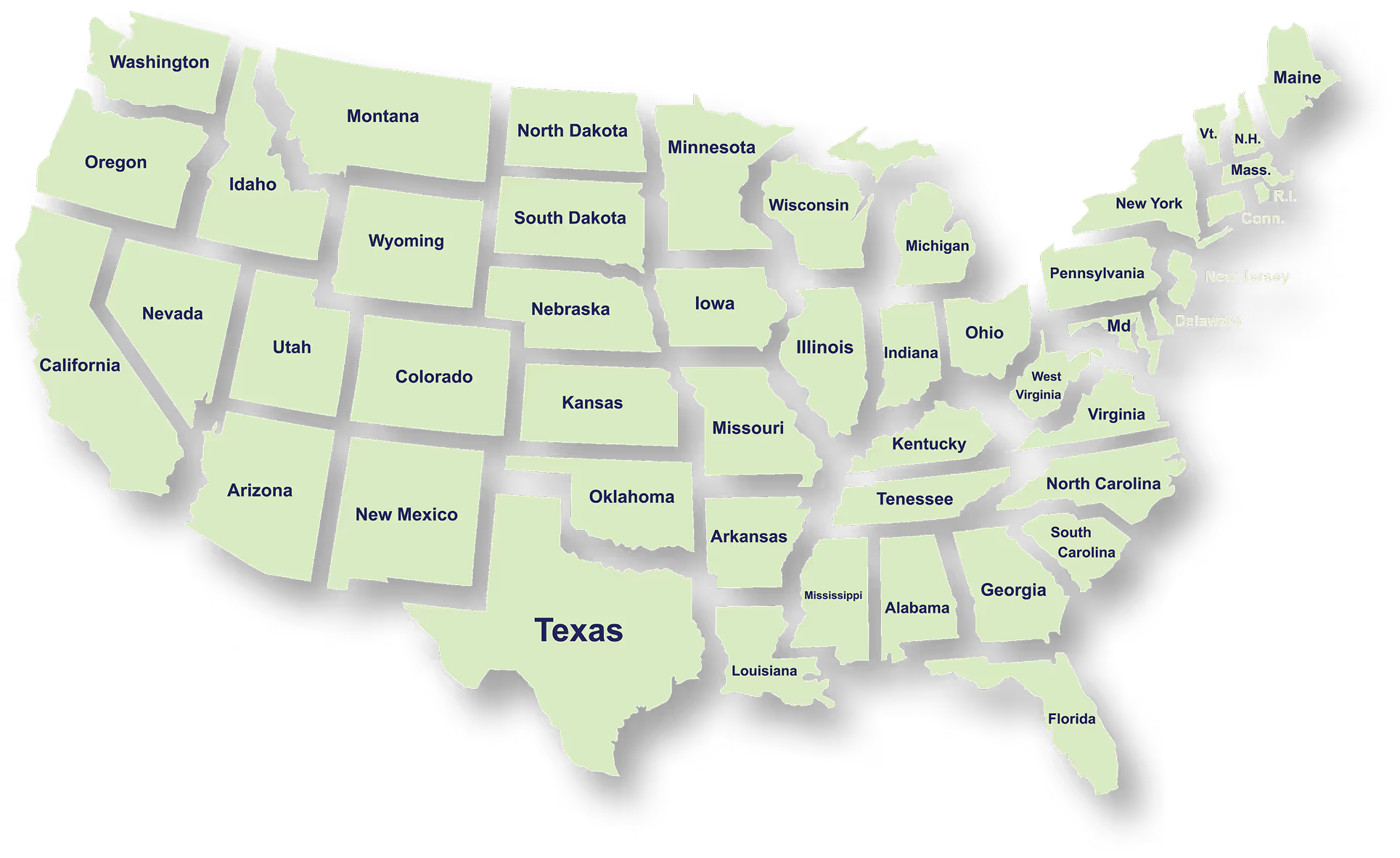
Serving Businesses & Individuals Across USA

We handle accounting, tax filing, and planning with defined timelines and accurate reporting for businesses and individuals across all states.

Frequently Asked Questions

What services does NR CPAs & Business Advisors provide?
What is tax planning and why is it important for businesses?
How can a Virtual CFO help my business?
When should a business consider IRS tax resolution services?
What financial statements does a business typically need?
How can startup advisory services help new businesses?
What is strategic business planning?
What is a Virtual Family Office and who can benefit from it?