%201.avif)


.webp)
.webp)

IRS Penalty Abatement: How To Remove IRS Penalties


IRS penalty abatement is the removal or reduction of penalties the IRS has assessed against you for failing to file a return, failing to pay taxes owed, or failing to make required tax deposits on time. According to the IRS, abating a penalty does not eliminate the underlying tax you owe, but it removes the additional charges the IRS added on top of that balance. Because penalties often represent a significant portion of a taxpayer's total debt, a successful abatement can substantially reduce the amount you need to pay.
According to the IRS, when penalties are removed, the interest charged on those penalties is also automatically eliminated. However, interest on the unpaid tax itself continues to accrue until the balance is paid in full. Penalty abatement is available for individual taxpayers, businesses, and employers, though the eligibility criteria and process differ depending on the type of penalty and the relief program you qualify for.
Types Of IRS Penalty Relief
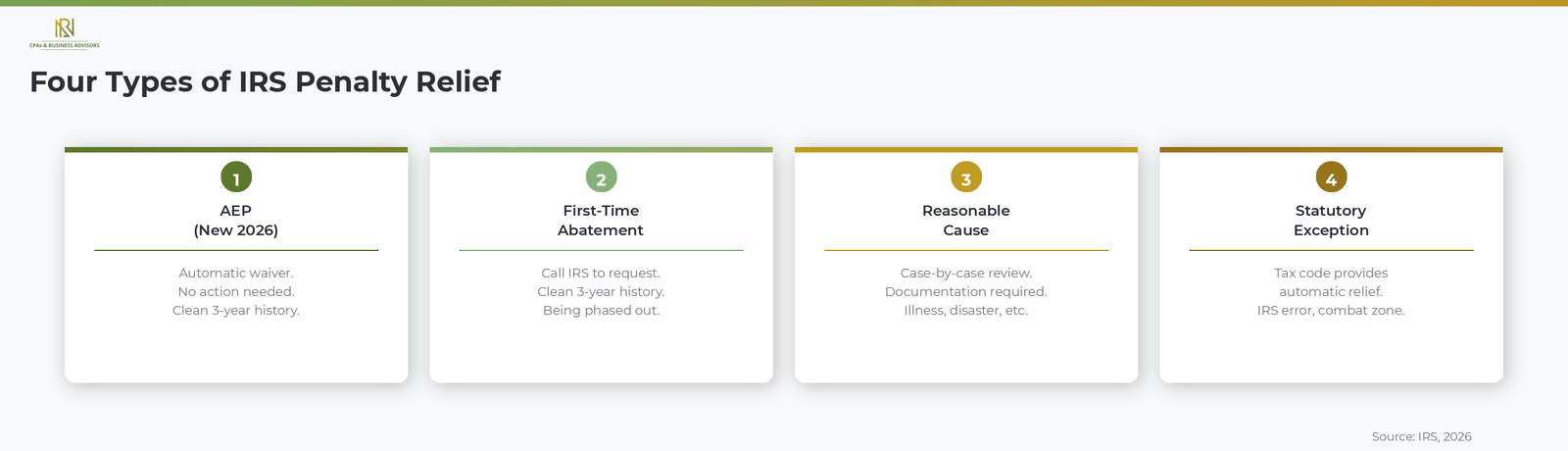
The IRS offers four main types of penalty relief: the Automatic Exemption from Penalty program, first-time penalty abatement, reasonable cause relief, and statutory exceptions. Each program has its own eligibility requirements and applies to different situations.
Automatic Exemption From Penalty Program
Starting in 2026, the IRS is phasing in the Automatic Exemption from Penalty (AEP) program, which automatically waives failure-to-file, failure-to-pay, and failure-to-deposit penalties for qualifying taxpayers without requiring any action on your part. According to the IRS, you qualify for AEP relief if you filed the same type of return on time for each of the previous three years and had no penalties assessed (other than estimated tax penalties) or any prior penalties were waived for reasonable cause. Unlike other programs, you do not need to call the IRS or submit paperwork. The IRS simply does not assess the penalty, and sends you a letter confirming the relief was applied.
According to the IRS, the AEP program applies to individual 1040 returns filed for tax year 2025 and later, and to certain quarterly business returns for tax year 2026 and later. The AEP program will fully replace the First-Time Penalty Abatement program for penalties related to returns originally due on or after January 1, 2027.
First-Time Penalty Abatement
First-Time Penalty Abatement (FTA) is an administrative waiver that removes failure-to-file, failure-to-pay, or failure-to-deposit penalties for taxpayers with a clean compliance history over the prior three years. According to the IRS, you qualify if you filed all required returns (or filed valid extensions), had no penalties assessed for the three preceding tax years, and have paid or arranged to pay any tax due. Unlike the AEP program, FTA is not automatic. You must contact the IRS by phone or submit Form 843, Claim for Refund and Request for Abatement, to request it.
According to the IRS, the FTA program is being phased out as the AEP program rolls in. FTA will be fully replaced for penalties associated with returns originally due on or after January 1, 2027. For penalties on returns due before that date, FTA remains available.

Reasonable Cause Relief
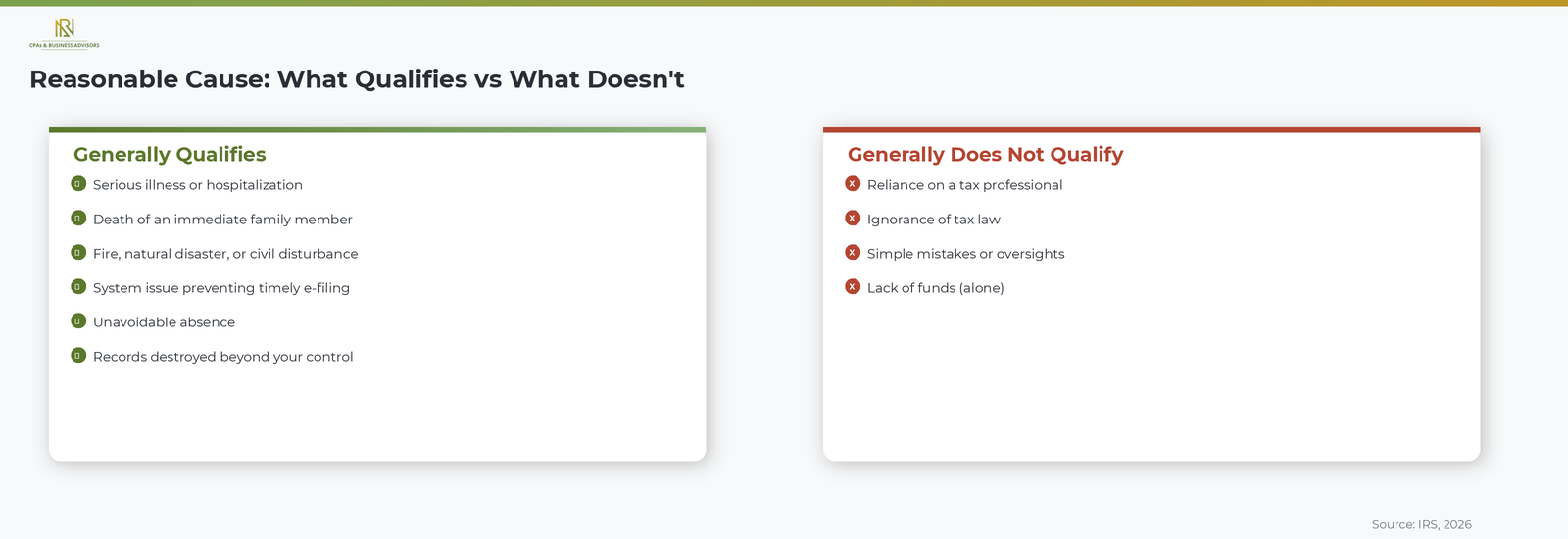
If you do not qualify for AEP or first-time abatement, the IRS can still remove penalties if you demonstrate that your failure to comply was due to reasonable cause and good faith. According to the IRS, reasonable cause is evaluated on a case-by-case basis considering all the facts and circumstances. Valid reasons include serious illness or death of an immediate family member, fires or natural disasters that destroyed records, system issues that prevented timely electronic filing or payment, and unavoidable absences.
According to the IRS, the following reasons generally do not qualify as reasonable cause on their own: reliance on a tax professional, ignorance of the law, simple mistakes or oversights, and lack of funds. However, lack of funds combined with other circumstances showing good-faith effort to comply may support a reasonable cause claim. You must provide supporting documentation such as medical records, court records, or correspondence that demonstrates the circumstances that prevented you from meeting your obligations.
Statutory Exceptions
In certain situations, the tax code itself provides an automatic exception that eliminates a penalty. According to the IRS, statutory exceptions include receiving incorrect written advice from the IRS that you reasonably relied on, being able to prove that your return or payment was mailed or e-filed before the deadline, being impacted by a federally declared disaster, and serving in a military combat zone.
Which Penalties Can Be Removed
The most common penalties eligible for abatement are the failure-to-file penalty, the failure-to-pay penalty, and the failure-to-deposit penalty. The failure-to-file penalty is 5 percent of the unpaid tax per month up to 25 percent. The failure-to-pay penalty is 0.5 percent per month up to 25 percent. Both penalties can be removed through AEP, FTA, or reasonable cause relief.
Accuracy-related penalties, which the IRS assesses when you underpay taxes due to negligence or a substantial understatement of income, can be removed through reasonable cause relief but are not eligible for AEP or first-time abatement. According to the IRS, the estimated tax penalty (for individuals who do not make sufficient quarterly payments) generally cannot be removed through any of the standard relief programs.
How To Request Penalty Abatement
The process for requesting penalty abatement depends on the type of relief you are seeking.
- AEP: No action required. The IRS applies the waiver automatically and sends you a confirmation letter.
- First-time abatement: Call the toll-free number on your IRS notice and request the abatement over the phone. If approved, the IRS sends a confirmation letter within 30 days.
- Reasonable cause: Call the IRS or submit Form 843 with a written explanation of your circumstances and supporting documentation. According to the IRS, phone requests are sometimes granted immediately, but complex cases may require a written submission.
- Statutory exception: Follow the instructions on your IRS notice or submit Form 843 with evidence of the exception (such as proof of timely mailing or a FEMA disaster declaration).
If you owe a balance beyond the penalties and cannot pay in full, you can set up an installment agreement to pay the remaining tax over time while your penalty abatement request is processed.

What To Do If Your Request Is Denied
If the IRS denies your penalty abatement request, you have 30 days from the date on the denial letter to appeal the decision to the IRS Independent Office of Appeals. According to the IRS, you must submit a written letter stating that you are appealing, include a copy of the denial notice, and provide any additional documentation or explanation you want the Appeals office to consider. Appeals officers review your case independently from the unit that issued the original denial.
If Appeals also denies your request, you can take the matter to court. According to the IRS, you can file a petition with the U.S. Tax Court before paying the disputed amount, or pay the penalty and file for a refund through the U.S. District Court or the U.S. Court of Federal Claims. Taxpayers who need to explore other ways to reduce their total IRS debt beyond penalty abatement, including Offers in Compromise and hardship status, can review the full range of IRS resolution options.
Frequently Asked Questions About Penalty Abatement
How Long Does It Take To Get Penalty Abatement?
It depends on the type of relief and how you request it. According to the IRS, first-time abatement requests made by phone can be approved immediately during the call. Written requests for reasonable cause relief may take several weeks to several months. The AEP program requires no wait time because the penalty is never assessed in the first place.
Can I Get Penalties Removed For Multiple Years?
First-time abatement and AEP apply to one tax period at a time. According to the IRS, you must have a clean three-year compliance history for each period you are requesting relief for. Reasonable cause relief can apply to multiple years if the same qualifying circumstance affected your ability to comply across those years, but you must demonstrate reasonable cause separately for each period.
Does Penalty Abatement Remove Interest Too?
Penalty abatement automatically removes the interest that was charged on the abated penalties, but it does not remove interest on the underlying tax. According to the IRS, interest on unpaid tax continues to accrue until the balance is paid in full, regardless of whether penalties are removed.

.avif)
.avif)