%201.avif)


.webp)
.webp)

How Far Back Can The IRS Go For Unpaid Taxes?


The IRS generally has 10 years from the date a tax is assessed to collect the balance, including penalties and interest, and after that 10-year window expires, the IRS can no longer legally pursue the debt. According to the IRS, this deadline is called the Collection Statute Expiration Date, or CSED. Each tax assessment on your account has its own CSED, which means different tax years or adjustments can expire at different times.
The 10-year clock starts when the IRS officially assesses the tax. For most taxpayers, this happens when you file your return and the IRS processes it. If the IRS later audits your return and determines you owe more, a new 10-year clock starts for the additional assessment. According to the IRS, you can find your CSED by requesting an account transcript through your IRS Online Account or by filing Form 4506-T. The CSED appears in the Transactions section of the transcript as a date below the relevant transaction code.
How Far Back The IRS Can Audit Your Tax Returns
The IRS audit statute of limitations is separate from the collection statute and determines how many years back the agency can examine your return and propose additional tax. The standard audit window is three years from the date you filed your return, but several exceptions can extend this period significantly.
- Three years (standard). According to the IRS, the agency has three years from your filing date (or the due date, whichever is later) to audit a return under normal circumstances.
- Six years for substantial understatements. If you omitted more than 25 percent of your gross income from your return, the IRS has six years to audit. This also applies to overstatements of basis that have the same effect as omitting income.
- Six years for foreign income and assets. If you omitted more than $5,000 of income from a foreign account or failed to file required foreign asset forms such as Form 8938, the audit window extends to six years.
- No limit for fraud or failure to file. If the IRS can prove civil or criminal fraud, or if you never filed a return at all, there is no statute of limitations on the audit. The IRS can examine and assess tax for any year, no matter how long ago.
Once the IRS completes an audit and assesses additional tax, the 10-year CSED collection clock begins for that new assessment.

When There Is No Statute Of Limitations
If you never file a tax return, the 10-year collection clock never starts, which means the IRS can pursue that unfiled year's tax debt indefinitely. According to the IRS, when no return has been filed, the agency may file a Substitute for Return on your behalf, assess the tax, and then the 10-year collection period begins from that assessment date. But until a return is filed or the IRS makes that substitute assessment, there is no expiration.
In practice, the IRS generally requires you to file the last six years of returns to be considered in compliance, even if older years also remain unfiled. However, according to the IRS, the agency reserves the right to request returns for any unfiled year if it believes taxes are owed. Taxpayers with multiple years of unfiled returns can find step-by-step guidance in our guide to filing back tax returns, which covers how to reconstruct records, which forms to use, and where to send completed returns.
Similarly, if the IRS can prove that a filed return was fraudulent, there is no statute of limitations on either the audit or the collection. Fraud cases are relatively rare, but the absence of any time limit gives the IRS permanent authority to pursue the debt.

What Can Suspend Or Extend The 10 Year Clock
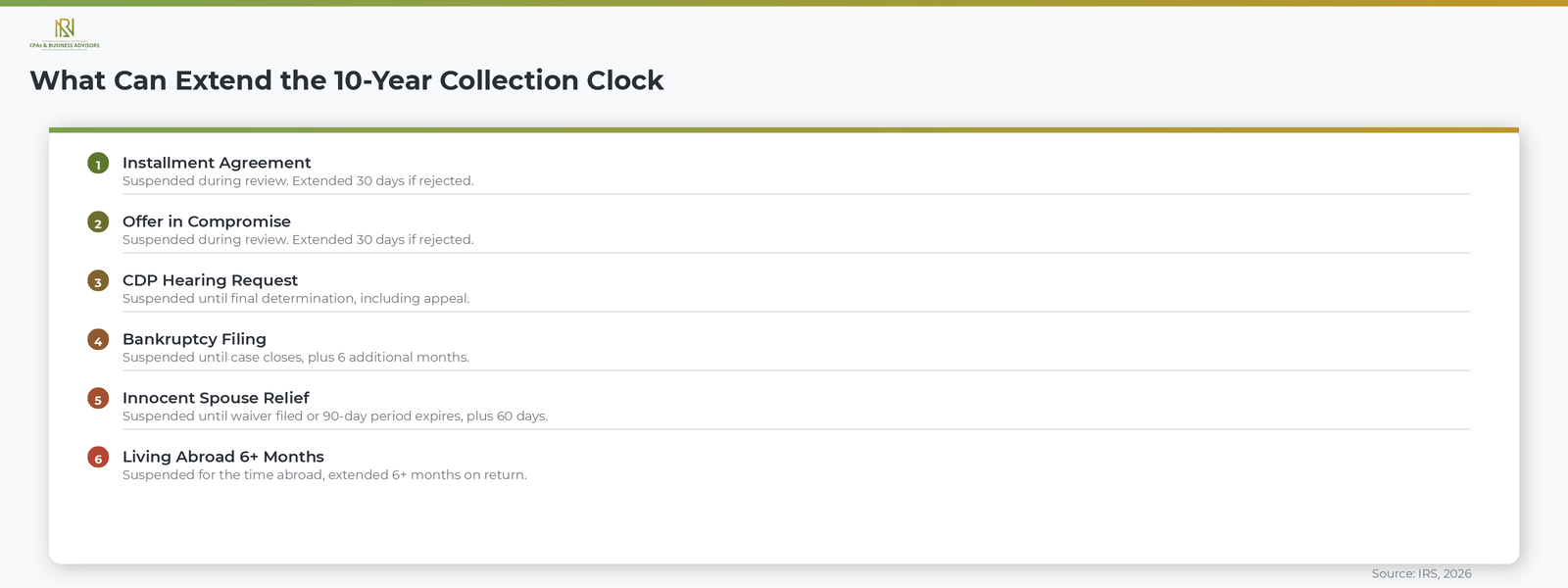
Several common actions and events can pause or extend the 10-year CSED, effectively giving the IRS more time to collect than the standard decade. According to the IRS, when the agency is legally prohibited from collecting, the clock is suspended (paused), and when the law permits additional time, the clock is extended. The most common situations include the following.
- Requesting an installment agreement. The CSED is suspended while the IRS reviews your request. If the IRS rejects or proposes terminating the agreement, the CSED is extended by 30 days. If you appeal, the suspension continues through the appeal.
- Filing an Offer in Compromise. The CSED is suspended while the IRS evaluates your offer. If the offer is rejected, the suspension continues for another 30 days, and through any appeal.
- Requesting a Collection Due Process hearing. The CSED is suspended from the time the IRS receives your request until it issues a final determination, including any appeal period.
- Filing for bankruptcy. The CSED is suspended from the date of the bankruptcy petition until the court discharges, dismisses, or closes the case, plus an additional six months.
- Requesting innocent spouse relief. The CSED is suspended until you file a waiver or your 90-day period to petition the Tax Court expires, plus 60 additional days.
- Living outside the United States. According to the IRS, if you live outside the country continuously for six months or more, the CSED is generally suspended for that period and may be extended by at least six months when you return.
These suspensions are important to understand because taxpayers sometimes unknowingly add years to their CSED by taking actions they believe will help resolve their debt. Requesting an installment agreement, for example, pauses the clock for the entire review period. This does not mean you should avoid resolution options, but it does mean you should factor the CSED impact into your decision.
How The Collection Statute Affects Your Resolution Options
The CSED can work in your favor when choosing how to resolve an IRS tax debt because the closer you are to the expiration date, the less the IRS expects to collect and the more leverage you may have in settlement negotiations. If your CSED is approaching and your balance is large, an Offer in Compromise may be more attractive to the IRS because the agency may determine that accepting a reduced amount now is better than collecting nothing after the statute expires.
Similarly, if your income is low enough to qualify for Currently Not Collectible status, the 10-year clock continues to run while your account is in that status. According to the IRS, if the CSED expires while your account is designated Currently Not Collectible, the remaining debt is written off permanently. For taxpayers who want to explore all available resolution paths, our guide to handling a tax balance you cannot pay covers installment agreements, Offers in Compromise, CNC status, and penalty relief.
Taxpayers who are working to get back into compliance across multiple years may also benefit from the IRS Fresh Start program, which expands eligibility for installment agreements and raises the threshold for lien filing, making it easier to resolve balances while the CSED clock continues to run.

Frequently Asked Questions
How Far Back Can The IRS Collect Unpaid Taxes?
The IRS has 10 years from the date a tax is assessed to collect it. According to the IRS, this is called the Collection Statute Expiration Date (CSED). After 10 years, the IRS can no longer legally collect the debt, though certain actions like installment agreements, bankruptcy, and living abroad can suspend or extend the clock.
Does The 10 Year Clock Start If You Never Filed?
No, the 10-year collection clock does not start until a tax is assessed. According to the IRS, if you never file a return and the IRS does not file a Substitute for Return on your behalf, there is no assessment and no statute of limitations. The IRS can pursue unfiled returns indefinitely.
Can The IRS Audit You After 10 Years?
The audit statute of limitations is separate from the collection statute and is typically three years, not 10. According to the IRS, the audit window extends to six years if you omitted more than 25 percent of your gross income, and there is no time limit at all if you never filed or filed a fraudulent return.
Does Filing An Offer In Compromise Extend The Collection Period?
Yes, filing an Offer in Compromise suspends the CSED while the IRS evaluates your offer. According to the IRS, the suspension continues for 30 additional days if the offer is rejected and through any subsequent appeal. This means the total collection period will be longer than 10 years if an OIC was submitted and later denied.

.avif)
.avif)