Learning Center for Tax and Financial Insights

Stay updated with clear, actionable articles on tax rules, deadlines, deductions, and financial decisions that impact individuals and businesses.

No items found.

Building Generational Wealth: A Comprehensive Guide to Trump Accounts

With the recent passage of the Working Families Tax Cuts Act—often referred to as the One Big Beautiful Bill Act (OBBBA)—President Trump has introduced a significant new vehicle for family financial planning: the Trump Account. For our clients here in Coral Gables and across South Florida, this presents a unique avenue to establish a financial foundation for the next generation.

These tax-advantaged savings accounts are designed specifically for children under the age of 18. Furthermore, for families welcoming new additions between January 1, 2025, and December 31, 2028, there is a distinct pilot program available that includes a $1,000 government contribution to jumpstart the account.

At NR CPAs & Business Advisors, we believe in proactive planning. Whether you are a business owner looking to maximize benefits or a parent focused on your child's future, understanding the nuances of these accounts is essential.

Understanding the Structure of Trump Accounts

Think of a Trump Account as an innovative hybrid savings vehicle, sharing DNA with Individual Retirement Accounts (IRAs), but tailored specifically to build wealth from the moment a child is born. The primary goal is long-term growth.

For children born during the eligibility window of 2025 through 2028, the accounts come with the option to receive a one-time $1,000 seed contribution from the federal government. Beyond that initial seed, the structure allows for additional private contributions of up to $5,000 annually. This cap will be adjusted for inflation in future years and remains in effect until the year before the child turns 18.

To ensure steady growth and minimize speculative risk, the funds within these accounts are invested exclusively in broad, low-cost stock market index funds. This strategy leverages the historical performance of the market to provide substantial accumulation over the child’s minority.

Father and son discussing financial future

Eligibility and Building the Pot: Who Can Contribute?

Inclusivity is a key feature of this legislation. Any child under the age of 18 with a valid Social Security number is eligible to have a Trump Account. While the account is managed by a parent or guardian until the child reaches adulthood, the ability to contribute extends to the entire "village."

1. The Contribution Ecosystem

We see this as a powerful tool for intergenerational wealth transfer. Contributions can be made by a wide variety of sources:

  • Diverse Contributors: Money can be deposited by parents, guardians, grandparents, extended family members, friends, and even the children themselves. The standard annual limit begins at $5,000 per child, subject to future inflation adjustments.
  • Tax Treatment of Contributions: Generally, these private contributions are not tax-deductible for the donor. However, there is a notable exception for business owners and employers (see below).
  • Employer Incentives: This is particularly relevant for our business clients. Employers can contribute up to $2,500 annually toward a child's $5,000 cap. The benefit here is twofold: the employer receives a tax deduction for the contribution, and it is treated as a non-taxable benefit for the employee. This can be a highly attractive addition to a benefits package.
  • Safeguarding the Limits: Because contributions can come from so many different sources—grandma, the employer, the parents—there is a risk of inadvertently exceeding the $5,000 annual cap. To prevent this, robust safeguards are required. A centralized record-keeping system is necessary to monitor total inflows for each child's account in real-time. We strongly advise setting up a protocol where contributors register their planned gifts in advance. The system should ideally flag any potential over-contributions before they happen. Implementing automated alerts when the account nears the $5,000 threshold is a prudent measure to avoid administrative headaches. Clear communication among family members regarding who is contributing what is vital to maintaining the integrity of the account.

2. Institutional and Charitable Contributions

The legislation also empowers qualifying charitable organizations and government entities (such as states, tribes, and municipalities) to bolster these accounts. However, these entities cannot pick and choose individual favorites; they must designate a "qualified class" of beneficiaries.

For example, a charity might fund accounts for all children born in a specific year within a designated geographic area. This framework allows philanthropic and governmental bodies to make broad, foundational investments in the financial health of specific demographics.

Real-World Example: Michael and Susan Dell, through the Michael & Susan Dell Foundation, have pledged $6.25 billion to seed Trump Accounts. They are providing $250 for children aged 10 or under who were born before Jan. 1, 2025. This massive pledge targets 25 million children in ZIP codes with a median income of $150,000 or less.

The $1,000 Government Seed: A Closer Look

For families with newborns, the federal government’s one-time $1,000 contribution acts as a powerful catalyst for compound interest. This seed money is designed to give the account immediate momentum in the stock market.

However, strict criteria apply to this government grant:

  • Birth Date Window: The child must be born on or after January 1, 2025, and before January 1, 2029.
  • Citizenship Requirement: The beneficiary must be a U.S. citizen possessing a valid Social Security number.
  • Affirmative Election: This is not automatic. A parent or guardian must explicitly elect to open the Trump Account on the child's behalf.
  • One-Time Event: This is a singular, initial deposit of $1,000. There are no recurring government contributions.
  • Exempt from Caps: Crucially, this $1,000 grant does not count toward the $5,000 annual private contribution limit.
  • Tax Treatment: While the seed money and its investment earnings grow tax-deferred, they are considered pre-tax funds. Consequently, they will be taxed as ordinary income when withdrawn after the child turns 18.

It is important to note that children born outside this specific four-year window (for instance, those born before 2025) are still eligible to have a Trump Account opened. They can still receive employer contributions and charitable grants (like the Dell Foundation example above), but they will not qualify for the federal $1,000 seed money.

Young entrepreneur reviewing documents

Investment Strategy: Simplicity and Growth

The investment rules for Trump Accounts are purposefully restrictive to protect the principal while chasing growth. Funds must be invested in broad U.S. equity index funds. These funds are characterized by minimal fees and a prohibition on using leverage. By tracking the broader market, the strategy aims to deliver consistent long-term returns without the volatility of picking individual stocks.

Navigating the Tax Implications

For our clients engaging in tax planning, understanding the "buckets" of money within a Trump Account is critical. It operates somewhat like a hybrid between a Roth IRA and a Traditional IRA.

Contributions made by parents or family are non-deductible (similar to a Roth). However, the earnings on those contributions grow tax-deferred (similar to a Traditional IRA) until withdrawal. Once the beneficiary reaches adulthood, standard IRA withdrawal rules come into play, including potential taxes and penalties for early access.

  • Distributions Before Age 18: Generally, the funds are locked. Distributions are not permitted until the beneficiary turns 18, ensuring the money is preserved for adulthood.

    Exceptions are made in tragic circumstances. If a child with a Trump Account passes away, the funds can be transferred to the child's estate or a designated survivor. We recommend establishing clear beneficiary directives when opening the account to ensure your intentions are honored.
  • Distributions After Age 18: Once the beneficiary is of age, withdrawals are split into two tax treatments:
  • After-tax contributions: Money contributed by parents, relatives, or friends can be withdrawn tax-free, as taxes were already paid on these funds before they were deposited.
  • Pre-tax amounts: This includes the investment earnings, the $1,000 government seed, and any employer or charitable contributions. These portions are taxed as ordinary income upon withdrawal.
  • The 10% Penalty: Similar to retirement accounts, a 10% early withdrawal penalty generally applies to taxable distributions taken before age 59½.
  • Penalty Exceptions: While the income tax on pre-tax portions cannot be avoided, the 10% penalty is waived if the funds are used for specific "qualified expenses" after age 18:
  • Higher Education: Costs for tuition, books, and fees at post-secondary institutions.
  • First-Time Home Purchase: Up to $10,000 may be applied toward a down payment.
  • Family Building: Up to $5,000 for qualified birth or adoption expenses.
  • Disability: Costs related to the beneficiary's disability.
  • Hardship: Specific exceptions exist for terminal illness and disaster recovery.

Account Management and Strategic Filing

Opening a Trump Account requires specific action. Guardians must utilize IRS Form 4547, "Trump Account Election(s)," or use the digital portal at trumpaccounts.gov.

While Form 4547 can be filed alongside your 2025 tax return, the online application tool is expected to launch in mid-2026. Furthermore, accounts cannot begin accepting contributions until July 4, 2026. Initially, these accounts are held by a Treasury-designated agent, but once established, they can be transferred to a private brokerage. This transferability allows you to consolidate your family's finances under one roof and select a firm that aligns with your service preferences.

Financial health and planning concept

IMPORTANT FILING REQUIREMENT

If you have children under 18 and wish to establish a Trump Account, you must file Form 4547 with your tax return. The form accommodates two children per page, and multiple forms can be attached if needed. It requires the parent/guardian's name, SSN, and contact info, as well as the child's name, SSN, DOB, and address.

Crucially, you must check the specific box on the form if you want an eligible child (born after January 1, 2025, and before January 1, 2029) to receive the $1,000 government seed contribution. Missing this checkbox could mean forfeiting the grant.

Properly setting up these accounts requires attention to detail, particularly regarding the election for the government contribution. If you need assistance filing Form 4547 or have questions about how Trump Accounts fit into your broader tax planning strategy, please contact NR CPAs & Business Advisors. We are here to help you navigate these changes and secure your family's financial future.

Explore More
No items found.

Tax Season Prep: Turning Organization into Deductions

Tax Season Prep: Turning Organization into Deductions

It is that time of year again. If you are like most of our Coral Gables clients, you might be staring down the task of compiling a year’s worth of records. While gathering receipts and statements feels like a chore, that effort directly translates into tax savings.

Maximize Your Time with NR CPAs

When you arrive fully prepared for your appointment with NR CPAs & Business Advisors—whether we meet in person, via videoconference, or over the phone—we can move past basic data entry and focus on strategy.

Office desk with financial documents and laptop

Strategic Planning with Nischay Rawal

Organized records allow us to spend our time exploring additional deductions and refining your long-term tax plan. Don't leave money on the table; let's make this tax season your most efficient one yet.

Explore More
No items found.

Navigating the Financial and Tax Realities of Addiction Recovery

Substance use disorders present a dual challenge: the immediate, profound impact on personal health and relationships, and the often-overlooked financial and tax complexities that follow. As trusted advisors at NR CPAs & Business Advisors in Coral Gables, we understand that the road to recovery is rarely a straight line. It involves an intricate web of economic decisions, from funding treatment to managing the tax implications of disability or unemployment.

For individuals striving toward sobriety, as well as their families and employers, understanding these tax nuances is not just about compliance—it is a critical component of a sustainable recovery plan. By leveraging the tax code correctly, you can help alleviate some of the financial burdens associated with this widespread social issue.

Treating Addiction: Tax Deductibility of Medical Expenses

The IRS acknowledges alcoholism and drug addiction as medical ailments. Consequently, the costs associated with treating these conditions are generally classified as deductible medical expenses. This is a vital distinction because it opens the door to potential tax relief for families paying out-of-pocket for care.

Family reviewing financial documents with an advisor

However, simply incurring the expense isn't enough. To claim these deductions, you must itemize your deductions on Schedule A, and your total medical expenses must exceed 7.5% of your Adjusted Gross Income (AGI). Only the amount above that 7.5% floor is deductible.

Eligible expenses typically include:

  • Inpatient treatment at therapeutic centers for alcohol or drug abuse (including meals and lodging provided during treatment)
  • Detoxification programs
  • Doctors and psychological services
  • Prescribed medications
  • Behavioral therapies and counseling
  • Laboratory testing
  • Transportation costs to and from treatment

It is important to note that to claim these expenses for someone other than yourself, the individual must have been your spouse or dependent either when the medical services were provided or when the bills were paid.

The "Medical Dependent" Exception

One of the most common questions we receive involves parents paying for the rehabilitation of an adult child. Often, these adult children do not meet the strict income requirements to be claimed as a dependent on a tax return. However, tax law provides a compassionate carve-out known as the "medical dependent" rule.

You may be able to deduct medical expenses you pay for an individual even if they do not qualify as your dependent for other tax purposes, provided they meet these three criteria:

  1. The person is related to you OR lived with you for the entire year as a member of your household (temporary absences for medical treatment count as living with you).
  2. The person was a U.S. citizen or resident (or a resident of Canada or Mexico) for part of the calendar year.
  3. You provided over half of that person’s total support for the calendar year.

If these conditions are met, the age and income of the person in recovery are not limiting factors. For example, if you pay the rehab facility directly for your adult child's treatment and you provide more than half their support for the year, you can include those costs in your medical expense calculations.

A Note for Divorced Parents: If a child qualifies as a dependent for either parent, each parent can generally deduct the medical expenses they personally paid for the child. Effective communication is key here; coordination ensures that payments are structured in a way that maximizes the tax benefit, perhaps by having the parent with the lower AGI (who can surpass the 7.5% floor more easily) make the payments.

The Hurdles: Standard Deduction vs. Itemizing

Even if your expenses are eligible, two mathematical hurdles determine whether you will see a tax benefit. First, as mentioned, is the 7.5% AGI floor. Second is the Standard Deduction. You only benefit from itemizing if your total itemized deductions (medical, state/local taxes, mortgage interest, charitable gifts) exceed your standard deduction.

With the standard deduction adjusted for inflation, this bar is set relatively high. Below are the standard deduction amounts for the 2025 and 2026 tax years:

BASIC STANDARD DEDUCTION

Filing Status

2025

2026

Single & Married Separate

$15,750

$16,100

Married Joint & Qualifying Surviving Spouse

$31,500

$32,200

Head of Household

$23,625

$24,150

Taxpayers age 65 or older, or those who are blind, receive an additional standard deduction:

  • 2025: $2,000 for Single/Head of Household; $1,600 per person for Married/Qualifying Surviving Spouse.
  • 2026: $2,050 for Single/Head of Household; $1,650 per person for Married/Qualifying Surviving Spouse.

Given these thresholds, tax planning becomes essential. If you anticipate high medical costs for addiction treatment, please reach out to NR CPAs. We can help you run the numbers to see if "bunching" expenses or other strategies might trigger a tax benefit.

Long exposure of a winding road at night

Employment, Benefits, and Income Tax

Substance addiction often disrupts employment, creating a ripple effect that impacts income stability. Navigating the intersection of unemployment, disability, and worker’s compensation is critical for maintaining financial health during recovery.

Unemployment Benefits

Unemployment insurance is a lifeline, but eligibility can be tricky when addiction is involved. Generally, you must lose your job through no fault of your own to qualify. Being terminated specifically for substance abuse at work often jeopardizes this eligibility.

However, there are exceptions. If an addiction causes job loss but the individual enters a documented treatment plan and actively seeks recovery, some jurisdictions may grant benefits. This underscores the importance of having a paper trail regarding rehabilitation efforts. While Florida does not tax personal income, it is important to remember that unemployment compensation is fully taxable for federal income tax purposes.

Disability Benefits (SSDI vs. SSI)

When addiction leads to long-term health consequences that prevent working, federal disability programs may apply.

  • SSDI (Social Security Disability Insurance): Addiction itself cannot be the material reason for the claim. However, if substance abuse has caused irreversible physical or mental impairments (such as liver disease or permanent cognitive issues), you may qualify based on those conditions. Like regular Social Security, SSDI may be federally taxable depending on your total household income.
  • SSI (Supplemental Security Income): This is a needs-based program. Again, the disability must be separate from the addiction. SSI payments are generally not taxable.

Worker’s Compensation

Worker’s compensation covers medical expenses and lost wages for work-related injuries. If substance use was the primary cause of the workplace accident, the claim is likely to be denied. However, if the addiction developed as a coping mechanism for severe job-related stress or untreated mental health conditions caused by the work environment, a claim might be viable. Worker’s compensation benefits are generally tax-free, though exceptions exist if you return to work on light duty or receive interest on payments.

For Employers: The Value of Employee Assistance Programs (EAPs)

For our business clients in Coral Gables and beyond, we often recommend implementing Employee Assistance Programs (EAPs). These are not just "perks"—they are strategic tools for risk management and employee retention.

Office desktop setup representing business planning

Employers can generally deduct the costs of EAPs as ordinary business expenses. These programs provide:

  • Confidential Support: Offering a safe harbor for employees to seek counseling without fear of immediate termination promotes early intervention.
  • Education & Prevention: Workshops on substance risks help build a healthier corporate culture and reduce the likelihood of workplace accidents.

Charitable Contributions and Support

Finally, many families and individuals choose to support addiction recovery non-profits.

  • Cash Contributions: Donations to qualified 501(c)(3) organizations are deductible for those who itemize. Looking ahead, new legislation taking effect after 2025 is set to allow non-itemizers to deduct up to $1,000 ($2,000 for joint returns) for cash charitable contributions. This specific deduction helps calculate taxable income but does not reduce AGI.
  • Volunteering: You cannot deduct the value of your time, but you can deduct out-of-pocket expenses incurred while volunteering, such as mileage to and from a support center, provided you itemize.

We Are Here to Help

At NR CPAs & Business Advisors, led by Nischay Rawal, we combine the technical depth of a large firm with the agility and empathy of a boutique partner. Whether you are a business owner managing employee benefits or a family member navigating the costs of recovery, you don't have to do it alone.

Contact us today to discuss your specific situation with confidentiality and care.

Explore More
No items found.

Exploring College Athletes' Evolving Income Streams: NIL Earnings and Revenue Sharing from Athletic Events

The world of college athletics has undergone significant changes in recent years, particularly with the introduction of Name, Image, and Likeness (NIL) income opportunities for student-athletes. As these athletes’ balance academics and sports, they must also navigate the complexities of taxation related to their various sources of income. This article explores the tax implications of NIL income, scholarships, grants, financial aid, part-time jobs, education credits, education loan interest and more.

Scholarships

Scholarships can be either taxable or non-taxable depending on how they are used and the terms of the scholarship. Here are the general rules:

  • Non-Taxable Scholarships: Scholarships are generally not taxable if they are used for qualified education expenses. These expenses typically include tuition, fees, and required books, supplies, and equipment for courses at an eligible educational institution. The scholarship must not exceed the amount of these expenses.
  • Taxable Scholarships: If any part of the scholarship is used for non-qualified expenses, such as room and board, travel, or optional equipment, that portion is considered taxable income. Additionally, if the scholarship terms specify that it must be used for non-qualified expenses, it is taxable.
  • Athletic Scholarships: These are often a mix of qualified and non-qualified funds. Student-athletes must carefully track how their scholarships are used to determine the taxable portion.

Reporting Requirements: Whether a student needs to report a scholarship on their tax return depends on whether any part of it is taxable. If the scholarship is entirely non-taxable, it generally does not need to be reported. However, if any portion is taxable, it must be included in gross income.

Education Tax Credits: When calculating education tax credits, qualified tuition must be reduced by any tax-free scholarship amounts. However, if the scholarship terms allow, students can allocate funds to maximize tax benefits by choosing how to apply the scholarship to different expenses that don’t qualify for education credits, for example room and board.

Understanding these rules can help in planning how to use scholarship funds effectively to minimize tax liability and maximize education tax credits.

Grants and Financial Aid

Pell Grants and other federal student aid are generally not taxable if they are used for qualified education expenses. Qualified education expenses typically include tuition and fees, books, supplies, and equipment required for courses as well as transportation and living expenses (such as room and board at the educational institution or off-campus rent).,

However, if a student chooses to apply the Pell Grant to non-qualified expenses, the amount used for those expenses must be included in gross income, which could make it taxable.

Pell Grants generally do not have to be repaid.

Income from NIL

NIL is the acronym for name, image, and likeness. In 2020, the National Collegiate Athletic Association (NCAA) changed its rules to allow schools to pay athletes for academic performance, but this was overruled by the Supreme Court in the NCAA vs. Alston case, which removed limits on such payments. In July 2021, the NCAA adopted a policy allowing student-athletes to profit from their NIL, marking a significant shift in college sports. Thus student-athletes can earn NIL income through endorsements, sponsorships, social media promotions, autograph signings, and appearances.

Subsequently, a NCAA NIL settlement, primarily the House v. NCAA case approved in June 2025, fundamentally changes college sports by allowing schools to pay athletes directly. Key provisions include approximately $2.8 billion in damages (back pay) for former athletes and a new framework for future revenue sharing for current athletes.

Beginning July 1, 2025, schools in participating conferences can share revenue directly with current student-athletes, up to an initial annual cap of $20.5 million per school, which will increase annually.

The settlement continues to allow third-party NIL deals (endorsements, sponsorships, etc.) but requires deals over $600 to be reported to a new third-party clearinghouse, "NIL Go," for review to ensure they have a valid business purpose and are at fair market value.

All previous NCAA scholarship limits are eliminated, allowing schools to offer full or partial scholarships to all athletes up to new roster limits.

Tax Reporting for NIL Income: Athletes receiving NIL income are generally considered independent contractors. They should receive Forms 1099-NEC or 1099-K, depending on the payment method. Athletes must report this income on their tax returns and may need to make estimated tax payments quarterly. The income is generally reported as self-employment income on a 1040 Schedule C.

  • Deductions and Expenses: Student-athletes can deduct ordinary and necessary business expenses related to their NIL income, such as travel, marketing, and professional fees related to the NIL income.
  • Self-Employment Tax: Since NIL payments are generally considered self-employment income, student athletes must pay self-employment (SE) taxes if their net earnings exceed $400 in a tax year. SE tax is like the FICA (6.2%) and Medicare (1.45%) withholding for employees. The key difference is that while employers pay an amount equal to what their employees pay, self-employed individuals act as both employer and employee, thus paying both portions, resulting in a total SE tax rate of 15.3%. Unlike employees, who are taxed on their gross taxable wages, self-employed individuals are only subject to SE tax on their net profit, which is calculated as gross income minus business expenses deductions.
  • Cryptocurrency: Occasionally a student athlete will receive NIL payments in cryptocurrency. When this occurs, there are several tax implications to consider:

    o    Income Recognition: Cryptocurrency received as payment for services, including NIL activities, is considered taxable income. The fair market value of the cryptocurrency at the time of receipt must be reported as income. Thus, a student-athlete receiving NIL payments in cryptocurrency would include that compensation, converted into U.S. dollars, on their Schedule C as part of their gross income.

    o    Capital Gains Tax: If the athlete holds the cryptocurrency and later sells or exchanges it for a different cryptocurrency or fiat currency, any gain or loss from the transaction will be subject to capital gains tax. The gain or loss is calculated based on the difference between the sale price and the fair market value at the time the cryptocurrency was received.

    o    Record Keeping: It is crucial for the athlete to maintain detailed records of all cryptocurrency transactions, including the date of receipt, fair market value at the time of receipt, and any subsequent sales or exchanges.

Overall, receiving NIL payments in cryptocurrency adds significant complexity to tax reporting and compliance.  

NCAA Eligibility and Tax Considerations

Maintaining NCAA eligibility is crucial for student-athletes, and understanding the tax implications of their income is part of this process:

  • Impact on Financial Aid: NIL income and other earnings can affect a student-athlete's eligibility for need-based financial aid when completing the Free Application for Federal Student Aid (FAFSA). It's important to report all income accurately on the form.
  • Compliance with NCAA Rules: While the NCAA now allows NIL income, athletes must still comply with institutional and conference rules. This includes understanding how income affects their amateur status and eligibility.

Part-Time Jobs

Many student-athletes take on part-time jobs to supplement their income. The income earned from these jobs is subject to federal and state income taxes. Key considerations include:

  • W-2 Income: Employers provide a W-2 form detailing wages earned and taxes withheld. Student-athletes must report this income on their tax returns.
  • Self-Employment: If a student-athlete engages in freelance work or gigs, they may be considered self-employed. This requires filing a Schedule C and paying self-employment taxes on net earnings over $400. If the student also has NIL income, the two are combined for SE tax purposes and the $400 limit applies to the combined total.

Student’s Standard Deduction

The standard deduction for a dependent, such as a full-time student-athlete under the age of 24, is calculated based on their earned income. This includes salaries, wages, tips, and other compensation for work performed, as well as any taxable portion of scholarships or fellowship grants.

  • Dependent: A student who does not provide over half of their own support is claimed as a dependent by their parents. The standard deduction for such a dependent in 2025 and 2026 is the greater of $1,350 or their earned income plus $450, but it cannot exceed the regular standard deduction for a single filer, which is adjusted annually for inflation. If the student's unearned income (such as interest and dividends) in 2025 and 2026 is more than $1,350 but less than $13,500, their parents have the option to claim this unearned income on their tax return.
  • Non-Dependent: A non-dependent is a self-supporting student who pays more than half of their own support and does not qualify as a dependent. This student is eligible for the regular standard deduction, which is adjusted annually for inflation, and is $16,100 for 2026 (up from $15,750 for 2025) if the student is not married or $32,200 for 2026 (up from $31,500 for 2025) if married and filing a joint return with their spouse.

Education Credit

The American Opportunity Tax Credit (AOTC) is a tax credit available to help offset the costs of higher education by reducing the amount of income tax the taxpayer may have to pay. Currently, the AOTC provides a credit of up to $2,500 for adjusted qualified education expenses paid for each student who qualifies for the credit.

The credit is partially refundable: if the credit reduces the tax to zero, 40% of any remaining amount of the credit (up to $1,000) is refundable. However, if the student is subject to the “kiddie tax” rules, no portion of the credit is refundable.

The credit is reduced for a taxpayer with modified adjusted gross income (AGI) over a certain threshold, which is $160,000 if married filing jointly, and $80,000 for other filing statuses. These threshold amounts are not indexed for inflation.

For years after 2025, the taxpayer who is claiming the credit must include on their tax return their own social security number (SSN), as well as the name and SSN of the student for whom the credit is claimed. For this purpose, an SSN is valid only if it is issued to a U.S. citizen or person authorized to work in the United States, and it is issued before the due date of the taxpayer’s return. The taxpayer must also include the employer identification number (EIN) of the eligible educational institution to which the qualified education expenses were paid.

To claim the AOTC, the student must be pursuing a degree or other recognized education credential, be enrolled at least half-time for at least one academic period beginning in the tax year and not have completed the first four years of higher education at the beginning of the tax year. Additionally, the credit can be claimed for a maximum of four tax years per eligible student.

The person who claims the student as a dependent on their tax return is generally the one who can claim the AOTC for that student. Most often this will be the parent(s) of the student. However, if the student is not claimed as a dependent, they can claim the credit on their own tax return.

There is another type of higher education credit called the Lifetime Learning Credit (LLC). Since students in their first four years of college will virtually all qualify for the larger AOTC, this article does not discuss the LLC.

When calculating education tax credits, qualified tuition must be reduced by any tax-free scholarship amounts. However, if the scholarship terms allow, students can allocate funds to maximize tax benefits by choosing how to apply the scholarship to different expenses.

Student Loan Interest Deduction

The student loan interest deduction allows borrowers to deduct up to $2,500 of interest paid on qualified student loans from their taxable income each year. This deduction is considered an above-the-line deduction, meaning it can be claimed regardless of whether the taxpayer itemizes deductions or takes the standard deduction.

  • Qualified Student Loans: The loan must be used solely for qualified higher-education expenses, which include tuition, fees, room and board, books, equipment, and other necessary expenses related to attending an eligible educational institution.

    Eligible loans can include federal student loans, private loans, home equity lines of credit, personal loans from unrelated parties, and even credit cards, provided they are used exclusively for education expenses.

    Loans from relatives or pension plans do not qualify.
  • Eligibility for Deduction: The borrower must be legally responsible for the loan and must have used the loan for qualified education expenses.

    The deduction is phased out for higher-income taxpayers. For single filers, the phase-out range is currently an Adjusted Gross Income (AGI) of $85,000 to $100,000. For married couples filing jointly, the range is $170,000 to $200,000.

    The deduction is not available for those who file as married filing separately or for an individual who is claimed as a dependent on another taxpayer's return.
  • Additional Requirements:

    The student must be enrolled at least half-time in a degree or certificate program at an eligible educational institution.

    The loan must be used within a reasonable time frame, typically defined as within 180 days of the start of the academic period for which the expenses are incurred.

State Tax Considerations

State tax laws can vary significantly, impacting student-athletes differently depending on where they attend school and where they earn income:

  • State Income Taxes: Some states have no income tax, while others have high rates. Athletes must file state tax returns in states where they earn income, which may include their home state and the state where their college is located, depending on the filing threshold set by each state.
  • NIL-Specific Legislation: Several states have enacted NIL-specific legislation, which may include tax provisions. Athletes should be aware of these laws and how they affect their tax obligations.

Planning and Compliance

Effective tax planning and compliance are essential for student-athletes to avoid penalties and maximize their financial benefits:

  • Record Keeping: Maintaining detailed records of all income, expenses, and scholarships is crucial for accurate tax reporting.
  • Professional Advice: Consulting with a tax professional who understands the unique circumstances of student-athletes can help navigate complex tax issues.
  • Education and Resources: Universities and athletic departments can provide resources and education to help athletes understand their tax responsibilities.

The financial landscape for student-athletes is evolving rapidly, with NIL income opportunities adding new dimensions to their tax obligations.

Understanding how the various tax implications of education benefits impact students and parents can lead to more beneficial use of the various tax benefits. Contact this office for assistance.  

Explore More
No items found.

Why Seeing the Same Concert in Las Vegas Can Cost Hundreds More Than Anywhere Else

Las Vegas has always sold itself as the entertainment capital of the world. Concerts, residencies, major sporting events, and once-in-a-lifetime shows are part of its brand. But lately, many travelers are noticing something else: seeing the same artist or event in Las Vegas often costs significantly more than seeing them in other cities, even nearby, drivable destinations like Los Angeles or Denver.

And it’s not just about ticket prices. Once you factor in fees, taxes, hotels, and the “Vegas premium,” the difference can be eye-opening.

Recent reporting out of Las Vegas has started to put real numbers behind what fans have been feeling for a while, and the comparisons tell a clear story.

The Kendrick Lamar Example: Same Artist, Same Tour, Higher Vegas Total

One of the clearest head-to-head comparisons comes from Kendrick Lamar’s 2025 tour.

According to a price analysis cited in local Las Vegas reporting and expanded on by Casino.org, Kendrick Lamar’s May 31 show at Allegiant Stadium in Las Vegas initially appeared slightly cheaper than his May 24 show at SoFi Stadium in Los Angeles — at least at first glance.

  • Base ticket price
    o   Las Vegas (Allegiant Stadium): slightly lower

    o   Los Angeles (SoFi Stadium): slightly higher

But the base price wasn’t the problem.

Once all fees and taxes were added, the picture changed dramatically:

  • Las Vegas total per ticket: approximately $520.25
  • Los Angeles total per ticket: approximately $478.30

That’s a difference of about $42 more per ticket to see the same artist on the same tour, simply because the show was in Las Vegas.

The extra cost came from a combination of higher service fees, facility charges, order-processing fees, and Nevada’s live entertainment tax. In other words, Vegas didn’t look more expensive until checkout, and by then, fans were already committed.

Beyoncé: Vegas Tickets Averaged More Than Other Tour Stops

Kendrick Lamar isn’t an outlier.

Analysts reviewing Beyoncé’s tour pricing found that tickets for her Las Vegas shows at Allegiant Stadium averaged about 23% higher than her performances in other major U.S. cities.

That premium wasn’t driven solely by resale markets or VIP packages. Instead, it reflected:

  • High tourist demand
  • Limited large-venue availability
  • Aggressive pricing for premium seating
  • Fees layered on top of already high demand

In cities like Los Angeles, New York, or Chicago, where multiple large venues compete, plus a greater percentage of attendees are local, pricing pressure is often spread out. In Las Vegas, demand is concentrated, and the audience includes visitors willing to pay more as part of a vacation experience.

Zach Bryan: Another Vegas Premium

Country star Zach Bryan provides another telling example.

Ticket data shows that Zach Bryan concerts in Las Vegas averaged about 16% more than the same shows on his tour in other cities. Again, this wasn’t because the show itself was different; it was the same artist, same production, same tour.

The difference was location.

Vegas audiences tend to include:

  • Tourists who have already spent money on flights and hotels
  • Fans who treat the show as the centerpiece of a weekend getaway
  • Attendees are more likely to purchase premium seats or add-ons

That combination allows promoters to push prices higher, and they often do so successfully.

Why Vegas Tickets End Up Higher Than LA or Denver

These examples highlight a broader pattern, and it comes down to a few key factors.

1. Fees and Taxes Matter More Than Base Price

Nevada imposes a live entertainment tax, which applies to many concerts and events. Add in venue fees and service charges, and Vegas tickets often carry more add-ons than tickets in other cities.

The result: two tickets with similar face values can end up dozens of dollars apart once fees are included.

2. Tourist Demand Changes Buyer Behavior

Las Vegas isn’t just selling a concert. It’s selling an experience.

Many attendees:

  • Are already traveling
  • Have built the event into a vacation budget
  • Are less price-sensitive because the trip itself is “special”

That mindset doesn’t exist to the same degree in cities like Los Angeles or Denver, where many fans are locals who can drive home after the show.

3. Fewer Comparable Venues

Los Angeles alone has multiple stadium-level venues and arenas. Denver, while smaller, still benefits from regional draw and competition.

Las Vegas, by contrast, has a limited number of massive venues – the Raiders’ Allegiant Stadium is by far the largest option — suitable for the biggest tours. When demand spikes, prices rise quickly, and there’s nowhere else for fans to go.

It’s Not Just the Ticket: The Total Vegas Cost Problem

Even if ticket prices were identical, Las Vegas trips often cost more overall.

  • Hotel taxes in Las Vegas hover around 13.38%, among the highest in the U.S.
  • Resort fees often add $30–$50 per night, on top of advertised rates
  • Food, drinks, parking, and transportation are frequently more expensive than visitors expect

By comparison, going to a similar concert in Los Angeles or Denver might allow fans to:

  • Drive instead of fly
  • Avoid resort fees
  • Stay with friends or choose from a wider range of accommodations

That’s why many travelers are discovering that a “cheap Vegas room” doesn’t mean a cheap weekend.

When Vegas Still Makes Sense

Despite the premium, Las Vegas still works for certain trips.

It can make sense if:

  • The artist is only playing Vegas, such as during a residency
  • You want a bundled entertainment weekend
  • You book far in advance or midweek
  • You value the overall experience more than the lowest price

But the days of assuming Vegas is automatically the cheaper option are over, especially for major events. The data backs up what fans are increasingly noticing: seeing the same concert in Las Vegas often costs more than seeing it elsewhere.

  • Kendrick Lamar: about $42 more per ticket than Los Angeles
  • Beyoncé: roughly 23% higher in Vegas
  • Zach Bryan: about 16% more than other tour stops

Between higher fees, taxes, tourist demand, and added travel costs, Las Vegas has become a premium destination, even when the show itself hasn’t changed.

For fans deciding where to see their favorite artist, the question is no longer just who’s performing, but where it makes financial sense to go.

Explore More
No items found.

Video Update: The 2026 Standard Business Mileage Rate

2026 IRS Mileage Rate Update

For self-employed professionals and business owners here in Coral Gables, maximizing vehicle deductions is a fundamental part of tax planning. The IRS has officially released the 2026 standard mileage rate, a figure derived from a comprehensive study of fixed and variable vehicle operating costs.

What This Means for Your Deductions

Watch the video above to get the specific numbers for the coming year. Remember, maintaining an accurate mileage log is your best defense to substantiate these expenses. If you have questions about lowering self-employment taxes or need a Fractional CFO to review your books, reach out to Nischay Rawal and the team at NR CPAs & Business Advisors.

Tax calendar and deadline management

Explore More
No results found.
Thank you! Your submission has been received!
Oops! Something went wrong while submitting the form.

Want tax & accounting tips & insights?Sign up for our newsletter.

Thank you! Your submission has been received!
Oops! Something went wrong while submitting the form.

Why Work With Us?

We combine deep tax expertise, financial strategy, and practical business insight to help you manage complexity, stay compliant, and make confident financial decisions.
A dollar sign, representing financial advice or discussion at NR CPAs & Business Advisors.

Experienced CPA and Enrolled Agent Leadership

Guidance led by licensed professionals with deep expertise in tax strategy, compliance, and complex financial matters.
White bar chart with an upward arrow on green circular background representing growth or progress at NR CPAs &. Business Advisors

Support for Growing Businesses and Startups

We understand the financial challenges of growth stage businesses and provide structured guidance to support expansion.
A white hand holding a dollar symbol and ascending bar chart on a green circular background representing financial growth or investment at NR CPAs & Business Advisors..

Strategic Financial Advisory

Our team helps you evaluate financial decisions with greater clarity, supported by practical insights and long term planning.

Fractional CFO Support

Access experienced financial leadership without the commitment and cost of hiring a full time Chief Financial Officer.

Proactive Tax Planning Approach

We focus on identifying tax opportunities throughout the year rather than reacting only during filing season.

Clear and Reliable Financial Reporting

Accurate financial statements and reporting that help you better understand performance and make informed decisions.
White IRS building icon with pillars and a dollar sign above on a green circular background.

Professional IRS Representation

Experienced support in resolving IRS notices, disputes, and compliance matters while protecting your financial interests.

Personalized Client Focus

Every client receives thoughtful attention and tailored financial solutions based on their specific needs and business goals.
Financial matters often involve important decisions. Working with experienced advisors can help you approach them with greater clarity and confidence in your choices.

Need Help With Your Tax or Financial Decisions?

Discuss your situation with our advisors to get clear guidance on tax planning, IRS matters, and the financial decisions ahead.
Business consulting at NR CPAs & Business Advisors.

Request Your Consultation

Fill out the form to discuss your tax concerns, financial questions, or advisory needs with our team. We will review your details and respond shortly.

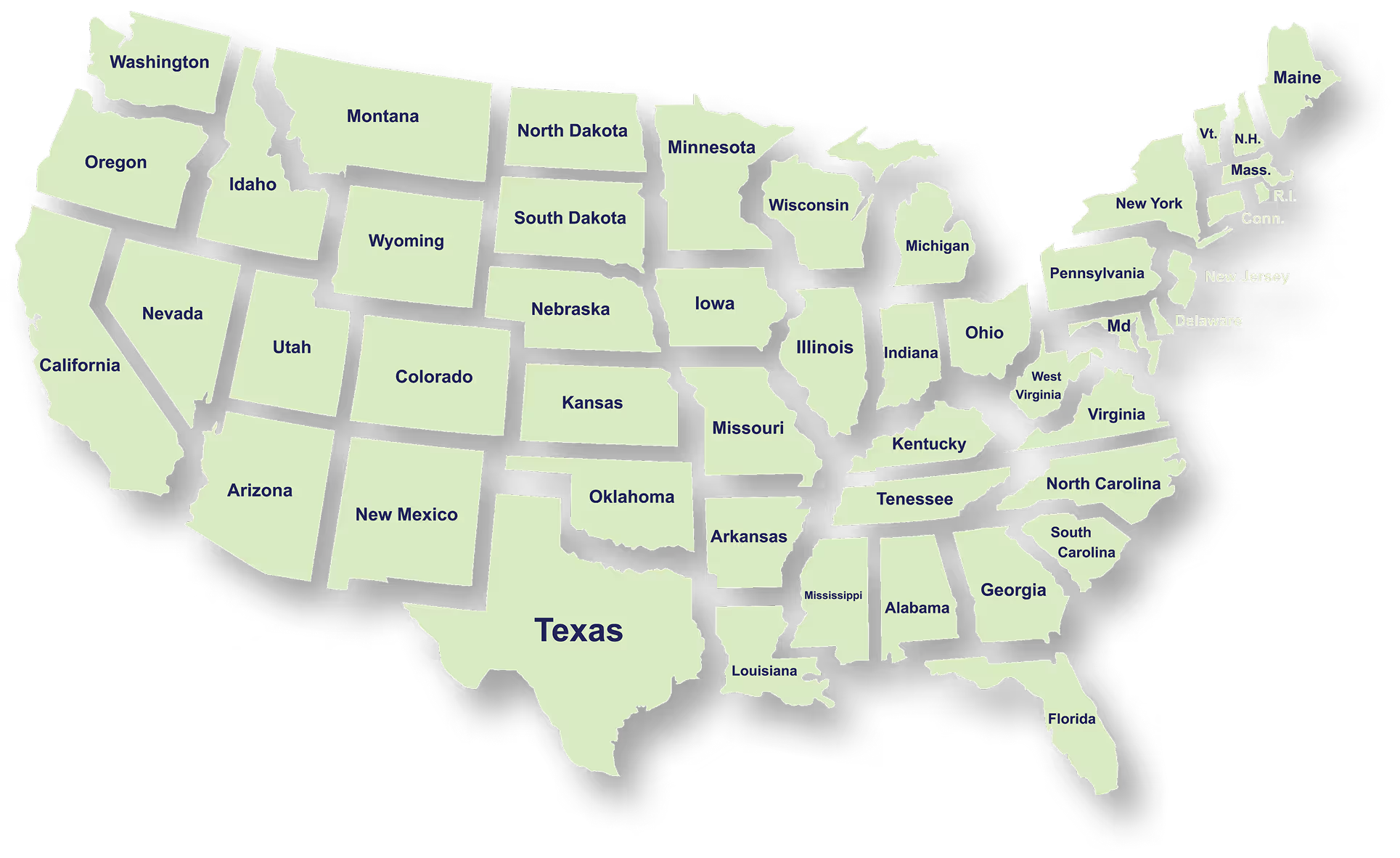
Serving Businesses & Individuals Across USA

We handle accounting, tax filing, and planning with defined timelines and accurate reporting for businesses and individuals across all states.

Frequently Asked Questions

What services does NR CPAs & Business Advisors provide?
What is tax planning and why is it important for businesses?
How can a Virtual CFO help my business?
When should a business consider IRS tax resolution services?
What financial statements does a business typically need?
How can startup advisory services help new businesses?
What is strategic business planning?
What is a Virtual Family Office and who can benefit from it?