Learning Center for Tax and Financial Insights

Stay updated with clear, actionable articles on tax rules, deadlines, deductions, and financial decisions that impact individuals and businesses.

No items found.

Unseen Cash Flow Challenges Facing Today's Small Businesses

Many small business operators are taken by surprise when confronted with a cash flow dilemma.

The threat sneaks in unnoticed.

Margins compress. Financial resources feel constrained. Routine decisions suddenly become complex. While revenue figures might appear satisfactory on paper, bank balances reveal a different scenario.

This situation isn’t a result of inadequate management. Instead, it's caused by multiple gradual financial stressors converging simultaneously, with many intensifying in recent years.

In this post, we’ll dissect the primary silent cash flow threats impacting small and medium-sized enterprises today and explore strategies for business owners to preemptively address these challenges before they become significant issues.

Image 2

1. Persistent Inflation Effects Continue to Linger

Despite a reduction in headline inflation rates, the lingering effects persist.

Numerous businesses are committed to inflated expenses established during peak inflation periods:

  • Inventory and supplies
  • Lease agreements
  • Supplier contracts
  • Insurance premiums

These expenditures do not revert quickly.

Concurrently, customer price sensitivity has escalated, hindering efforts to transfer cost increases. This scenario results in a profit margin squeeze, which might not present as a conspicuous warning but gradually deteriorates profitability.

2. Payroll Growth is Squeezing Margins

Payroll has emerged as one of the most rapidly increasing expenses for SMBs.

Factors include:

  • Rising wage competition
  • Escalating benefits expenses
  • Payroll taxation
  • Overtime transitioning from exception to norm

Many proprietors are now incurring higher payroll costs for the same level of productivity as in previous years.

The complexity arises because isolated payroll increments often appear justified. An increase here. A new hire there. Cumulatively, it evolves into the predominant drain on cash flow.

Image 3

3. Continued Impact of Tariffs and Supply Chain Costs

Even enterprises not engaged directly in importing feel the repercussions of tariffs and global supply chain disruptions.

Increased costs are relayed through:

  • Manufacturers
  • Distributors
  • Vendors
  • Your business

The issue lies in timing. These increases tend to impact several months post pricing decisions, leading businesses to absorb the discrepancies rather than anticipate them.

4. Subscription Overload Drains Resources

Subscriptions, each seemingly minor at $30, $50, or $100 monthly, can deceptively accumulate.

Consider the aggregate cost of:

  • Software tools
  • Applications
  • Platforms
  • Underutilized services

What originating as efficiency enhancements can discreetly escalate into a fixed overhead outlay of thousands monthly.

The auto-renewal feature of subscriptions allows them to persist unmonitored for years, depleting cash without delivering substantial ROI.

Image 1

5. Unexpected Tax Liabilities Surprise Business Owners

This constitutes one of the most painful—and avoidable—cash flow shocks.

Common problematic areas include:

  • Underestimated quarterly tax payments
  • Changes in allowable deductions or credits
  • Mismatched entity structure and operational needs
  • Singular income events causing unexpected tax obligations

Many business owners presume tax matters will self-resolve at tax filing time. When they do not, the resulting unanticipated tax bill impacts cash flow swiftly and significantly.

The Collective Hazard of These Issues

Any of these financial pressures alone is manageable.

The tangible risk arises when they accumulate.

Heightened payroll combined with persistent inflation.
Subscriptions superimposed on top of supply chain cost increments.
Compounded by an unforeseen tax obligation.

This is how seemingly thriving businesses can suddenly experience financial strain.

Proactive Strategies of Savvy Business Owners

The most robust small business owners are not merely reacting to financial challenges. They’re scrutinizing them before escalation occurs.

They evaluate:

  • Where is cash covertly leaking?
  • Which expenses have expanded without examination?
  • Are taxes optimized strategically—or merely paid routinely?

This approach isn’t about indiscriminate cost cutting. It’s focused on ensuring strategic alignment.

Conclusion

Cash flow adversities typically do not announce their onset.

They manifest subtly, camouflaged as routine enhancements, minor incremental decisions, and deferred repercussions.

An anticipatory review can identify inefficiencies, planning opportunities missed, and tax strategies to bolster cash stability before urgent interventions are required.

Engaging in a proactive tax review potentially uncovers overlooked savings for many proprietors.

If these financial pressures sound familiar, reach out to our office to conduct a detailed review before minor challenges evolve into major concerns.

Explore More
No items found.

Maximizing Refunds: Benefiting from Filing Even When Not Required

Many taxpayers may assume that if their income does not exceed certain limits, they can skip out on filing a tax return. However, doing so can mean foregoing substantial refunds and other financial advantages. Let’s delve into why filing a tax return might be beneficial, even if you're not required to do so due to income constraints.

Image 3

Income Thresholds for 2025 – Below are the income limits for various filing statuses for the 2025 tax year, which will be reported by April 2026:

2025 INDIVIDUAL INCOME TAX RETURN FILING THRESHOLDSFILING STATUSUNDER AGE 65AGE 65 OR OLDERSingle$15,750$17,750Head of Household$23,625$25,625Married, Filing Jointly$31,500 (if both under 65)$33,100 (if one is 65+)$34,700 (if both are 65+)Married, Filing Separately$5 (any age)$5 (any age)Qualifying Surviving Spouse$31,500$33,100

Additional Filing Considerations – Besides income levels, you may still need to file if:

  • You have net earnings from self-employment of at least $400.
  • You're subject to the Alternative Minimum Tax.
  • You received advance payments of the Premium Tax Credit for your health insurance.
  • You have unreported Church-related income of $108.28 or more.
  • You need to pay Social Security or Medicare taxes.
  • You've withdrawn from your Health Savings Account (HSA).

Dependent Filing Requirements – Dependents may need to file if their:

  • Unearned income exceeds $1,350.
  • Earned income exceeds $15,750.
  • Total income is more than the larger of $1,350 or their earned income plus $450.

Benefits of Filing Regardless of Requirement – Even when a return isn't mandatory, significant monetary benefits may prompt you to file:

  • Claiming Tax Withholding – Any federal tax withheld from wages is fully refundable if you don't owe taxes.
  • Earned Income Tax Credit (EITC) – This can be a lifeline for lower-income earners, with potential refunds reaching $8,046 in 2025.
  • Child Tax Credit (CTC) – Beneficial even if you're not required to file, offering refunds up to $1,700 per child.
  • American Opportunity Tax Credit (AOTC) – Offers up to $1,000 in refunds for education expenses, benefiting even those without tax liabilities.
  • Premium Tax Credit – Makes health coverage more affordable for those purchasing insurance through the Marketplace.

Carrying Over Deductions – Some deductions must be used for the current year’s return before carryover benefits take effect:

  1. Net Operating Losses (NOLs) – Carrying forward business losses for future tax reductions.
  2. Charitable Contributions – Ensures excess donations can benefit in profitable years.
  3. Passive Activity Losses – Forward losses from rentals to offset future earnings.
  4. Capital Losses: Provides carryover potential to offset future capital gains.

More Considerations:

  • State Program Eligibility – Filing may impact state tax matters and benefit policies.
  • Financial Documentation – Consistent filing supports future loans or mortgage approvals.
  • Security of Information – Filing reduces risks of tax identity theft.

Ultimately, you might be underestimating the benefits of filing a seemingly non-compulsory tax return. To avoid missing out on possible refunds, including substantial credits like the EITC, consult NR CPAs & Business Advisors for tailored guidance on your tax filing strategy. Past tax returns might even surprise you with refunds!

Image 2

Explore More
No items found.

Key Tax Deadlines for February 2026: Individual Filers Guide

Stay on track with your taxes this February 2026! This guide highlights essential deadlines, including estimated tax payments, tip reporting procedures, and W-4 exemption updates, tailored for individual taxpayers.

February 2 - Filers with Estimated Tax Payments

For those who missed the chance to pay the final installment of their estimated taxes by January 15, there’s still an option to file your income tax return (Form 1040 or 1040-SR) for the year 2025 by February 2. Filing and paying any owed tax by this date can help you avoid penalties for late payment. If you find that you can’t meet this deadline, ensure your tax return is filed and paid by April 15.

February 10 - Guidelines for Employees Earning Tips

Did you earn $20 or more in tips during January? It’s essential to report these to your employer promptly. Use IRS Form 4070 or a personal statement including your signature, complete name and address, Social Security number, and employer’s details. Your employer will handle the required FICA and income tax withholding. Should your earnings not sufficiently cover these withholdings, the uncollected amount will appear in Box 8 of your W-2, which you’ll need to address when filing your annual tax return.

February 17 - Withholding Exemption Updates

Individuals who claimed an income tax withholding exemption using Form W-4 last year must submit a new form by this date to maintain their exemption status for the upcoming year.

Considerations for Weekends and Holidays

If a tax deadline lands on a weekend or recognized holiday, it automatically extends to the next business day.

Special Note on Disaster Area Extensions

For residents in areas recently declared disaster zones, tax deadlines may be adjusted. For the latest updates on designated disaster areas and any deadline extensions, please visit FEMA and IRS.

Image 2

For personalized tax advice and planning assistance, [Schedule a consultation](#) with our experts today, ensuring you stay ahead of your tax obligations and optimize your financial strategies effectively.

Explore More
No items found.

Dodge the Tax Torpedoes: Navigating Your Income with Strategic Planning

Dodge the Tax Torpedoes: Navigating Your Income with Strategic Planning

In the intricate landscape of taxation, particularly here in Coral Gables and the broader South Florida region, the concept of Modified Adjusted Gross Income (MAGI) often operates as a silent yet formidable force. While many of our clients focus heavily on standard deductions, itemized expenses, and maximizing various tax credits, the anticipated benefits of these strategies can be unexpectedly derailed by the invisible threshold of MAGI.

This figure, which serves as the gatekeeper for key tax benefits, can stealthily transform expected savings into liabilities. In the accounting world, we refer to this phenomenon as a "tax torpedo." When your income crosses specific lines, it doesn't just increase your tax rate incrementally; it can trigger a cascade of surcharges and phase-outs that dramatically alter your effective tax rate. This guide explores how MAGI can thwart even the most carefully planned financial positions and offers professional insights into navigating these potential pitfalls effectively.

What is Modified Adjusted Gross Income (MAGI)?

To understand the torpedo, you must understand the trigger. MAGI begins with your Adjusted Gross Income (AGI). Your AGI is your total gross income—encompassing wages, dividends, capital gains, net business income, and other sources—minus specific adjustments. These preliminary adjustments might include deductions for education expenses, student loan interest, retirement plan contributions, and the exclusion of certain foreign income.

MAGI is essentially your AGI added back with specified deductions or exclusions to present a "truer" picture of your economic income for testing purposes. These add-backs typically include:

  • Foreign earned income and housing exclusions (under IRC Section 911).
  • Exclusions of income from Puerto Rico, American Samoa, or Guam (under IRC Sections 931 and 933).
  • Tax-exempt interest, such as income from municipal bonds.

The specific adjustments required to compute MAGI depend entirely on the specific tax benefit or rule being applied. Crucially, tax torpedoes are not solely a problem for the ultra-wealthy. They frequently impact middle-to-upper-income taxpayers who may encounter these burdens when determining the taxation of Social Security benefits or the phase-out of family-based tax credits.

THE SOCIAL SECURITY BENEFITS TORPEDO

For those approaching or living in retirement, the taxation of Social Security benefits can be a jarring surprise. The rules determining what portion of these benefits is taxable are complex, involving a "provisional income" calculation that creates a high effective marginal tax rate—the classic torpedo effect.

Social Security benefits may be taxable depending on your filing status and income level. The core concept is that once your combined income crosses a certain floor, a portion of your benefits becomes subject to federal income tax.

  • Calculating Taxable Social Security Benefits

    1. Identify the Base Amount: The base amount is fixed and not adjusted for inflation, which catches more seniors every year. For individual taxpayers, the base amount is $25,000; for married couples filing jointly, it is $32,000.

    2. Determine Combined Income: Your combined income is the sum of your Adjusted Gross Income (AGI), any tax-exempt interest income (like municipal bonds), and 50% of your Social Security benefits.

    3. Threshold and Base Amounts: We then compare this combined income to the base amounts. If the combined income exceeds the base, the torpedo launches, and benefits become taxable.
  • The 85% Rule - At maximum exposure, 85% of your Social Security benefits can be taxed. This occurs when a taxpayer’s combined income significantly exceeds a secondary threshold. Here is the breakdown:

    o   Up to 50% of benefits are taxable if combined income exceeds the base amount ($25k/$32k) but is less than the higher threshold (e.g., $34,000 for single filers and $44,000 for joint filers).
    o   Up to 85% of benefits are taxable if combined income exceeds that higher threshold.

    As your MAGI increases, it pushes the combined income above these static base and threshold amounts, leading to a higher percentage of your benefits being swept into your taxable income.
  • Practical Example - Consider Jane, a single taxpayer in Florida with an AGI of $26,000, nontaxable interest of $500, and Social Security benefits of $10,000. Jane's combined income calculation looks like this:

    o   AGI: $26,000
    o   Nontaxable Interest: $500
    o   Half of Social Security: $5,000

    Her combined income totals $31,500. Because this exceeds the base amount of $25,000, she has triggered a tax on her benefits. Depending on the exact figures, up to 50% of that $10,000 benefit could be added to her taxable income, increasing her tax bill unexpectedly.

THE SENIOR DEDUCTION TORPEDO

Looking ahead, the introduction of the senior deduction for tax years 2025 through 2028 presents a mix of opportunity and risk for clients aged 65 and above. This benefit is designed to provide financial relief, but its phased-out nature requires strategic planning to avoid the "cliff effect."

  • Understanding the Senior Deduction: Initially discussed as a plan to eliminate tax on Social Security benefits, this provision evolved into a deduction available to those who itemize as well as those taking the standard deduction. Notably, you do not need to receive Social Security benefits to qualify. For those age 65 or older, the senior deduction provides an additional deduction of up to $6,000 for individuals and $12,000 for married couples filing jointly.

    However, the benefit is not unlimited. It begins to phase out when a taxpayer’s MAGI exceeds $75,000 for single filers or $150,000 for joint filers. This gradual reduction means that finding yourself slightly over these income lines could eliminate the deduction entirely, increasing your overall liability. For this computation, MAGI means AGI plus the foreign income exclusions previously noted.

THE MEDICARE TORPEDO (IRMAA)

This is perhaps the most common frustration we see among our retired clients. Many retirees do not realize that the Income-Related Monthly Adjustment Amount (IRMAA) acts as a surcharge on Medicare Parts B and D—covering medical services and prescriptions—based strictly on income levels. This is effectively a tax on higher earnings in retirement.

For those retiring without access to a spouse’s employer health plan, Medicare often commences the month you turn 65. Consequently, income earned at age 63—often a peak earning year—influences your premiums when you enroll, due to the two-year lookback period.

Senior couple reviewing documents

Your premiums are based on your MAGI from IRS tax returns two years prior. For example, for the 2025 benefit year, the Social Security Administration looks at your 2023 tax return. If your MAGI in 2023 exceeded $106,000 as a single filer or $212,000 for those filing jointly, IRMAA increases your monthly premium. The table below illustrates how these costs escalate. Note that the Part D surcharge for 2026 ranged significantly based on income.

MONTHLY MEDICARE B PREMIUMS – 2026

Status

Modified AGI 2024

2026 monthly Part B premium

Individuals
Married Filing Joint1

$109,000 or less
$218,000 or less

$202.90

Individuals
Married Filing Joint1

$109,001 - $137,000
$218,001 - $274,000

$284.10

Individuals
Married Filing Joint1

$137,001 - $171,000
$274,001 - $342,000

$405.80

Individuals
Married Filing Joint1

$171,001 - $205,000
$342,001 - $410,000

$527.50

Individuals
Married Filing Joint1

$205,001 - $499,999
$410,001 - $749,999

$649.20

Individuals
Married Filing Joint1

$500,000 & above
$750,000 & above

$689.90

Married Filing Separate1
(If lived apart from spouse all
year, use Individual)

$109,000 or less
$109,001 – $391,000
$391,001 & above

$202.90
$649.20
$689.90

A critical detail of IRMAA is its "tax cliff" nature. Even one dollar over the threshold propels you into the next premium bracket; there is no gradual phase-in. Medicare Part B premiums and IRMAA surcharges can be deducted from Social Security payments or paid directly.

If you experience a significant life event—such as marriage, divorce, the death of a spouse, or retirement (work stoppage)—you can request a reassessment of your IRMAA based on more recent data. However, a higher income resulting from a one-time large capital gain, such as selling a highly appreciated property in Coral Gables or a stock portfolio, is generally not a valid reason for a reduction.

THE SALT TORPEDO

The rules surrounding the State and Local Tax (SALT) deduction have been volatile, and new legislation (referred to here as OBBBA) introduces significant alterations that impact high-income taxpayers. Known as the "SALT Torpedo," these changes involve both an increased SALT cap in the early years and a subsequent income-based reduction mechanism.

SALT Deduction Cap Increases: The SALT deduction limitation was solidified by the 2017 Tax Cuts and Jobs Act, capping deductions at $10,000 per year through 2025. The new framework initiates a phased approach, increasing the cap through 2029 before reverting to the $10,000 limit in 2030:

SALT DEDUCTION CAP

Year

2025

2026

2027

2028

2029

2030 & After

SALT Cap

$40,000

$40,400

$40,804

$41,212

$41,624

$10,000

For married couples filing separately, these amounts are halved

Mechanism for Income-Based Reduction: While the cap increases are welcome, the "torpedo" lies in the reduction mechanism. Allowable SALT deductions are reduced for taxpayers exceeding certain MAGI thresholds. This reduction is calculated as 30% of the income exceeding the threshold. However, a safety net exists: if the taxpayer has paid at least $10,000 in SALT taxes, the limit cannot fall below $10,000.

Business professional analyzing tax data

MAGI Phase-Out Schedule: The thresholds for income-based reductions are as follows:

  • 2025: MAGI Phase-Out Threshold - $500,000; Reduced to $10,000 at $600,000
  • 2026: MAGI Phase-Out Threshold - $505,000; Reduced to $10,000 at $606,333
  • 2027: MAGI Phase-Out Threshold - $510,050; Reduced to $10,000 at $612,730
  • 2028: MAGI Phase-Out Threshold - $515,150; Reduced to $10,000 at $619,190
  • 2029: MAGI Phase-Out Threshold - $520,302; Reduced to $10,000 at $625,719

Examples Illustrating the Impact

Example #1 – Taxpayer paid $50,000 in SALT taxes:

Year: 2026

Maximum SALT Deduction:  

$40,400

Taxpayer’s MAGI:    

$523,000

Phase-Out Threshold:

$505,000

Income Excess:  

$18,000 x 30% =

<$5,400>

Allowed 2026 SALT Deduction

$35,000

Example #2 – Taxpayer paid $50,000 in SALT taxes:

Year: 2026

Maximum SALT Deduction:

$40,400

Taxpayer’s MAGI:

$630,000

Phase-Out Threshold:

$505,000

Income Excess:

$125,000 x 30% =

<$37,500>

Tentative 2026 SALT Deduction:  

$2,900

Allowed 2026 SALT Deduction*:

$10,000

* Deduction cannot be reduced below $10,000

ITEMIZED DEDUCTION TAX TORPEDO

Although suspended through 2025 under the TCJA, the notorious "Pease limitation" previously acted as a stealth tax on wealthy taxpayers by eroding itemized deductions. OBBBA permanently repealed that specific limitation but substituted it with a refined mechanism that adjusts the benefits of itemized deductions for high earners.

Features of the Itemized Deduction Limitation

  1. Cap on Deduction Value: The value of each dollar in itemized deductions is effectively capped at $0.35 for affected taxpayers.
  2. Targeted Bracket: This limitation specifically targets taxpayers within the highest income bracket—those taxed at a 37% marginal rate.
  3. Implementation Date: These rules apply for tax years beginning after December 31, 2025.

How the New Limitation Works

Under this framework, taxpayers must reduce the value of their itemized deductions that would typically be deductible at the 37% rate, using a reduction factor of 2/37. This reduction applies to the lesser of:

  • Total itemized deductions, or
  • The excess of taxable income (before itemized deductions) over the threshold for the 37% tax rate.

Example: The Limitation in Practice

Consider Bob, a high-income taxpayer facing this limitation in 2026:

  • Itemized Deductions: $500,000
  • Taxable Income (before deductions): $1,200,000
  • Threshold for 37% Tax Rate (single filers): $640,600

Bob's excess income is $559,400 ($1,200,000 - $640,600). Since $500,000 is less than $559,400, Bob's itemized deductions will be reduced by $27,027 (calculated as $500,000 x 2/37). This math can be dense, which is why we handle these projections during our planning sessions.

NET INVESTMENT INCOME TAX (NIIT) TORPEDO

The Net Investment Income Tax (NIIT) is a 3.8% surtax imposed on investment income for high-income individuals, estates, and trusts. This tax often catches people off guard when they sell a business or a vacation home. It is a classic "tax torpedo" because it applies to the lesser of net investment income (NII) or the excess of MAGI over specified thresholds.

Understanding the Scope of NIIT

1.    Net Investment Income (NII): This includes interest, dividends, capital gains, rental and royalty income, non-qualified annuities, and passive income from partnerships and S-corporations.

2.    Modified Adjusted Gross Income (MAGI): For this specific tax, MAGI applies to individuals with income exceeding $200,000 ($250,000 for married couples filing jointly, and $125,000 for married filing separately).

Several common scenarios can inadvertently trigger this increased burden:

  • Capital Gains: Selling high-value assets can push your MAGI over the threshold. Since capital gains are part of NII, they become subject to the 3.8% tax on top of standard capital gains rates.
  • Rental Income: Taxpayers with rental income must carefully consider whether their activities constitute a trade or business. If classified as passive, this income is subject to the NIIT.

ALTERNATIVE MINIMUM TAX (AMT) TORPEDO

The Alternative Minimum Tax (AMT) is a parallel tax system originally designed to ensure high-income taxpayers pay a fair share. However, due to inflation and complex calculations, it often acts as a trap for the upper-middle class. The AMT calculation disallows many standard deductions, such as state and local taxes, and adds back certain tax-preference items.

Common Triggers:

  1. Incentive Stock Options (ISOs): Exercising ISOs is a major AMT trigger because the "paper gain" at exercise is treated as income for AMT purposes, even if you haven't sold the stock yet.
  2. Significant Capital Gains: Large one-time gains can distort your ratio of income to deductions, triggering AMT.

The AMT uses a two-bracket system (26% and 28%) and applies if the tentative AMT liability exceeds your regular tax liability. You pay whichever amount is higher.

MITIGATING ACTIONS AND STRATEGIC PLANNING

Virtually all tax torpedoes discussed are triggered by increased income. The goal isn't necessarily to make less money, but to structure that income efficiently to stay below phase-out thresholds where possible. At NR CPAs & Business Advisors, we help clients implement the following strategies to divert or lessen the impact.

Tax planning on laptop
  1. Qualified Charitable Distributions (QCDs): For those aged 70½ or older, you can transfer funds directly from your IRA to a charity (up to an inflation-adjusted limit, e.g., $111,000 for 2026). This satisfies RMD requirements without increasing your AGI, effectively bypassing the torpedo.
  2. Qualified Opportunity Zone (QOZ) Investments: If you have a large capital gain, you can defer the tax by investing the gain into a QOZ fund within 180 days. This keeps the gain out of your current year's MAGI.
  3. Tax-Deferred Exchange (1031 Exchange): Real estate investors can defer capital gains tax by reinvesting proceeds into "like-kind" property. Strict timelines apply (45 days to identify, 180 to close), and a qualified intermediary is required.
  4. Installment Sales: Instead of receiving all proceeds from a business or property sale at once, an installment sale spreads the income—and the tax hit—over multiple years, potentially keeping you in lower brackets.
  5. Municipal Bonds Awareness: While interest from muni bonds is federally tax-free, remember that it is added back for Social Security and IRMAA calculations. It lowers your tax bill, but it doesn't lower your MAGI for these specific tests.
  6. Strategic Business Purchases: For our business owner clients, purchasing equipment or investing in infrastructure (Section 179 expensing) can reduce pass-through income. This directly lowers the owner's personal MAGI. However, the asset must be placed in service during the tax year to qualify.
  7. Roth Conversions: Converting a Traditional IRA to a Roth IRA increases MAGI in the year of conversion. However, it eliminates taxes on future withdrawals. This is a strategic move: you might choose to take a "tax hit" in a lower-income year to avoid higher taxes and RMDs in the future.

In Conclusion

The issues discussed here—Social Security taxation, IRMAA, NIIT, and AMT—are just a few of the areas where income limits can trip up the unprepared. Other affected areas include education credits, child tax credits, and adoption credits.

Tax planning is not a once-a-year event; it is a continuous process of navigating these invisible cliffs. At NR CPAs & Business Advisors, led by Nischay Rawal, we combine the depth of a large firm with the agility of a boutique advisor. We help you look beyond the tax form to see the financial big picture.

If you are concerned about triggering a tax torpedo or want to optimize your long-term strategy, don't navigate these waters alone. Contact our Coral Gables office today to schedule a consultation and ensure your financial ship stays on course.

Explore More
No items found.

Why January is Ideal for Cleaning Up Your QuickBooks

At the start of each year, business owners often vow to finally streamline their finances. With the unpredictability of last year in the rearview mirror, fresh goals are in focus, and QuickBooks holds the promise of a smoother financial path forward.

However, this is also when many realize that their financial records may not be as tidy as hoped.

QuickBooks doesn't automatically start afresh with the new year. Any cluttered records, like misclassified transactions, duplicate entries from bank feeds, incorrect payroll entries, or unreconciled invoices, carry over into the new year. As tax season kicks in, these issues can become more challenging to address.

Therefore, tackling these discrepancies now, as the year begins, offers the perfect opportunity for a clean financial slate.

Your Opening Balances Dictate the Year Ahead

On the first day of January, QuickBooks captures a snapshot of your business's financial state — including cash balances, credit cards, accounts receivable, inventory, and owner equity from December 31.

If inaccuracies exist, these become your "opening balances." This scenario presents risks such as:

  • Inflated equity if income was overstated the prior year
  • Potential for incorrect tax returns due to misclassified expenses
  • Misleading perceptions of wealth if loans are incorrectly entered

Fixing these discrepancies later in the year, especially March or April, can be intricate and costly, necessitating adjustments to a closed tax year. January is the time to resolve them efficiently.

February Offers the Clearest Bank Feeds

Many businesses use QuickBooks' bank feeds for automatic transaction imports. By February, all transactions from the previous year have settled, simplifying reconciliation.

Delaying reconciliation can lead to issues like:

  • Old transactions being wrongly affected by bank rules
  • Entry of duplicate transactions
  • An accrual of unmatched deposits and payments

A thorough reconciliation completed in late January or early February confirms the accuracy of your cash balances entering the new year.

Your Accountant Needs Accuracy — Not a Guess

During tax season, accountants, including our team, devote significant time to tidying QuickBooks entries that should be ready for review. This task accrues extra fees and can extend the time required for tax return preparations.

Correctly managed books ensure:

  • Faster tax return preparation
  • Reduced necessity for tax return amendments
  • Avoidance of IRS notices from discrepancies
  • Improved tax planning insights

Remember, QuickBooks is more than just a record-keeping tool; it serves as the groundwork for your tax declarations.

Payroll Errors Don’t Disappear at Year-End

As W-2s and 1099s are issued, payroll discrepancies become apparent. Common payroll issues in QuickBooks include:

  • Misclassification of employee roles
  • Incorrect taxation of benefits
  • Mistakes in state withholding calculations
  • Missed payroll tax contributions

Unaddressed, these issues could lead to penalties and audits later.

Clean Records, Informed Decisions

Once your books are accurate, QuickBooks transforms into a strategic business instrument. You gain insights into:

  • Real profitability levels
  • Cash flow patterns
  • The feasibility of expanding your team
  • Tax savings opportunities
  • Spending inefficiencies

Without accurate data, QuickBooks is just a digital clutter collector.

Action Steps for Business Owners Now

Here’s an optimum approach to launch your year:

  1. Engage our firm to review your QuickBooks file — our team is ready to assist!
  2. Reconcile all financial accounts, including bank and credit cards
  3. Ensure your chart of accounts aligns with your tax return
  4. Correct any misclassified financial entries
  5. Verify payroll and tax information
  6. Secure last year’s records once corrections are complete

Taking these steps now protects you from unexpected challenges, keeps accounting costs down, and supports sound financial decisions. It can also increase your business's market value, as lenders, investors, and potential buyers rely on your financial statements.

If QuickBooks has ever seemed daunting or unreliable, seize this moment to transform your financial management experience.

Explore More
No items found.

Key February 2026 Tax Deadlines for Florida Businesses

Key February 2026 Tax Deadlines for Florida Businesses

While January kicks off tax season, February is when many of the most critical filing deadlines arrive for businesses. Staying on top of these dates is essential for avoiding penalties and maintaining compliance. At NR CPAs & Business Advisors, we guide our clients through this busy period. Here’s a rundown of the key business tax due dates you need to circle on your calendar for February 2026.

February 2: The First Major Deadline Day

This is a significant date for any business that works with employees or independent contractors. Ensure you have your records in order to meet these requirements.

Forms 1099-NEC & W-2

If your business paid $600 or more to an independent contractor for services in 2025, you must issue them a Form 1099-NEC. Similarly, all employees must receive their Form W-2, detailing their 2025 earnings and withholdings. Crucially, copies of both Form 1099-NEC and Form W-2 (along with Form W-3) must be filed with the government (IRS and SSA, respectively) by this date. For businesses filing 10 or more information returns, electronic filing is mandatory.

Other Information Returns (1098 & Other 1099s)

You must also provide recipient copies of other information returns by February 2. This includes forms reporting mortgage interest (1098), dividends (1099-DIV), rent (1099-MISC), and other payments. While the recipient copies are due now, the IRS copies for these specific forms are generally due later.

Annual and Q4 Payroll Tax Forms

Several key payroll tax forms for 2025 are due:

  • Form 941 (Employer’s QUARTERLY Federal Tax Return): File for the fourth quarter of 2025 and deposit any remaining tax.
  • Form 943 (Employer’s Annual Federal Tax Return for Agricultural Employees): Farm employers must file to report 2025 Social Security, Medicare, and withheld income tax.
  • Form 940 (Employer’s Annual Federal Unemployment (FUTA) Tax Return): File your annual FUTA return for 2025.
  • Form 945 (Annual Return of Withheld Federal Income Tax): This form is for reporting income tax withheld from nonpayroll items like pensions, annuities, and gambling winnings.

February 10: An Extended Deadline for Diligent Depositors

Did you deposit all of your employment taxes for the reporting period on time and in full? If so, the IRS gives you an extra 10 days to file several key forms. This extension applies to Forms 940, 941, 943, 944 (for certain small employers), and 945. This grace period rewards businesses that maintain good financial habits throughout the year.

February 17: Mid-Month Checkpoints

A few more deadlines arrive after the Presidents' Day holiday. This is also the date by which employers must begin withholding income tax for employees who claimed exemption in 2025 but have not submitted a new W-4 for 2026.

A businessman reviewing documents and tax deadlines

Certain Information Returns Due

Recipient copies for Form 1099-B (Broker Transactions), Form 1099-S (Real Estate Transactions), and certain Form 1099-MISC filings (for attorney proceeds or substitute payments) are due by February 17.

Monthly Tax Deposits

For businesses on a monthly deposit schedule, your January deposits for Social Security, Medicare, and withheld income tax (both payroll and nonpayroll) are due on this date.

Important Considerations

Weekends, Holidays, and Disaster Relief

Remember, if a tax deadline falls on a weekend or a legal holiday, the due date automatically shifts to the next business day. As Florida business owners know well, natural disasters can also impact deadlines. The IRS often grants extensions to taxpayers in federally declared disaster areas. You can find up-to-date information on the official sites:

  • FEMA: https://www.fema.gov/disaster/declarations
  • IRS: https://www.irs.gov/newsroom/tax-relief-in-disaster-situations

Need Help Managing Your Business Tax Filings?

Navigating these deadlines can be complex. At NR CPAs & Business Advisors, we help business owners in Coral Gables and across Florida manage their tax obligations with confidence and clarity. Contact our team for assistance with your information returns and payroll tax compliance.

Explore More
No results found.
Thank you! Your submission has been received!
Oops! Something went wrong while submitting the form.

Want tax & accounting tips & insights?Sign up for our newsletter.

Thank you! Your submission has been received!
Oops! Something went wrong while submitting the form.

Why Work With Us?

We combine deep tax expertise, financial strategy, and practical business insight to help you manage complexity, stay compliant, and make confident financial decisions.
A dollar sign, representing financial advice or discussion at NR CPAs & Business Advisors.

Experienced CPA and Enrolled Agent Leadership

Guidance led by licensed professionals with deep expertise in tax strategy, compliance, and complex financial matters.
White bar chart with an upward arrow on green circular background representing growth or progress at NR CPAs &. Business Advisors

Support for Growing Businesses and Startups

We understand the financial challenges of growth stage businesses and provide structured guidance to support expansion.
A white hand holding a dollar symbol and ascending bar chart on a green circular background representing financial growth or investment at NR CPAs & Business Advisors..

Strategic Financial Advisory

Our team helps you evaluate financial decisions with greater clarity, supported by practical insights and long term planning.

Fractional CFO Support

Access experienced financial leadership without the commitment and cost of hiring a full time Chief Financial Officer.

Proactive Tax Planning Approach

We focus on identifying tax opportunities throughout the year rather than reacting only during filing season.

Clear and Reliable Financial Reporting

Accurate financial statements and reporting that help you better understand performance and make informed decisions.
White IRS building icon with pillars and a dollar sign above on a green circular background.

Professional IRS Representation

Experienced support in resolving IRS notices, disputes, and compliance matters while protecting your financial interests.

Personalized Client Focus

Every client receives thoughtful attention and tailored financial solutions based on their specific needs and business goals.
Financial matters often involve important decisions. Working with experienced advisors can help you approach them with greater clarity and confidence in your choices.

Need Help With Your Tax or Financial Decisions?

Discuss your situation with our advisors to get clear guidance on tax planning, IRS matters, and the financial decisions ahead.
Business consulting at NR CPAs & Business Advisors.

Request Your Consultation

Fill out the form to discuss your tax concerns, financial questions, or advisory needs with our team. We will review your details and respond shortly.

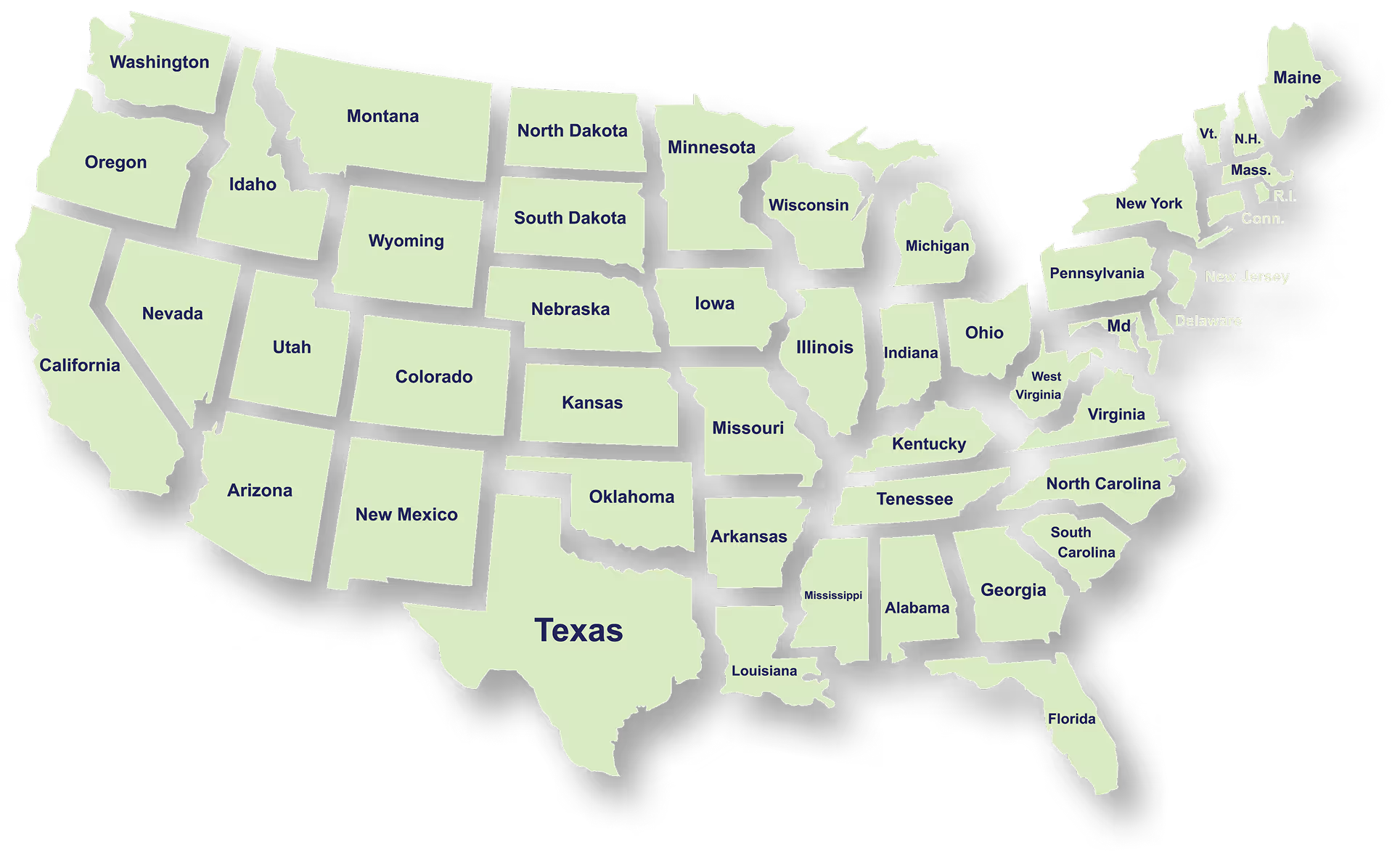
Serving Businesses & Individuals Across USA

We handle accounting, tax filing, and planning with defined timelines and accurate reporting for businesses and individuals across all states.

Frequently Asked Questions

What services does NR CPAs & Business Advisors provide?
What is tax planning and why is it important for businesses?
How can a Virtual CFO help my business?
When should a business consider IRS tax resolution services?
What financial statements does a business typically need?
How can startup advisory services help new businesses?
What is strategic business planning?
What is a Virtual Family Office and who can benefit from it?