IRS Substitute For Return (SFR): When The IRS Files For You

July 14, 2026
No items found.

A Substitute for Return (SFR) is a tax return the IRS prepares and files on your behalf when you fail to file your own. According to the IRS, the agency uses income information reported by employers, banks, and other third parties to calculate your tax liability. The SFR does not include any deductions, credits, or exemptions you may be entitled to claim, which means the resulting tax bill is almost always significantly higher than what you would owe if you had filed your own return.

The IRS is authorized to file a Substitute for Return under Internal Revenue Code Section 6020(b). According to the IRS, the SFR process is a serious enforcement action that typically follows a sequence of non-filer notices the agency sends before taking this step. The SFR is not a bill. It is a proposed tax assessment that triggers a 90-day response window before the IRS finalizes the amount and begins collection.

How The IRS Builds A Substitute Return

The IRS constructs an SFR using only the income documents it already has on file, including W-2s, 1099-INT, 1099-DIV, 1099-NEC, 1099-MISC, and other third-party information returns. According to the IRS, the agency does not attempt to identify or apply deductions you may qualify for, such as mortgage interest, medical expenses, business expenses, or education credits. The IRS also does not factor in your actual filing status if it differs from the default it assigns.

For individual taxpayers, the IRS typically assigns a filing status of single or married filing separately, even if you would normally file as head of household or married filing jointly. According to the IRS, joint SFRs cannot be filed, so each spouse is handled separately. The combination of inflated income (no deductions) and a less favorable filing status means the SFR almost always produces a tax liability that is thousands of dollars more than what you would actually owe.
What Happens After The IRS Files An SFR

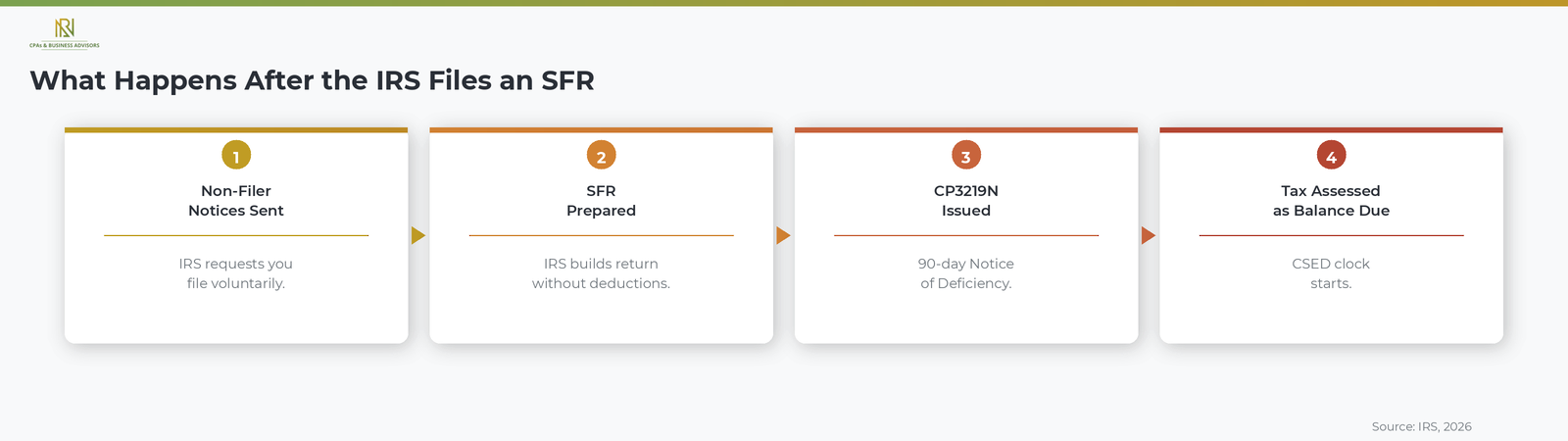
After preparing the SFR, the IRS sends a CP3219N Notice of Deficiency, which gives you 90 days to either file your own return or petition the U.S. Tax Court. This notice is sometimes called a 90-day letter, and the deadline cannot be extended. According to the IRS, if you do not respond within 90 days, the agency finalizes the proposed assessment, and the tax, penalties, and interest become a legally enforceable balance on your account.

Once the assessment is finalized, the balance enters the standard IRS collection process. The IRS will send collection notices and can eventually pursue enforcement actions including wage garnishments, bank levies, and federal tax liens. The CP3219N follows the same 90-day structure as the CP3219A statutory Notice of Deficiency issued through the Automated Underreporter program, including the same Tax Court petition rights and deadline rules.

According to the IRS, the 10-year Collection Statute Expiration Date (CSED) begins when the SFR assessment is finalized. This means the longer you wait to address unfiled returns, the later the collection clock starts, and the longer the IRS has to pursue the debt.
How To Replace An SFR With Your Own Return

You can replace a Substitute for Return with your own accurately filed tax return at any time, even after the IRS has finalized the assessment. According to the IRS, the agency will accept your return and adjust your account to reflect the correct figures, which almost always results in a lower tax liability because your return includes deductions and credits the SFR did not.

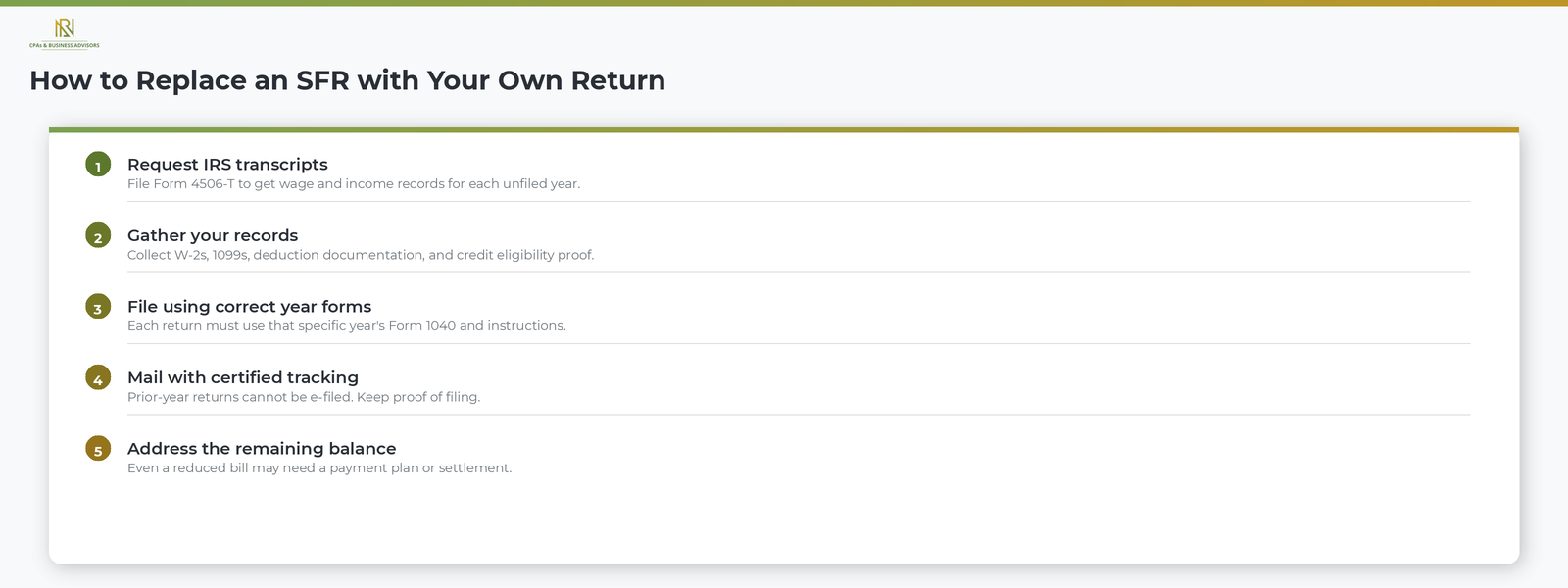
To replace an SFR, follow these steps.

  1. Request your wage and income transcripts. File Form 4506-T with the IRS to get the income data the agency has on file for each unfiled year.
  2. Gather your records. Collect any available W-2s, 1099s, deduction documentation, and receipts for credits you are eligible to claim.
  3. Prepare your return using the correct year's forms. Each return must use the tax forms and instructions for the specific year it covers.
  4. Mail the return to the IRS. Prior-year returns generally cannot be e-filed. Use certified mail so you have proof of filing.
  5. Address the remaining balance. Even after your return reduces the liability, you may still owe penalties and interest. The IRS offers installment agreements, Offers in Compromise, and Currently Not Collectible status for taxpayers who cannot pay in full.

Taxpayers with multiple years of unfiled returns should work through the filing process systematically. The IRS generally requires the last six years of returns to consider you in compliance, and filing back tax returns is required before the agency will approve most resolution options.
Why An SFR Almost Always Overstates Your Tax

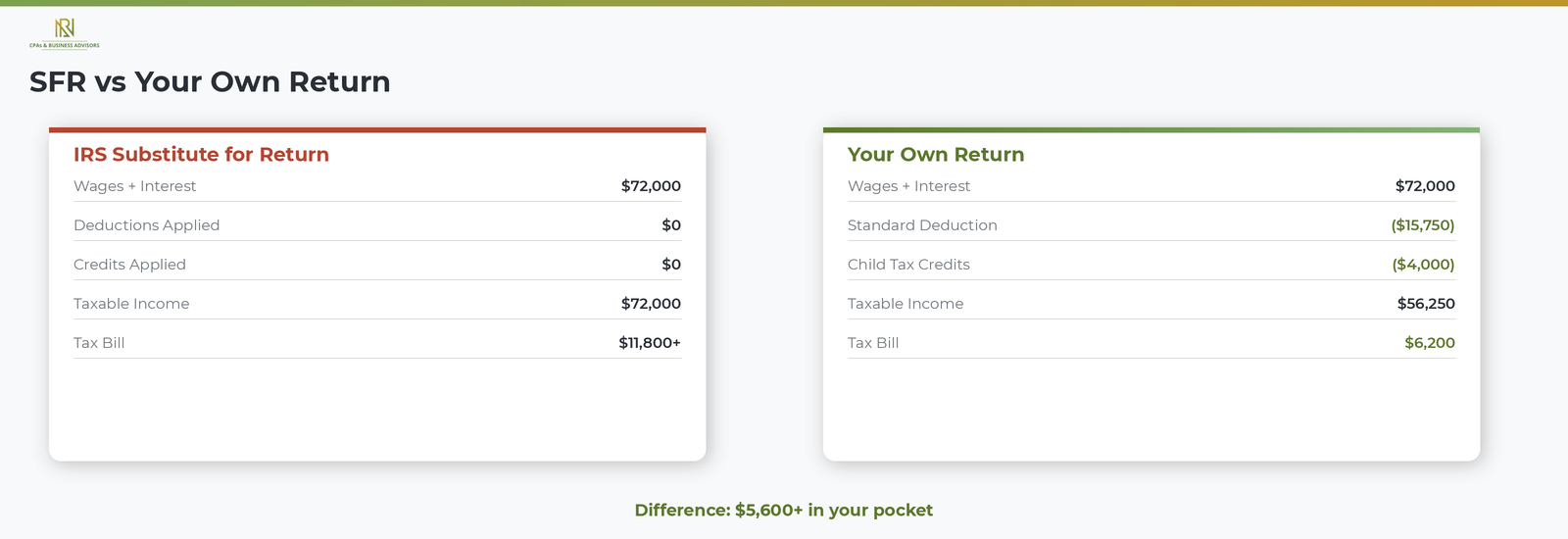
Because the IRS does not include deductions, credits, or favorable filing status adjustments, a Substitute for Return typically produces a tax bill that is significantly higher than what you would owe on a correctly filed return. The gap can be substantial. A taxpayer earning $70,000 with a standard deduction and two dependents could see their SFR tax liability exceed their actual liability by $5,000 or more, before penalties and interest.

Filing your own return to replace the SFR is almost always worth doing, even years later. According to the IRS, the agency will adjust the previously assessed balance to match the figures on your return. If the corrected return shows less tax than the SFR, the difference is removed from your account. However, penalties and interest that accumulated before you filed are not automatically removed. You may be able to request penalty abatement if you qualify for first-time relief or can demonstrate reasonable cause.

If you owe a balance after replacing the SFR and cannot pay it in full, the IRS provides several paths including payment plans, settlement offers, and hardship status for taxpayers who need more time or cannot pay at all.

Frequently Asked Questions About Substitute For Return

Can The IRS File An SFR For Multiple Years?

Yes, the IRS can prepare a Substitute for Return for every year it has income records and no filed return. According to the IRS, each unfiled year is handled as a separate SFR with its own Notice of Deficiency and 90-day response window.

Does Replacing An SFR Remove Penalties?

No, filing your own return reduces the tax liability but does not automatically remove penalties and interest. According to the IRS, you can request penalty abatement through first-time relief (if you have a clean three-year compliance history) or by demonstrating reasonable cause for the late filing.

What If I Ignore The SFR Entirely?

If you do not respond to the CP3219N within 90 days, the IRS finalizes the assessment at the inflated SFR amount. According to the IRS, the balance then enters the collection process, and the agency can pursue liens, levies, and wage garnishments to collect the debt.

Tax and Financial Insights
by NR CPAs & Business Advisors

Explore practical articles that explain tax strategies, financial considerations, and important topics that may affect your business decisions.

IRS Currently Not Collectible (CNC) Status: How It Works

Currently Not Collectible (CNC) is an IRS designation that temporarily pauses all collection activity on your account when you cannot afford to pay anything toward your tax debt without failing to cover basic living expenses. According to the IRS, CNC status means the agency has determined that requiring any payment would cause you financial hardship. While your account is in CNC, the IRS will not levy your wages, seize your bank accounts, or garnish your income.

CNC status does not eliminate your tax debt. According to the IRS, you still owe the full balance, and penalties and interest continue to accrue while your account is in this status. The IRS may also file a Notice of Federal Tax Lien to protect the government's interest in your property, and it will apply any future federal tax refunds to your outstanding balance. CNC is a temporary measure, not a permanent resolution, but it can provide critical breathing room for taxpayers in severe financial hardship.

Who Qualifies For CNC Status

You may qualify for CNC status if your monthly income, after allowable living expenses, leaves you unable to make even a small payment toward your tax debt. According to the IRS, the agency uses national and local cost-of-living standards to evaluate your expenses, including housing, utilities, food, transportation, health insurance, and out-of-pocket medical costs. If your allowable expenses equal or exceed your income, and you have no significant assets the IRS could use to satisfy the debt, CNC status is typically approved.

Common situations that support CNC eligibility include the following.

  • Your only income is from government assistance. Social Security, disability benefits, unemployment compensation, or public assistance programs.
  • You are unemployed with no other income. Especially when unemployment benefits barely cover basic expenses.
  • You have a serious medical condition or disability. Particularly conditions that permanently limit your earning capacity.
  • Your expenses exceed your income. Even after the IRS applies its own expense standards, there is no disposable income available for tax payments.

How To Request Currently Not Collectible Status

To request CNC status, call the IRS at 800-829-1040 or the phone number on your most recent notice and explain that you cannot afford to make any payments toward your tax debt. According to the IRS, the agent will ask you to provide financial information to verify your hardship. In most cases, you will need to complete Form 433-F, Collection Information Statement, which is a two-page form that documents your income, monthly expenses, debts, and assets.

For more complex financial situations, the IRS may require Form 433-A (for wage earners and self-employed individuals) or Form 433-B (for businesses). According to the IRS, you should be prepared to provide supporting documentation including pay stubs, bank statements, utility bills, rent or mortgage statements, and medical records if applicable. The IRS compares your reported expenses against its allowable expense standards to determine whether any payment is feasible.

When speaking with the IRS, be clear that you cannot afford any monthly payment, not just that you cannot pay the full amount. According to the IRS, if you can afford a small monthly payment, the agency will typically direct you toward an installment agreement or partial payment plan instead of CNC status.

What Happens While Your Account Is In CNC

While your account is in CNC status, the IRS suspends most active collection efforts but retains the right to take certain actions that protect the government's interest. According to the IRS, the following applies during CNC.

  • No levies or garnishments. The IRS will not levy your wages, bank accounts, or other property.
  • Tax refunds are still taken. The IRS will intercept and apply any federal tax refund you receive to the outstanding balance.
  • A federal tax lien may be filed. According to the IRS, if you owe more than $10,000, the agency will generally file a Notice of Federal Tax Lien, which is a public record that can affect your credit and your ability to sell or refinance property.
  • Penalties and interest continue. The balance grows while you are in CNC because the IRS does not stop charging penalties or interest during this period.
  • Periodic reviews. The IRS may review your financial situation later and resume collection if your income improves.

When The IRS Can Remove CNC Status

The IRS can remove your account from CNC status and resume collection activity if your financial situation improves. According to the IRS, the agency assigns a closing code to each CNC account that corresponds to an income threshold. If your reported income exceeds that threshold, as indicated by W-2s, 1099s, or tax returns filed in subsequent years, the IRS may contact you to reassess your ability to pay.

If the IRS determines you can now afford payments, it will typically offer you the option to set up an installment agreement or pursue another resolution. If your income remains below the threshold indefinitely, your CNC status continues until the 10-year Collection Statute Expiration Date (CSED) expires, at which point the remaining debt is written off permanently.

How CNC Interacts With The 10 Year Collection Statute

One of the most important features of CNC status is that it does not pause or extend the IRS's 10-year collection clock. According to the IRS, the CSED continues to run while your account is in CNC. This means that if your income does not improve before the statute expires, the IRS loses its legal authority to collect the debt, and the balance is permanently written off.

This is a key distinction from other resolution options. Requesting an Offer in Compromise or an installment agreement suspends the CSED while the IRS evaluates your application, effectively giving the agency more time to collect. CNC status does not. For taxpayers with older tax debts and limited income prospects, CNC can be strategically advantageous because the clock keeps running in your favor.

However, CNC is not always the best long-term strategy. If your income is likely to improve, the IRS will remove you from CNC and resume collection, potentially with a larger balance due to accumulated penalties and interest. Taxpayers weighing CNC against other options like payment plans, Offers in Compromise, or penalty relief can compare all available paths in the IRS tax debt resolution overview.

Frequently Asked Questions About CNC Status

Does CNC Status Forgive My Tax Debt?

No, CNC status does not forgive or cancel your tax debt. According to the IRS, you still owe the full balance, and penalties and interest continue to accrue. The debt is only eliminated if the 10-year CSED expires while your account remains in CNC.

Will The IRS Take My Tax Refund While I Am In CNC?

Yes, the IRS will intercept and apply your federal tax refund to the outstanding balance even while your account is in CNC status. According to the IRS, refund offsets are one of the collection actions the agency continues during CNC.

How Long Can I Stay In CNC Status?

There is no fixed time limit on CNC status. According to the IRS, your account remains in CNC as long as your financial situation does not improve beyond the threshold the agency sets. The IRS may review your finances periodically, but CNC can last for years if your income remains at hardship levels.

IRS Penalty Abatement: How To Remove IRS Penalties

IRS penalty abatement is the removal or reduction of penalties the IRS has assessed against you for failing to file a return, failing to pay taxes owed, or failing to make required tax deposits on time. According to the IRS, abating a penalty does not eliminate the underlying tax you owe, but it removes the additional charges the IRS added on top of that balance. Because penalties often represent a significant portion of a taxpayer's total debt, a successful abatement can substantially reduce the amount you need to pay.

According to the IRS, when penalties are removed, the interest charged on those penalties is also automatically eliminated. However, interest on the unpaid tax itself continues to accrue until the balance is paid in full. Penalty abatement is available for individual taxpayers, businesses, and employers, though the eligibility criteria and process differ depending on the type of penalty and the relief program you qualify for.

Types Of IRS Penalty Relief

The IRS offers four main types of penalty relief: the Automatic Exemption from Penalty program, first-time penalty abatement, reasonable cause relief, and statutory exceptions. Each program has its own eligibility requirements and applies to different situations.

Automatic Exemption From Penalty Program

Starting in 2026, the IRS is phasing in the Automatic Exemption from Penalty (AEP) program, which automatically waives failure-to-file, failure-to-pay, and failure-to-deposit penalties for qualifying taxpayers without requiring any action on your part. According to the IRS, you qualify for AEP relief if you filed the same type of return on time for each of the previous three years and had no penalties assessed (other than estimated tax penalties) or any prior penalties were waived for reasonable cause. Unlike other programs, you do not need to call the IRS or submit paperwork. The IRS simply does not assess the penalty, and sends you a letter confirming the relief was applied.

According to the IRS, the AEP program applies to individual 1040 returns filed for tax year 2025 and later, and to certain quarterly business returns for tax year 2026 and later. The AEP program will fully replace the First-Time Penalty Abatement program for penalties related to returns originally due on or after January 1, 2027.

First-Time Penalty Abatement

First-Time Penalty Abatement (FTA) is an administrative waiver that removes failure-to-file, failure-to-pay, or failure-to-deposit penalties for taxpayers with a clean compliance history over the prior three years. According to the IRS, you qualify if you filed all required returns (or filed valid extensions), had no penalties assessed for the three preceding tax years, and have paid or arranged to pay any tax due. Unlike the AEP program, FTA is not automatic. You must contact the IRS by phone or submit Form 843, Claim for Refund and Request for Abatement, to request it.

According to the IRS, the FTA program is being phased out as the AEP program rolls in. FTA will be fully replaced for penalties associated with returns originally due on or after January 1, 2027. For penalties on returns due before that date, FTA remains available.

Reasonable Cause Relief

If you do not qualify for AEP or first-time abatement, the IRS can still remove penalties if you demonstrate that your failure to comply was due to reasonable cause and good faith. According to the IRS, reasonable cause is evaluated on a case-by-case basis considering all the facts and circumstances. Valid reasons include serious illness or death of an immediate family member, fires or natural disasters that destroyed records, system issues that prevented timely electronic filing or payment, and unavoidable absences.

According to the IRS, the following reasons generally do not qualify as reasonable cause on their own: reliance on a tax professional, ignorance of the law, simple mistakes or oversights, and lack of funds. However, lack of funds combined with other circumstances showing good-faith effort to comply may support a reasonable cause claim. You must provide supporting documentation such as medical records, court records, or correspondence that demonstrates the circumstances that prevented you from meeting your obligations.

Statutory Exceptions

In certain situations, the tax code itself provides an automatic exception that eliminates a penalty. According to the IRS, statutory exceptions include receiving incorrect written advice from the IRS that you reasonably relied on, being able to prove that your return or payment was mailed or e-filed before the deadline, being impacted by a federally declared disaster, and serving in a military combat zone.

Which Penalties Can Be Removed

The most common penalties eligible for abatement are the failure-to-file penalty, the failure-to-pay penalty, and the failure-to-deposit penalty. The failure-to-file penalty is 5 percent of the unpaid tax per month up to 25 percent. The failure-to-pay penalty is 0.5 percent per month up to 25 percent. Both penalties can be removed through AEP, FTA, or reasonable cause relief.

Accuracy-related penalties, which the IRS assesses when you underpay taxes due to negligence or a substantial understatement of income, can be removed through reasonable cause relief but are not eligible for AEP or first-time abatement. According to the IRS, the estimated tax penalty (for individuals who do not make sufficient quarterly payments) generally cannot be removed through any of the standard relief programs.

How To Request Penalty Abatement

The process for requesting penalty abatement depends on the type of relief you are seeking.

  • AEP: No action required. The IRS applies the waiver automatically and sends you a confirmation letter.
  • First-time abatement: Call the toll-free number on your IRS notice and request the abatement over the phone. If approved, the IRS sends a confirmation letter within 30 days.
  • Reasonable cause: Call the IRS or submit Form 843 with a written explanation of your circumstances and supporting documentation. According to the IRS, phone requests are sometimes granted immediately, but complex cases may require a written submission.
  • Statutory exception: Follow the instructions on your IRS notice or submit Form 843 with evidence of the exception (such as proof of timely mailing or a FEMA disaster declaration).

If you owe a balance beyond the penalties and cannot pay in full, you can set up an installment agreement to pay the remaining tax over time while your penalty abatement request is processed.

What To Do If Your Request Is Denied

If the IRS denies your penalty abatement request, you have 30 days from the date on the denial letter to appeal the decision to the IRS Independent Office of Appeals. According to the IRS, you must submit a written letter stating that you are appealing, include a copy of the denial notice, and provide any additional documentation or explanation you want the Appeals office to consider. Appeals officers review your case independently from the unit that issued the original denial.

If Appeals also denies your request, you can take the matter to court. According to the IRS, you can file a petition with the U.S. Tax Court before paying the disputed amount, or pay the penalty and file for a refund through the U.S. District Court or the U.S. Court of Federal Claims. Taxpayers who need to explore other ways to reduce their total IRS debt beyond penalty abatement, including Offers in Compromise and hardship status, can review the full range of IRS resolution options.

Frequently Asked Questions About Penalty Abatement

How Long Does It Take To Get Penalty Abatement?

It depends on the type of relief and how you request it. According to the IRS, first-time abatement requests made by phone can be approved immediately during the call. Written requests for reasonable cause relief may take several weeks to several months. The AEP program requires no wait time because the penalty is never assessed in the first place.

Can I Get Penalties Removed For Multiple Years?

First-time abatement and AEP apply to one tax period at a time. According to the IRS, you must have a clean three-year compliance history for each period you are requesting relief for. Reasonable cause relief can apply to multiple years if the same qualifying circumstance affected your ability to comply across those years, but you must demonstrate reasonable cause separately for each period.

Does Penalty Abatement Remove Interest Too?

Penalty abatement automatically removes the interest that was charged on the abated penalties, but it does not remove interest on the underlying tax. According to the IRS, interest on unpaid tax continues to accrue until the balance is paid in full, regardless of whether penalties are removed.

Want tax & accounting tips & insights?Sign up for our newsletter.

Thank you! Your submission has been received!
Oops! Something went wrong while submitting the form.