IRS CP504 Notice: Intent To Levy — What To Do Now

July 3, 2026
No items found.

What Is An IRS CP504 Notice

An IRS CP504 is a Notice of Intent to Levy, meaning the IRS is informing you that it will seize your state tax refund, wages, bank accounts, or other property if you do not pay your unpaid tax balance or make payment arrangements immediately. According to the IRS, the CP504 is issued under Internal Revenue Code Section 6331(d) and represents the final automated balance due reminder before the agency begins active enforcement. If you have received this notice, the IRS has already sent prior correspondence about the same unpaid balance and has not received payment or a response.

The CP504 includes your Social Security number, the date of the notice, and the specific tax year and form the balance relates to. It breaks the total amount owed into original tax, assessed penalties, and accrued interest. The notice also provides payment instructions, explains your right to appeal under the Collection Appeals Program, and describes the consequences of not responding. For a broader overview of how all IRS notices work and what different notice types mean, our complete guide to IRS correspondence covers every category from adjustments to enforcement.

Where CP504 Falls In The IRS Collection Sequence

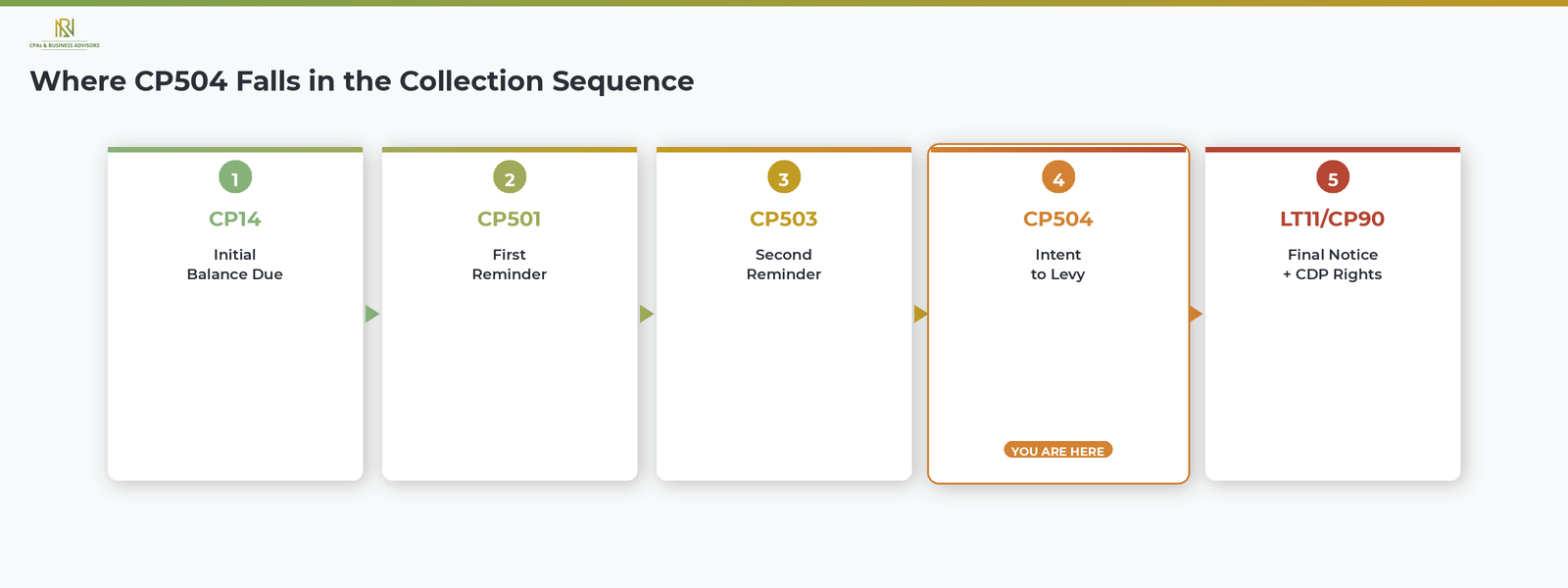
The CP504 is the fourth notice in a five-step collection sequence that the IRS follows when an individual taxpayer has an unpaid balance. Each notice in this sequence carries more urgency than the last, and the CP504 marks the transition point from automated reminders to active enforcement. According to the IRS, the standard progression works as follows.

  1. CP14: the initial notice that your tax return has an unpaid balance. Taxpayers who want to understand this first notice in the collection sequence can review our full guide to the CP14 balance due letter.
  2. CP501: a first reminder that the balance remains unpaid.
  3. CP503: a second reminder with stronger language, noting that the IRS has still not received payment.
  4. CP504: the Notice of Intent to Levy, warning that the IRS will begin seizing assets if you do not act.
  5. LT11 or CP90: the Final Notice of Intent to Levy, which grants you the right to request a Collection Due Process hearing within 30 days before the IRS proceeds.

The critical difference between the CP504 and the notices that came before it is that the CP504 authorizes the IRS to levy your state income tax refund without further notice. The final notices that follow, LT11 and CP90, authorize the IRS to levy everything else, including wages, bank accounts, and personal property.
What The IRS Can Seize After A CP504 Notice

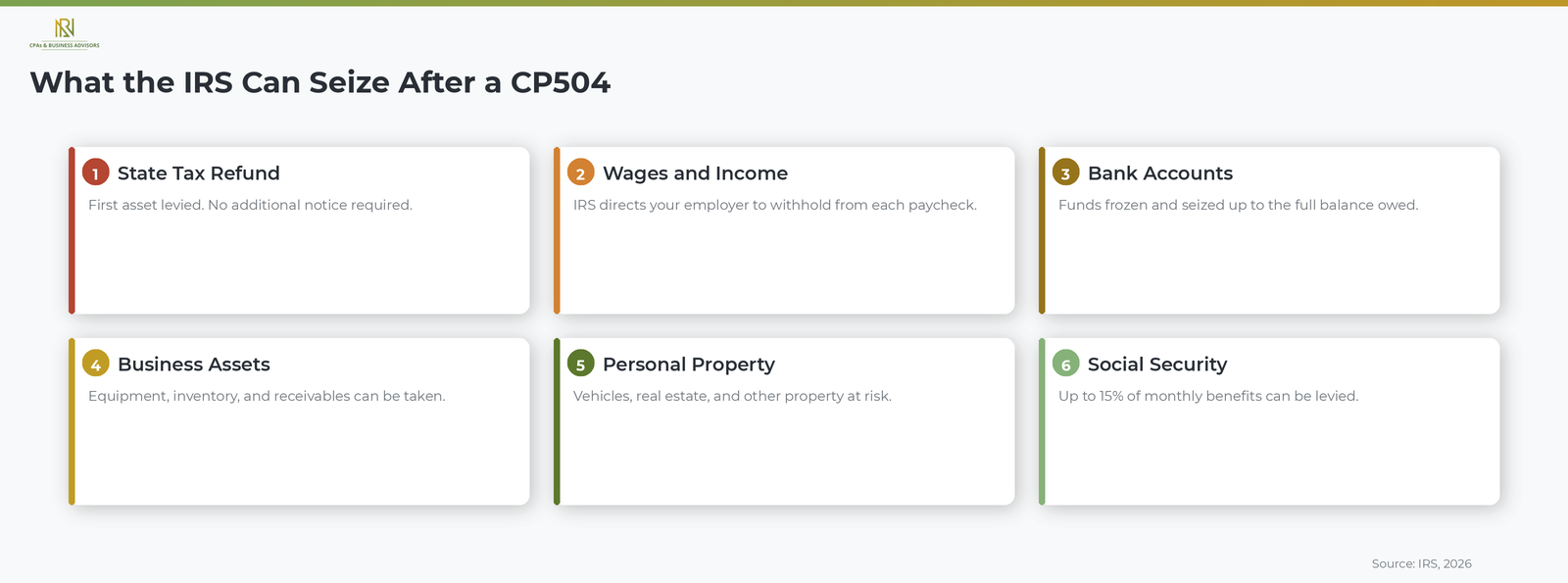
After sending a CP504, the IRS can immediately intercept your state income tax refund, and after issuing a subsequent final notice, it can seize virtually any other asset or income stream you have. According to the IRS, property subject to levy includes the following.

  • State income tax refunds. According to the IRS, this is typically the first asset levied after a CP504 because the agency can intercept it without issuing an additional notice.
  • Wages, salaries, and commissions. The IRS can direct your employer to withhold a portion of each paycheck until the debt is satisfied.
  • Bank accounts. The IRS can freeze funds in your checking and savings accounts and seize the balance up to the total amount owed.
  • Business assets. Equipment, inventory, and accounts receivable can all be seized to satisfy a business or individual tax debt.
  • Personal property. According to the IRS, the agency can seize your vehicle, your home, and other real or personal property. The IRS is one of the few creditors authorized to take a personal residence despite state homestead protections.
  • Social Security benefits. The IRS can levy up to 15 percent of your monthly Social Security payments.

In addition to levies, the IRS can file a Notice of Federal Tax Lien, which is a public claim against your current and future assets. According to the IRS, a lien can damage your credit, make it difficult to sell or refinance property, and establish the government's legal priority over other creditors. The FAST Act also authorizes the State Department to deny, revoke, or limit your passport if your tax debt meets the threshold for seriously delinquent tax debt.
How To Respond To An IRS CP504 Notice

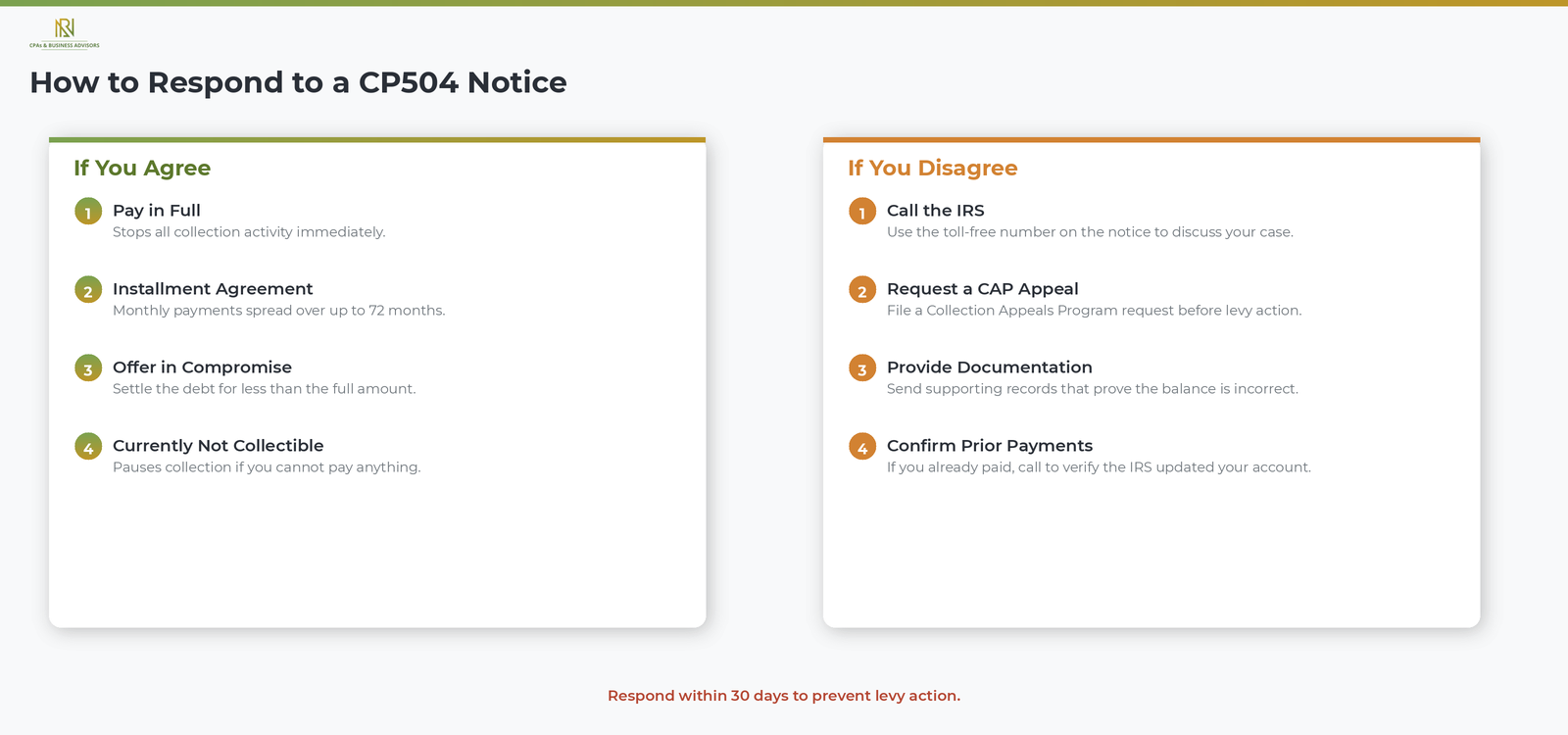
Respond to a CP504 as quickly as possible, ideally well within the 30-day window the IRS provides before taking levy action. Your best course of action depends on whether you agree or disagree with the amount the notice says you owe.

If You Agree With The Amount Owed

According to the IRS, you have several options for resolving the balance.

  1. Pay in full. The fastest way to stop collection activity is to pay the entire balance shown on the notice. You can pay online at IRS.gov, by phone, or by mailing a check with the payment voucher included in the notice.
  2. Set up an installment agreement. If you cannot pay the full amount at once, you may qualify for a monthly IRS payment plan or installment agreement. Our step-by-step guide to setting up structured payments covers the application process, balance thresholds, and how interest is calculated on the remaining amount.
  3. Submit an Offer in Compromise. If your financial situation makes it unlikely you can pay the full debt even with a payment plan, you may be able to settle for less than you owe through a formal Offer in Compromise.
  4. Request Currently Not Collectible status. If you have no ability to pay anything toward the debt, the IRS may temporarily pause collection activity by placing your account in Currently Not Collectible status. This does not eliminate the debt, but it stops levies while you remain unable to pay.

Taxpayers facing significant financial hardship may also qualify for the IRS Fresh Start program, which expands access to installment agreements and eases qualification thresholds for eligible individuals and businesses.

If You Disagree With The Amount Owed

If you believe the balance on the CP504 is incorrect, call the toll-free number printed on the notice immediately. According to the IRS, you can also request an appeal under the Collection Appeals Program before collection action takes place by following the instructions included in the notice. If you have already paid the balance or set up an installment agreement, contact the IRS at the number on the notice to confirm that your account reflects the payment or arrangement.

For general guidance on responding to any IRS correspondence, including how to organize supporting documentation and meet response deadlines, our guide on what to do when you receive an IRS notice provides a step-by-step walkthrough of the full response process.
What Happens If You Ignore A CP504 Notice

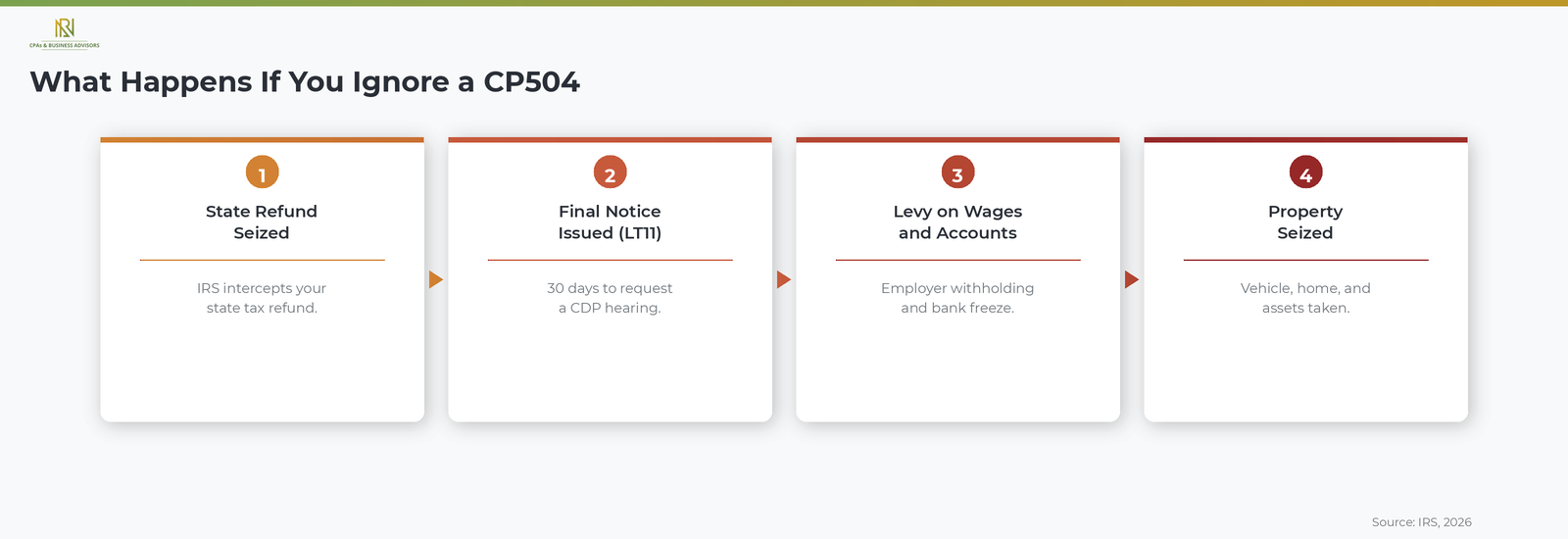
Ignoring a CP504 causes the IRS to escalate to its final enforcement steps, beginning with the seizure of your state tax refund and progressing to levies on your wages, bank accounts, and personal property. According to the IRS, the next notice after the CP504 is typically the LT11 or Letter 1058, labeled "Final Notice of Intent to Levy and Notice of Your Right to a Hearing." This notice grants you the right to request a Collection Due Process hearing within 30 days, which is your last formal opportunity to challenge the proposed levy or present an alternative resolution before the IRS takes action.

If you do not respond to that final notice, the IRS can proceed with levying all available assets, filing a federal tax lien that becomes part of the public record and affects your credit, and, for balances meeting the seriously delinquent threshold, certifying your debt to the State Department for passport denial or revocation. Penalties and interest continue to accrue on the unpaid balance throughout this process, increasing the total amount owed with each month that passes.
Difference Between CP504 And CP504B

The CP504 is issued to individual taxpayers for unpaid personal income tax, while the CP504B is issued to businesses for unpaid business tax obligations such as employment taxes or excise taxes. According to the IRS, both notices carry the same intent to levy warning and the same level of urgency. If you received a CP504B for a business tax account, the response options and deadlines are the same as those described above for the standard CP504.

Frequently Asked Questions About The IRS CP504 Notice

How Serious Is A CP504 Notice?

A CP504 is one of the most urgent notices the IRS issues. According to the IRS, it is a formal Notice of Intent to Levy that authorizes the agency to begin seizing your state tax refund immediately and signals that levies on wages, bank accounts, and property will follow if you do not respond.

What Comes After A CP504 Notice?

The next step after a CP504 is typically the LT11 or Letter 1058, the Final Notice of Intent to Levy. According to the IRS, this final notice grants you 30 days to request a Collection Due Process hearing. If you do not respond, the IRS can proceed with levying your assets.

Is A CP504 Sent By Certified Mail?

The CP504 is typically sent by regular U.S. mail, not certified mail. According to the IRS, the subsequent final notice (LT11 or CP90) may arrive by certified mail because it triggers Collection Due Process hearing rights and the IRS must document delivery.

Can I Set Up A Payment Plan After Receiving A CP504?

Yes, you can still apply for an installment agreement after receiving a CP504. According to the IRS, you can apply online through the IRS Online Payment Agreement tool at IRS.gov or by calling the toll-free number printed on the notice. Setting up a payment plan stops the escalation toward active levy action as long as you remain current on your payments.

Tax and Financial Insights
by NR CPAs & Business Advisors

Explore practical articles that explain tax strategies, financial considerations, and important topics that may affect your business decisions.

Federal Tax Lien: How To Remove Or Withdraw It

A federal tax lien is the government's legal claim against your property when you fail to pay a tax debt after the IRS has assessed the amount owed and sent you a bill. According to the IRS, the lien attaches to all of your property, including real estate, vehicles, financial accounts, and business assets, as well as any property you acquire in the future while the lien is active. The lien protects the government's interest by establishing its priority over other creditors.

A federal tax lien is created automatically by law once three conditions are met: the IRS assesses the tax, sends you a Notice and Demand for Payment, and you neglect or refuse to pay the balance in time. According to the IRS, the agency then files a public document called a Notice of Federal Tax Lien (NFTL) with your state or county recording office to alert other creditors that the government has a legal right to your property. The lien itself exists from the moment you fail to pay, but the public notice is what damages your credit and affects your ability to sell or borrow against your assets.

How A Federal Tax Lien Affects You

A federal tax lien can significantly impact your finances, credit, and ability to conduct business. According to the IRS, the effects include the following.

  • Credit damage. Once the Notice of Federal Tax Lien is filed, it becomes a public record. Lenders, landlords, and creditors can see it, and it can lower your ability to obtain credit, loans, or mortgages.
  • Property restrictions. The lien attaches to all your current and future assets. You cannot sell or refinance real estate without satisfying or addressing the lien first.
  • Business impact. The lien attaches to business property and accounts receivable, which can interfere with operations and relationships with vendors and clients.
  • Bankruptcy limitations. According to the IRS, a tax lien and the Notice of Federal Tax Lien may continue even after bankruptcy in certain situations.

How To Remove A Federal Tax Lien

The IRS provides four methods for removing or reducing the impact of a federal tax lien: paying the debt in full, requesting a discharge, requesting subordination, and requesting a withdrawal.

Pay The Debt In Full

Paying your tax debt in full is the most direct way to eliminate a federal tax lien. According to the IRS, the agency releases the lien within 30 days after the balance, including penalties and interest, is paid in full. If you cannot pay the entire amount at once, an installment agreement allows you to pay over time, and the lien is released once the final payment is made.

Discharge Of Property

A discharge removes the lien from a specific piece of property, allowing you to sell or transfer it. According to the IRS, a discharge may be granted if the remaining property still subject to the lien is worth at least double the total tax liability plus all other encumbrances, or if the IRS receives payment equal to the government's interest in the property being discharged. This option is commonly used to facilitate real estate sales when the lien amount exceeds the property value.

Subordination

Subordination does not remove the lien but allows other creditors to move ahead of the IRS in priority. According to the IRS, this can make it easier to obtain a mortgage or loan because the lending institution's lien takes priority over the government's claim. The IRS may approve subordination if it determines that doing so will ultimately increase the total amount collected.

Withdrawal

A withdrawal removes the public Notice of Federal Tax Lien from the record, though you remain liable for the underlying debt. According to the IRS, a withdrawal may be granted if the agency filed the notice prematurely or not in accordance with its procedures, if you have entered into a Direct Debit installment agreement, or if the withdrawal would facilitate collection. Under the IRS Fresh Start program, taxpayers who owe $25,000 or less and have a Direct Debit installment agreement may request withdrawal of the NFTL after making three consecutive payments.

Federal Tax Lien vs Levy

A lien and a levy are two different IRS actions, and understanding the distinction is important. According to the IRS, a lien is a legal claim that secures the government's interest in your property. It does not take your property. A levy, by contrast, actually seizes your property to satisfy the tax debt. Levies can target wages, bank accounts, Social Security benefits, vehicles, and real estate.

The IRS typically files a lien first and proceeds to a levy only after sending multiple collection notices and a Final Notice of Intent to Levy. Addressing the lien early through payment, a resolution agreement, or one of the removal options above can prevent the situation from escalating to a levy.

How To Prevent A Federal Tax Lien

The simplest way to prevent a federal tax lien is to file your tax returns on time and pay the full amount owed. If you cannot pay in full, acting before the IRS files a lien gives you the most options. According to the IRS, setting up a payment plan before a lien is filed can prevent the public notice from being recorded. Taxpayers who owe $50,000 or less can apply for a streamlined installment agreement online, and those who qualify for the IRS Fresh Start program benefit from higher thresholds before the IRS will file a lien.

If you already owe the IRS and are unsure which resolution path to pursue, the full range of IRS resolution options includes installment agreements, Offers in Compromise, Currently Not Collectible status, and penalty relief.

Frequently Asked Questions About Federal Tax Liens

How Long Does A Federal Tax Lien Last?

A federal tax lien generally lasts until the underlying tax debt is paid in full or the 10-year Collection Statute Expiration Date (CSED) passes. According to the IRS, the NFTL will self-release 30 days after the 10-year collection period expires if the IRS does not refile it. However, certain actions such as installment agreements, Offers in Compromise, and bankruptcy can suspend or extend the CSED.

Can A Federal Tax Lien Be Filed Without Warning?

The IRS must send you a Notice and Demand for Payment before a lien can arise, and must notify you within five business days after filing the Notice of Federal Tax Lien. According to the IRS, you have the right to request a Collection Due Process (CDP) hearing to challenge the filing.

Does A Federal Tax Lien Show Up On My Credit Report?

The major credit bureaus no longer include tax liens on standard credit reports, but the Notice of Federal Tax Lien remains a public record. Lenders who search public records during the mortgage or loan approval process will still find it, and it can affect your ability to obtain financing.

IRS Innocent Spouse Relief: When You're Not Liable

Innocent spouse relief is an IRS program that can remove your responsibility for paying additional taxes, penalties, and interest when your spouse or former spouse understated the taxes owed on a joint return without your knowledge. According to the IRS, when you file a joint tax return, both spouses are jointly and severally liable for the full tax amount, which means the IRS can collect the entire balance from either spouse, even after a divorce. Innocent spouse relief is an exception to that rule for spouses who did not know about or benefit from the errors on the return.

According to the IRS, innocent spouse relief applies only to taxes due on your spouse's income from employment or self-employment. It does not cover taxes on your own income, household employment taxes, business taxes, or trust fund recovery penalties. The relief is available whether you are still married, separated, or divorced.

The Three Types Of Innocent Spouse Relief

The IRS evaluates three forms of relief when you file a request, and you do not need to specify which type applies to your situation because the IRS will automatically consider all three.

Innocent Spouse Relief

This is the primary form of relief, available when your joint return understated the tax due because of errors attributable to your spouse, and you did not know or have reason to know about those errors. According to the IRS, errors that qualify include unreported income, incorrect deductions or credits, and incorrect asset values. The IRS considers whether a reasonable person in your circumstances would have known about the errors and whether you received any financial benefit from the understated income.

Separation Of Liability Relief

This form of relief divides the understated tax, penalties, and interest between you and your spouse based on each person's share of the errors. According to the IRS, you are generally eligible if you are divorced, legally separated, or have not lived with your spouse for at least 12 months before filing the request. You must also demonstrate that you did not know about the errors when you signed the return.

Equitable Relief

If you do not qualify for innocent spouse relief or separation of liability, the IRS may grant equitable relief if holding you responsible for the tax debt would be unfair given all the facts and circumstances. According to the IRS, equitable relief considers factors including your current marital status, whether you suffered economic hardship, whether you knew or had reason to know about the understated tax, and whether you were a victim of domestic abuse that affected your ability to challenge the return.

Who Qualifies For Innocent Spouse Relief

To be eligible, you must have filed a joint return that understated the tax due because of errors attributable to your spouse, and you must not have known or had reason to know about those errors when you signed the return. According to the IRS, you are not eligible in any year where you signed an Offer in Compromise with the IRS, signed a closing agreement covering the same taxes, or a court has already issued a final decision denying you relief.

Victims of domestic abuse receive a special exception. According to the IRS, you may still qualify for relief even if you had some knowledge of the errors if you signed the return because of spousal abuse, threats, or coercion and were afraid to challenge the items on the return.

The IRS approval rate for innocent spouse relief is relatively low. According to Jackson Hewitt, the IRS received over 26,000 requests in a recent year and fully approved fewer than 5,000. The fact-based, case-by-case nature of the evaluation means that the strength of your documentation and the clarity of your explanation are critical to the outcome.

How To Apply For Innocent Spouse Relief

To request relief, file Form 8857, Request for Innocent Spouse Relief, with the IRS. According to the IRS, Form 8857 covers all three types of relief (innocent spouse, separation of liability, and equitable), so you do not need to determine which type fits your situation. The IRS will evaluate your information and apply the appropriate form of relief if you qualify.

Form 8857 is a seven-page form that requires detailed information about your tax situation, your relationship with your spouse, your knowledge of the return's contents, and your financial circumstances. You should include supporting documentation such as divorce decrees, court orders, financial records, and any correspondence that demonstrates you did not know about the errors. According to the IRS, you must file the request within two years of receiving an IRS notice of an audit or additional taxes due because of an error on your return.

While your request is being reviewed, continue to file your tax returns and pay any taxes you owe. If you received an IRS notice about a balance and cannot pay while the review is pending, you may be able to set up an installment agreement to manage the amount in the meantime.

Innocent Spouse vs Injured Spouse

Innocent spouse relief and injured spouse relief are two separate IRS programs that address different problems. They are frequently confused because of their similar names, but they apply in entirely different situations.

  • Innocent spouse relief removes your liability for tax debt caused by your spouse's errors or omissions on a joint return. It addresses the underlying tax, penalties, and interest.
  • Injured spouse relief protects your share of a joint tax refund from being applied to your spouse's past-due debts such as student loans, child support, or state taxes. It does not address tax liability at all. You request injured spouse relief by filing Form 8379.

If you owe the IRS because of your spouse's errors, you need innocent spouse relief (Form 8857). If your refund was taken to pay your spouse's separate debts, you need injured spouse relief (Form 8379).

What Happens After You Apply

After you submit Form 8857, the IRS will notify your current or former spouse that you filed a request, which allows them to participate in the review process. According to the IRS, the review can take six months or longer. When the review is complete, the IRS sends a letter of determination with its decision. If approved, the IRS removes your responsibility for the additional tax, penalties, and interest attributable to your spouse's actions.

If the IRS denies your request, both spouses have the right to appeal within 30 days of the determination letter. You can file Form 12509, Statement of Disagreement, and request a review by the IRS Independent Office of Appeals. If you cannot reach agreement through Appeals, you can petition the U.S. Tax Court. Taxpayers exploring other ways to resolve joint tax debt beyond innocent spouse relief can review the full range of IRS resolution options available for balances you cannot pay.

Frequently Asked Questions

Do I Have To Be Divorced To Qualify?

No, you do not have to be divorced to qualify for innocent spouse relief. According to the IRS, the relief is available whether you are married, separated, or divorced. However, separation of liability relief specifically requires that you are divorced, legally separated, or have not lived with your spouse for at least 12 months.

Will My Spouse Be Notified?

Yes, the IRS is required to notify your current or former spouse when you file Form 8857. According to the IRS, the other spouse has the right to participate in the review process and can appeal the decision if relief is granted.

What If I Knew About Some But Not All Of The Errors?

The IRS evaluates each item on the return separately, so you may receive partial relief for items you did not know about while remaining liable for items you were aware of. According to the IRS, the determination depends on whether a reasonable person in your situation would have known about each specific error.

Want tax & accounting tips & insights?Sign up for our newsletter.

Thank you! Your submission has been received!
Oops! Something went wrong while submitting the form.