How To File Unfiled (Back) Tax Returns?

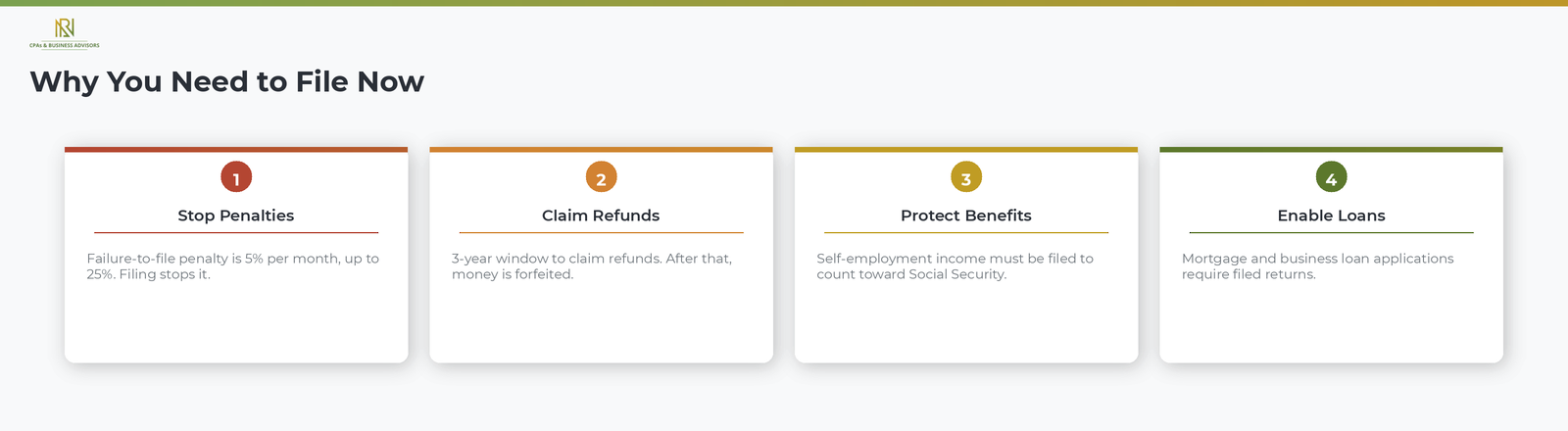
Filing unfiled tax returns, even if they are years late, stops the IRS from increasing your penalties, preserves your right to claim refunds and credits, and prevents the agency from filing a return on your behalf that gives you none of the deductions or credits you may be entitled to. According to the IRS, the failure-to-file penalty is 5 percent of the unpaid tax for each month or part of a month that a return is late, up to a maximum of 25 percent. This penalty is separate from and more expensive than the failure-to-pay penalty, which is 0.5 percent per month. Filing, even when you cannot pay the balance, stops the larger penalty from growing.
Beyond penalties, unfiled returns create problems that extend into other areas of your financial life. According to the IRS, the agency holds income tax refunds when its records show that one or more returns are past due. Self-employed individuals who do not file will not have their earnings reported to the Social Security Administration, which means lost credits toward retirement and disability benefits. Mortgage lenders, business loan providers, and federal financial aid programs all require copies of filed tax returns as part of the approval process.

How Many Years Of Back Taxes Do You Need To File
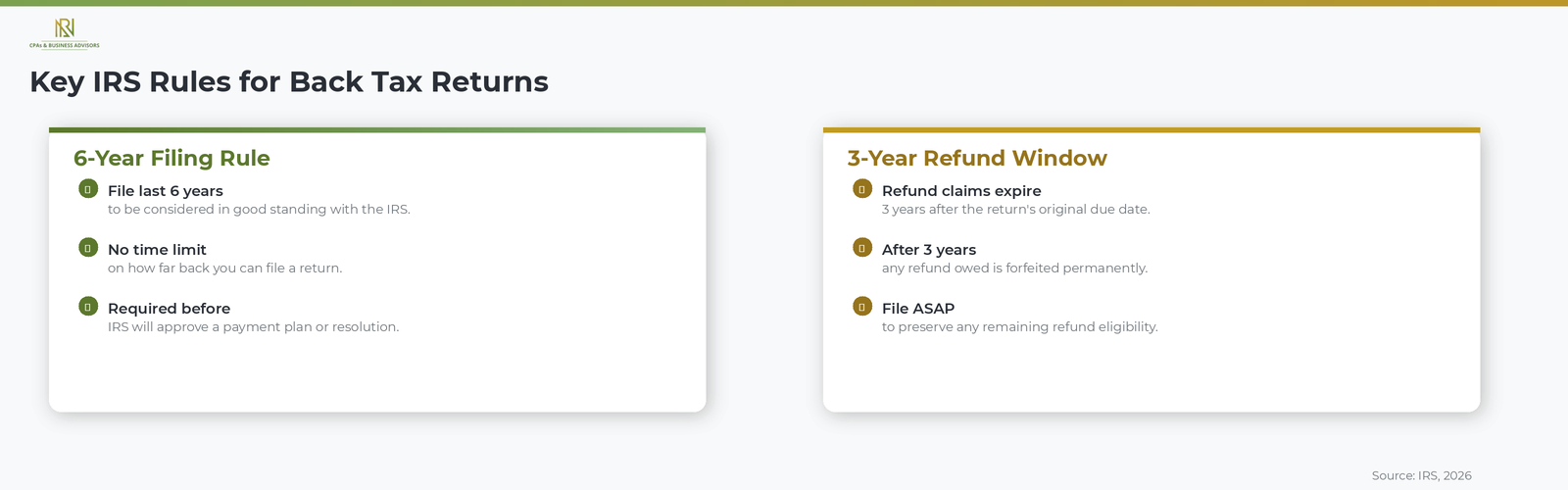
The IRS generally requires you to file the last six years of unfiled tax returns to be considered in compliance, though the agency prefers that you file all outstanding returns. According to the IRS, there is no statute of limitations on filing a past-due return, meaning you can file a return for any prior year regardless of how long ago it was due. However, the IRS only allows you to claim a refund within three years of the return's original due date. After that three-year window closes, any refund you would have been owed is forfeited permanently.
If you have multiple years of unfiled returns, the IRS typically asks you to start with the oldest unfiled year and work forward. Filing all six years brings your account into good standing and is usually required before the IRS will approve a payment plan or other resolution for any balance you owe. For a full overview of the resolution options available once you have filed, our guide to handling a tax balance you cannot pay covers installment agreements, Offers in Compromise, and hardship status.

How To Reconstruct Tax Records For Past Years
If you no longer have the W-2s, 1099s, or other income documents you need to prepare a past-due return, the IRS can provide transcripts of the income information it has on file for you. According to the IRS, you can request wage and income transcripts by filing Form 4506-T, Request for Transcript of Tax Return. These transcripts cover the last 10 tax years and include the information reported to the IRS by your employers, banks, and other payers.
Wage and income transcripts show the data from forms such as W-2s, 1099s, and 1098s, but they do not include information about deductions or credits you may qualify for. To fill in those gaps, gather any records you still have, including bank and brokerage statements, mortgage interest statements, property tax records, charitable donation receipts, and documentation of business expenses if you were self-employed. If you cannot locate certain records, your bank or financial institution may be able to provide duplicate statements for prior years.
Step By Step Guide To Filing Back Tax Returns
Filing a back tax return follows the same general process as filing a current-year return, with a few important differences in the forms and filing method you use. Follow these steps to file each unfiled return.
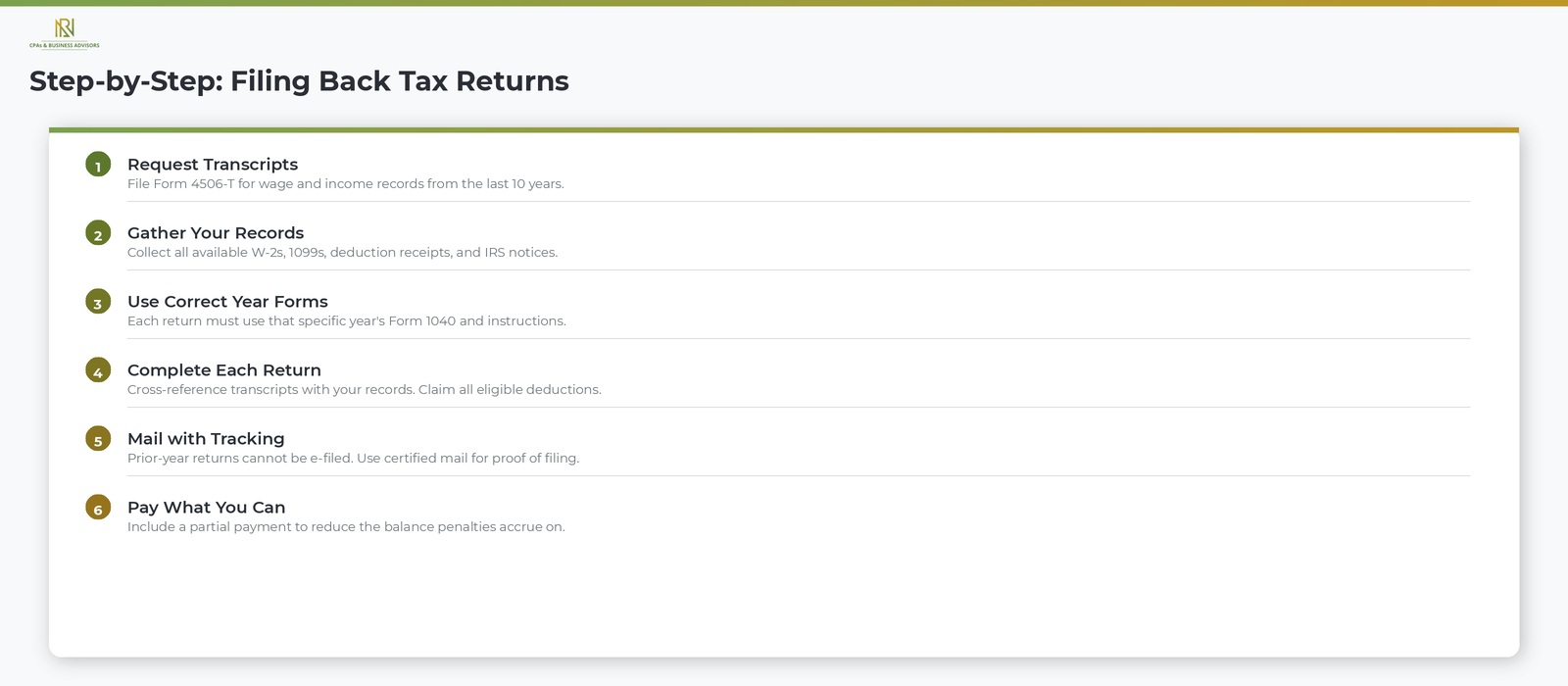
- Request your transcripts. File Form 4506-T with the IRS to get wage and income transcripts for each unfiled year. You can request transcripts online through your IRS Online Account, by mail, or by calling 800-829-1040.
- Gather your records. Collect all available income documents, deduction and credit documentation, and any IRS notices you have received for each unfiled year.
- Use the correct year's tax forms. According to the IRS, you must file each return using the tax forms and instructions for the specific year the return covers. A 2021 return must be filed on 2021 forms, a 2022 return on 2022 forms, and so on. Prior-year forms are available on the IRS website under "Prior Year Products."
- Complete the return carefully. Cross-reference the information on your transcript with the documents you gathered to make sure all income is reported and all eligible deductions and credits are claimed. Review each return against the transcript before filing.
- Mail the return. According to the IRS, prior-year returns generally cannot be e-filed and must be mailed to the address listed in the instructions for that year's Form 1040. Use certified mail or a trackable delivery service so you have proof of filing.
- Pay what you can. If the return shows a balance due, include a payment for as much as you can afford. Even a partial payment reduces the balance on which penalties and interest accrue.
According to the IRS, it takes approximately six weeks to process an accurately completed past-due return. If you received a notice about unfiled returns, send the completed return to the address indicated on the notice rather than the standard filing address.

What Happens If The IRS Files A Return For You
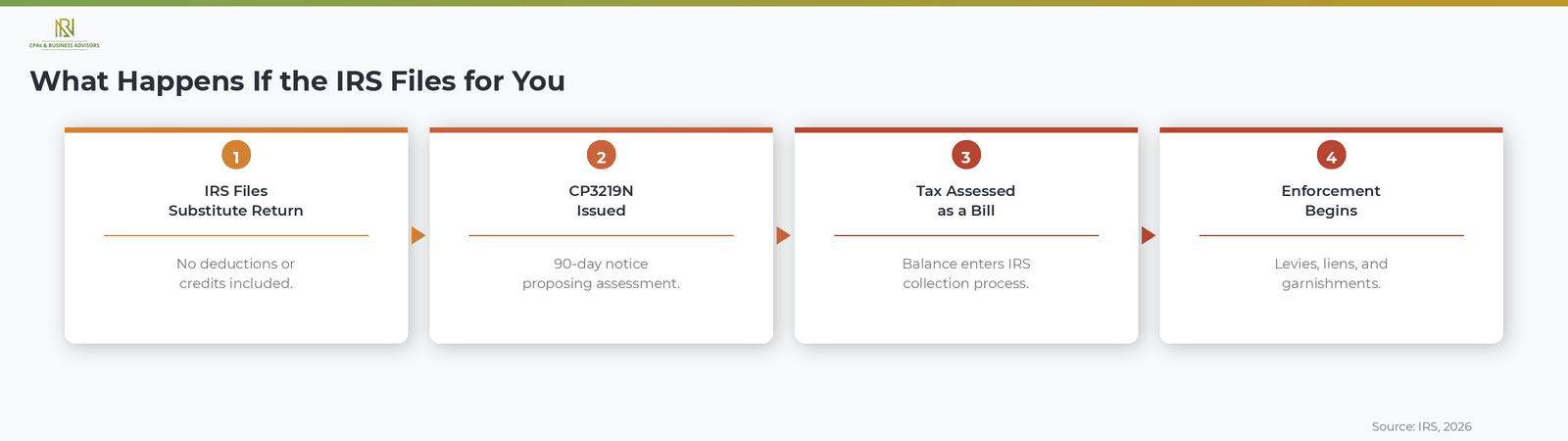
If you do not file voluntarily, the IRS can file a substitute return on your behalf, and this substitute return will not include deductions, credits, or exemptions you may be entitled to claim. According to the IRS, a substitute return is based solely on the income information the agency received from third parties such as employers and banks. Because it does not account for deductions like business expenses, itemized deductions, or tax credits such as the Earned Income Credit, the substitute return almost always results in a higher tax bill than the return you would have filed yourself.
After preparing a substitute return, the IRS sends a CP3219N, which is a Notice of Deficiency (also called a 90-day letter) proposing the tax assessment. You have 90 days to either file your own return or petition the U.S. Tax Court. Taxpayers who want to understand the CP3219A Notice of Deficiency in detail, including the 90-day deadline and Tax Court options, can review our full guide to the statutory notice of deficiency. If you do neither, the IRS proceeds with the assessment, and the balance enters the standard collection process.

How To Handle The Balance After Filing
Filing back tax returns often results in a balance due, and the IRS expects you to address that balance even if you cannot pay it in full. According to the IRS, you have several options for resolving the amount owed.
- Pay in full. The fastest way to stop penalties and interest from accruing further.
- Short-term payment extension. According to the IRS, you can request an additional 60 to 120 days to pay your balance in full through the IRS Online Payment Agreement tool or by calling 800-829-1040, with no setup fee.
- Installment agreement. A monthly payment plan that spreads the balance over time. Our step-by-step guide to installment agreements explains the application process and balance thresholds.
- Offer in Compromise. If the full balance is unlikely to be collected, you may be able to settle for less than you owe.
- Currently Not Collectible status. If you cannot afford to pay anything, the IRS may temporarily pause collection.
Taxpayers who are filing multiple years of back returns and facing a combined balance may also qualify for the IRS Fresh Start program, which expands eligibility for installment agreements and eases lien thresholds for individuals and businesses working to get back into compliance.
Frequently Asked Questions About Filing Back Taxes
How Far Back Can You File Taxes?
You can file a tax return for any prior year with no time limit on how far back you go. According to the IRS, there is no statute of limitations on filing a past-due return. However, refund claims must be filed within three years of the return's original due date, and the IRS generally requires the last six years of returns to consider you in compliance.
Can You File Back Taxes Online?
Most prior-year returns cannot be e-filed and must be printed and mailed to the IRS. According to the IRS, e-filing is generally only available for the current tax year and the two most recent prior years. Returns for earlier years must be completed on the appropriate year's forms and mailed to the address in the instructions.
What Happens If You Have Not Filed Taxes In Several Years?
The IRS tracks unfiled returns and can take enforcement action including filing a substitute return, assessing penalties, holding your refunds, and eventually pursuing levies and liens. According to the IRS, the best course of action is to file all outstanding returns as soon as possible, pay what you can, and contact the IRS to discuss resolution options for any remaining balance.
Tax and Financial Insights
by NR CPAs & Business Advisors
.png)

Federal Tax Lien: How To Remove Or Withdraw It
A federal tax lien is the government's legal claim against your property when you fail to pay a tax debt after the IRS has assessed the amount owed and sent you a bill. According to the IRS, the lien attaches to all of your property, including real estate, vehicles, financial accounts, and business assets, as well as any property you acquire in the future while the lien is active. The lien protects the government's interest by establishing its priority over other creditors.
A federal tax lien is created automatically by law once three conditions are met: the IRS assesses the tax, sends you a Notice and Demand for Payment, and you neglect or refuse to pay the balance in time. According to the IRS, the agency then files a public document called a Notice of Federal Tax Lien (NFTL) with your state or county recording office to alert other creditors that the government has a legal right to your property. The lien itself exists from the moment you fail to pay, but the public notice is what damages your credit and affects your ability to sell or borrow against your assets.
How A Federal Tax Lien Affects You
A federal tax lien can significantly impact your finances, credit, and ability to conduct business. According to the IRS, the effects include the following.
- Credit damage. Once the Notice of Federal Tax Lien is filed, it becomes a public record. Lenders, landlords, and creditors can see it, and it can lower your ability to obtain credit, loans, or mortgages.
- Property restrictions. The lien attaches to all your current and future assets. You cannot sell or refinance real estate without satisfying or addressing the lien first.
- Business impact. The lien attaches to business property and accounts receivable, which can interfere with operations and relationships with vendors and clients.
- Bankruptcy limitations. According to the IRS, a tax lien and the Notice of Federal Tax Lien may continue even after bankruptcy in certain situations.

How To Remove A Federal Tax Lien
The IRS provides four methods for removing or reducing the impact of a federal tax lien: paying the debt in full, requesting a discharge, requesting subordination, and requesting a withdrawal.
Pay The Debt In Full
Paying your tax debt in full is the most direct way to eliminate a federal tax lien. According to the IRS, the agency releases the lien within 30 days after the balance, including penalties and interest, is paid in full. If you cannot pay the entire amount at once, an installment agreement allows you to pay over time, and the lien is released once the final payment is made.
Discharge Of Property
A discharge removes the lien from a specific piece of property, allowing you to sell or transfer it. According to the IRS, a discharge may be granted if the remaining property still subject to the lien is worth at least double the total tax liability plus all other encumbrances, or if the IRS receives payment equal to the government's interest in the property being discharged. This option is commonly used to facilitate real estate sales when the lien amount exceeds the property value.
Subordination
Subordination does not remove the lien but allows other creditors to move ahead of the IRS in priority. According to the IRS, this can make it easier to obtain a mortgage or loan because the lending institution's lien takes priority over the government's claim. The IRS may approve subordination if it determines that doing so will ultimately increase the total amount collected.
Withdrawal
A withdrawal removes the public Notice of Federal Tax Lien from the record, though you remain liable for the underlying debt. According to the IRS, a withdrawal may be granted if the agency filed the notice prematurely or not in accordance with its procedures, if you have entered into a Direct Debit installment agreement, or if the withdrawal would facilitate collection. Under the IRS Fresh Start program, taxpayers who owe $25,000 or less and have a Direct Debit installment agreement may request withdrawal of the NFTL after making three consecutive payments.

Federal Tax Lien vs Levy
A lien and a levy are two different IRS actions, and understanding the distinction is important. According to the IRS, a lien is a legal claim that secures the government's interest in your property. It does not take your property. A levy, by contrast, actually seizes your property to satisfy the tax debt. Levies can target wages, bank accounts, Social Security benefits, vehicles, and real estate.
The IRS typically files a lien first and proceeds to a levy only after sending multiple collection notices and a Final Notice of Intent to Levy. Addressing the lien early through payment, a resolution agreement, or one of the removal options above can prevent the situation from escalating to a levy.

How To Prevent A Federal Tax Lien
The simplest way to prevent a federal tax lien is to file your tax returns on time and pay the full amount owed. If you cannot pay in full, acting before the IRS files a lien gives you the most options. According to the IRS, setting up a payment plan before a lien is filed can prevent the public notice from being recorded. Taxpayers who owe $50,000 or less can apply for a streamlined installment agreement online, and those who qualify for the IRS Fresh Start program benefit from higher thresholds before the IRS will file a lien.
If you already owe the IRS and are unsure which resolution path to pursue, the full range of IRS resolution options includes installment agreements, Offers in Compromise, Currently Not Collectible status, and penalty relief.

Frequently Asked Questions About Federal Tax Liens
How Long Does A Federal Tax Lien Last?
A federal tax lien generally lasts until the underlying tax debt is paid in full or the 10-year Collection Statute Expiration Date (CSED) passes. According to the IRS, the NFTL will self-release 30 days after the 10-year collection period expires if the IRS does not refile it. However, certain actions such as installment agreements, Offers in Compromise, and bankruptcy can suspend or extend the CSED.
Can A Federal Tax Lien Be Filed Without Warning?
The IRS must send you a Notice and Demand for Payment before a lien can arise, and must notify you within five business days after filing the Notice of Federal Tax Lien. According to the IRS, you have the right to request a Collection Due Process (CDP) hearing to challenge the filing.
Does A Federal Tax Lien Show Up On My Credit Report?
The major credit bureaus no longer include tax liens on standard credit reports, but the Notice of Federal Tax Lien remains a public record. Lenders who search public records during the mortgage or loan approval process will still find it, and it can affect your ability to obtain financing.


IRS Innocent Spouse Relief: When You're Not Liable
Innocent spouse relief is an IRS program that can remove your responsibility for paying additional taxes, penalties, and interest when your spouse or former spouse understated the taxes owed on a joint return without your knowledge. According to the IRS, when you file a joint tax return, both spouses are jointly and severally liable for the full tax amount, which means the IRS can collect the entire balance from either spouse, even after a divorce. Innocent spouse relief is an exception to that rule for spouses who did not know about or benefit from the errors on the return.
According to the IRS, innocent spouse relief applies only to taxes due on your spouse's income from employment or self-employment. It does not cover taxes on your own income, household employment taxes, business taxes, or trust fund recovery penalties. The relief is available whether you are still married, separated, or divorced.
The Three Types Of Innocent Spouse Relief
The IRS evaluates three forms of relief when you file a request, and you do not need to specify which type applies to your situation because the IRS will automatically consider all three.
Innocent Spouse Relief
This is the primary form of relief, available when your joint return understated the tax due because of errors attributable to your spouse, and you did not know or have reason to know about those errors. According to the IRS, errors that qualify include unreported income, incorrect deductions or credits, and incorrect asset values. The IRS considers whether a reasonable person in your circumstances would have known about the errors and whether you received any financial benefit from the understated income.
Separation Of Liability Relief
This form of relief divides the understated tax, penalties, and interest between you and your spouse based on each person's share of the errors. According to the IRS, you are generally eligible if you are divorced, legally separated, or have not lived with your spouse for at least 12 months before filing the request. You must also demonstrate that you did not know about the errors when you signed the return.
Equitable Relief
If you do not qualify for innocent spouse relief or separation of liability, the IRS may grant equitable relief if holding you responsible for the tax debt would be unfair given all the facts and circumstances. According to the IRS, equitable relief considers factors including your current marital status, whether you suffered economic hardship, whether you knew or had reason to know about the understated tax, and whether you were a victim of domestic abuse that affected your ability to challenge the return.

Who Qualifies For Innocent Spouse Relief
To be eligible, you must have filed a joint return that understated the tax due because of errors attributable to your spouse, and you must not have known or had reason to know about those errors when you signed the return. According to the IRS, you are not eligible in any year where you signed an Offer in Compromise with the IRS, signed a closing agreement covering the same taxes, or a court has already issued a final decision denying you relief.
Victims of domestic abuse receive a special exception. According to the IRS, you may still qualify for relief even if you had some knowledge of the errors if you signed the return because of spousal abuse, threats, or coercion and were afraid to challenge the items on the return.
The IRS approval rate for innocent spouse relief is relatively low. According to Jackson Hewitt, the IRS received over 26,000 requests in a recent year and fully approved fewer than 5,000. The fact-based, case-by-case nature of the evaluation means that the strength of your documentation and the clarity of your explanation are critical to the outcome.

How To Apply For Innocent Spouse Relief
To request relief, file Form 8857, Request for Innocent Spouse Relief, with the IRS. According to the IRS, Form 8857 covers all three types of relief (innocent spouse, separation of liability, and equitable), so you do not need to determine which type fits your situation. The IRS will evaluate your information and apply the appropriate form of relief if you qualify.
Form 8857 is a seven-page form that requires detailed information about your tax situation, your relationship with your spouse, your knowledge of the return's contents, and your financial circumstances. You should include supporting documentation such as divorce decrees, court orders, financial records, and any correspondence that demonstrates you did not know about the errors. According to the IRS, you must file the request within two years of receiving an IRS notice of an audit or additional taxes due because of an error on your return.
While your request is being reviewed, continue to file your tax returns and pay any taxes you owe. If you received an IRS notice about a balance and cannot pay while the review is pending, you may be able to set up an installment agreement to manage the amount in the meantime.
Innocent Spouse vs Injured Spouse
Innocent spouse relief and injured spouse relief are two separate IRS programs that address different problems. They are frequently confused because of their similar names, but they apply in entirely different situations.
- Innocent spouse relief removes your liability for tax debt caused by your spouse's errors or omissions on a joint return. It addresses the underlying tax, penalties, and interest.
- Injured spouse relief protects your share of a joint tax refund from being applied to your spouse's past-due debts such as student loans, child support, or state taxes. It does not address tax liability at all. You request injured spouse relief by filing Form 8379.
If you owe the IRS because of your spouse's errors, you need innocent spouse relief (Form 8857). If your refund was taken to pay your spouse's separate debts, you need injured spouse relief (Form 8379).

What Happens After You Apply
After you submit Form 8857, the IRS will notify your current or former spouse that you filed a request, which allows them to participate in the review process. According to the IRS, the review can take six months or longer. When the review is complete, the IRS sends a letter of determination with its decision. If approved, the IRS removes your responsibility for the additional tax, penalties, and interest attributable to your spouse's actions.
If the IRS denies your request, both spouses have the right to appeal within 30 days of the determination letter. You can file Form 12509, Statement of Disagreement, and request a review by the IRS Independent Office of Appeals. If you cannot reach agreement through Appeals, you can petition the U.S. Tax Court. Taxpayers exploring other ways to resolve joint tax debt beyond innocent spouse relief can review the full range of IRS resolution options available for balances you cannot pay.

Frequently Asked Questions
Do I Have To Be Divorced To Qualify?
No, you do not have to be divorced to qualify for innocent spouse relief. According to the IRS, the relief is available whether you are married, separated, or divorced. However, separation of liability relief specifically requires that you are divorced, legally separated, or have not lived with your spouse for at least 12 months.
Will My Spouse Be Notified?
Yes, the IRS is required to notify your current or former spouse when you file Form 8857. According to the IRS, the other spouse has the right to participate in the review process and can appeal the decision if relief is granted.
What If I Knew About Some But Not All Of The Errors?
The IRS evaluates each item on the return separately, so you may receive partial relief for items you did not know about while remaining liable for items you were aware of. According to the IRS, the determination depends on whether a reasonable person in your situation would have known about each specific error.

%201.avif)


.png)
.png)