



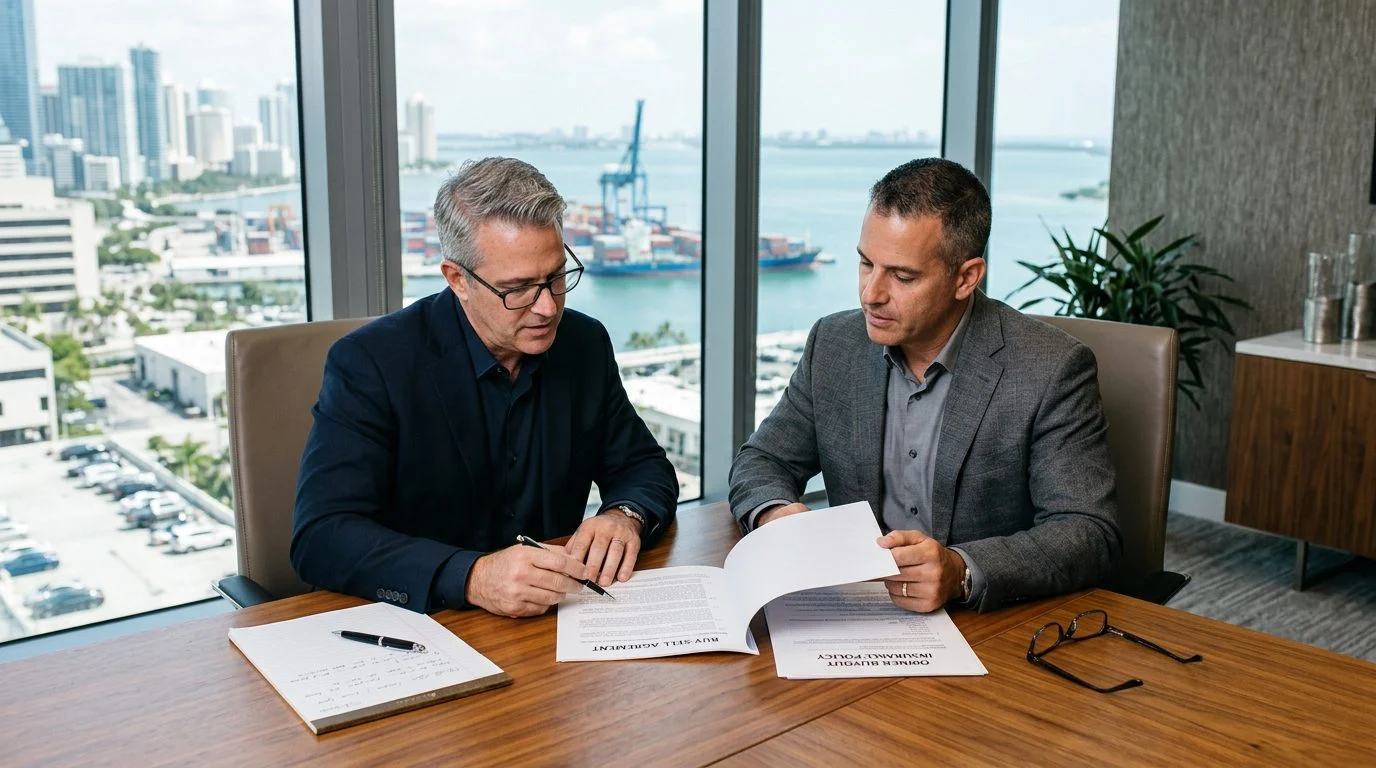
Buy-Sell Agreement Insurance | Miami, FL
Keep Your Business Moving When an Owner Dies
Buy-sell agreement insurance can provide the cash to buy out a deceased owner's share, so the surviving owners and the owner's family can plan with clarity. Nischay Rawal, a licensed insurance agent, reviews how the funding fits your agreement and your company's cash flow.
By Nischay Rawal · Published October 20, 2026
Buy-sell agreement insurance is life insurance that provides the cash to buy an owner’s share of a business when that owner dies. The agreement sets the rules, and the policy supplies the money to follow them. For Miami owners, the choices that matter most are who owns each policy, which policy type fits, and how the buyout price is set. This guide explains buy-sell agreement insurance Miami business owners need to understand, in plain words and from a CPA’s view of tax and cash flow.
What a Buy-Sell Agreement Does for a Miami Business
A buy-sell agreement is a contract among owners. It says who may buy an owner’s interest, and at what price, when a set event happens.
Common triggers include death, disability, retirement, divorce, and an owner’s decision to leave. The agreement sets the steps for each one. Without it, a business can end up with new owners nobody chose.
Miami-Dade companies with two or more owners often put buy-sell agreement insurance Miami in place as a funding source. That includes family-held businesses and professional practices where partners share work, money, and risk.
Florida law recognizes these agreements. Under Fla. Stat. § 607.0732, a shareholder agreement that meets the statute is effective among the shareholders and the corporation. For partnerships, Fla. Stat. § 620.8701 requires the partnership to buy a dissociated partner’s interest at a buyout price set under the statute when the dissociation does not result in dissolution and winding up of the partnership business.
Insurance is one way to fund that buyout. The agreement is the legal document. The policy supplies the money.

Not sure what your next step is?
Talk it through with our team — we can walk you through how a situation like yours is usually handled and what your options are.
Cross-Purchase and Entity-Purchase: Who Owns the Policy
In a cross-purchase plan, each owner owns a policy on every other owner. In an entity-purchase plan, the business owns the policy on each owner.
Here is how a cross-purchase plan works after an owner dies. The surviving owners receive the policy proceeds they own on the deceased owner. They use that money to buy the deceased owner’s interest, and the estate receives payment.
An entity-purchase plan works in a similar way. The business receives the proceeds and uses them to buy the interest from the estate.
The number of policies grows with the number of owners. Three owners in a cross-purchase plan need six policies, because each owner insures the other two. An entity plan needs three, one for each owner.
Ownership also affects estate tax. Under IRC § 2042, policy proceeds count in a person’s gross estate when they are payable to the executor, or when that person held incidents of ownership at death. Whether a policy counts depends on the facts.
Florida law also lets each individual party to a buy-sell purchase contract insure the others. Fla. Stat. § 627.404 gives that insurable interest for that contract only.
Term or Whole Life for the Buyout
Term life insurance covers a set number of years. Whole life insurance stays in force as long as premiums are paid.
Term often fits a need that should end on a known date, such as a planned retirement. Whole life fits a need that may last longer. Whole life policies may pay dividends, and dividends are not guaranteed.
The policy amount should match the buyout price. That price usually comes from a valuation method written into the agreement. Federal rules value a business interest at the net amount a willing buyer would pay a willing seller, based on all relevant factors, including a fair appraisal of assets and goodwill and the business’s earning capacity. See federal business valuation rules.
A formula written years ago can leave the buyout underfunded. The policy may pay less than the price the business now needs.
Key person insurance is different. It pays the business if an essential employee or owner dies. It is a separate coverage from buyout funding.
Miami Owner Situations That Change the Plan
Each owner’s age, health, residence, and family ties can change which policy fits. They also affect whether coverage is available.
Age and health affect both cost and availability. Coverage requires health questions, and issue may depend on insurability.
Florida law adds a consent step. A life insurance contract on a person generally needs that person’s written consent. A business can insure an owner or key person only with written consent obtained before the purchase. It may not retaliate against someone who refuses.
Owners who live or work partly outside the United States may need NRI life insurance. Their residence and coverage should be reviewed together.
Family-held companies face a transfer question. A spouse, child, or other relative may inherit an interest. The agreement should say whether they can keep it, and how a buyout works if they cannot.
Professional practices in Miami-Dade often have owners of different ages. Each owner’s policy should match that owner’s share of the agreed price.
Have questions about what happened?
Ask our team directly. Tell us what you are dealing with and we will explain how the process works from here.
Review Points Before You Fund a Buyout
The main review points are ownership changes, valuation, premium payers, and how the buyout is paid. Each one can change the result.
Transfers matter. Under IRC § 101, when a life insurance contract is transferred for valuable consideration, the tax-free amount is capped at the price paid plus later premiums and other amounts the new owner pays. The rule has exceptions, so review any ownership change before it happens.
Interest on the proceeds is included in gross income under IRC § 101(c) when the proceeds are held under an agreement to pay interest; this section instead addresses interest paid by a transferee on indebtedness, which counts as an ‘other amount’ in the transfer cap. The IRS guidance on proceeds explains these rules.
Bring these questions to your review. Which valuation method does the agreement use, and when was it last updated? Who owns each policy, and who pays the premiums? How will the buyout be paid? Does the agreement change when ownership does?
If a CPA firm accepts a commission on a product it sells to a client, Fla. Stat. § 473.3205 requires written disclosure. Insurance is offered by Nischay Rawal, a licensed insurance agent, separately from our accounting practice. Any commission the licensed agent receives on an insurance recommendation is disclosed in writing before the engagement, in an engagement letter that gives the complete details of the compensation.

How a Coverage Review Works for Your Buy-Sell Plan
A coverage review for buy-sell agreement insurance Miami owners looks at your agreement, each owner’s age and insurability, and your funding method. It then compares policy options that fit that structure.
Nischay Rawal is acting as a licensed insurance agent in Florida. Insurance is offered by the licensed agent, separately from the accounting practice of NR CPAs & Business Advisors, a Miami firm.
Our team supports clients across the United States. A funded buy-sell agreement helps protect your loved ones by giving them a clear buyout path.
Can life insurance pay for a buy-sell buyout?
Yes. A policy can supply the cash for a buyout when an insured owner dies, if the agreement and ownership are set up for that purpose.
Is life insurance paid to a business taxable?
Interest paid on the proceeds is generally taxable.
Can a Florida business buy life insurance on an owner?
Yes, with conditions. Florida law requires written consent from the owner or key person before the coverage is bought.
If a co-owner’s death would leave your buyout unfunded, call us today to set up a coverage review.
Want to know where you stand?
Tell us about your situation and our team will walk you through the options available to you.
What We Look at in a Buy-Sell Coverage Review
Your Buy-Sell Agreement
We start with the terms of the agreement, including the trigger events, the valuation method and the purchase price formula, so the funding matches what the owners have agreed to.
Policy Ownership and Beneficiaries
We review who owns and who is named on each policy, because those choices affect how proceeds reach the buyout and how the arrangement is taxed.
Cash Flow and Tax Context
As a CPA firm, we look at how premiums, proceeds and the company's books work together, so the plan fits your financial picture.
Coverage for Each Owner
We help you compare coverage amounts across owners so the funding stays in step with each owner's share as the business changes.
Set Up Before You Need It
Life insurance can fund a buyout only when the agreement and the policy ownership are arranged for that purpose. Review the structure with us before the policies are issued, not after an owner's death.
How the Funding Works in Plain Terms
1. Agree on the Buyout Terms
The owners set the triggers, such as death, and the price or formula for the buyout in a written buy-sell agreement.
2. Fund the Agreement
Each owner's policy is set up to supply cash for the buyout. Whole life or term life insurance may be used, depending on the goals of the owners.
3. Review It Over Time
Business values, ownership shares and owners' ages change. We revisit the coverage so it still matches the agreement.


