IRS Notices Explained: What Each Letter Means And What To Do?

What Is An IRS Notice
An IRS notice is official correspondence that the Internal Revenue Service sends through the U.S. mail to inform you about a specific issue with your federal tax return or account. According to the IRS, the agency sends notices for reasons ranging from a simple math correction on your return to an unpaid balance or a request for additional documentation. Receiving a notice does not necessarily mean you made a mistake or owe additional tax, and many notices can be resolved by following the instructions printed on the document.
The IRS draws a practical distinction between two categories of mail. A notice is typically system-generated and addresses a specific account issue such as a balance due, a refund adjustment, or a processing change. A letter, by contrast, often comes from an individual IRS employee or department and may request information, confirm an action, or relate to an ongoing examination. Both arrive by U.S. mail, and both include a notice or letter number in the upper right corner of the first page that identifies exactly what the correspondence is about.
Common Reasons The IRS Sends Notices
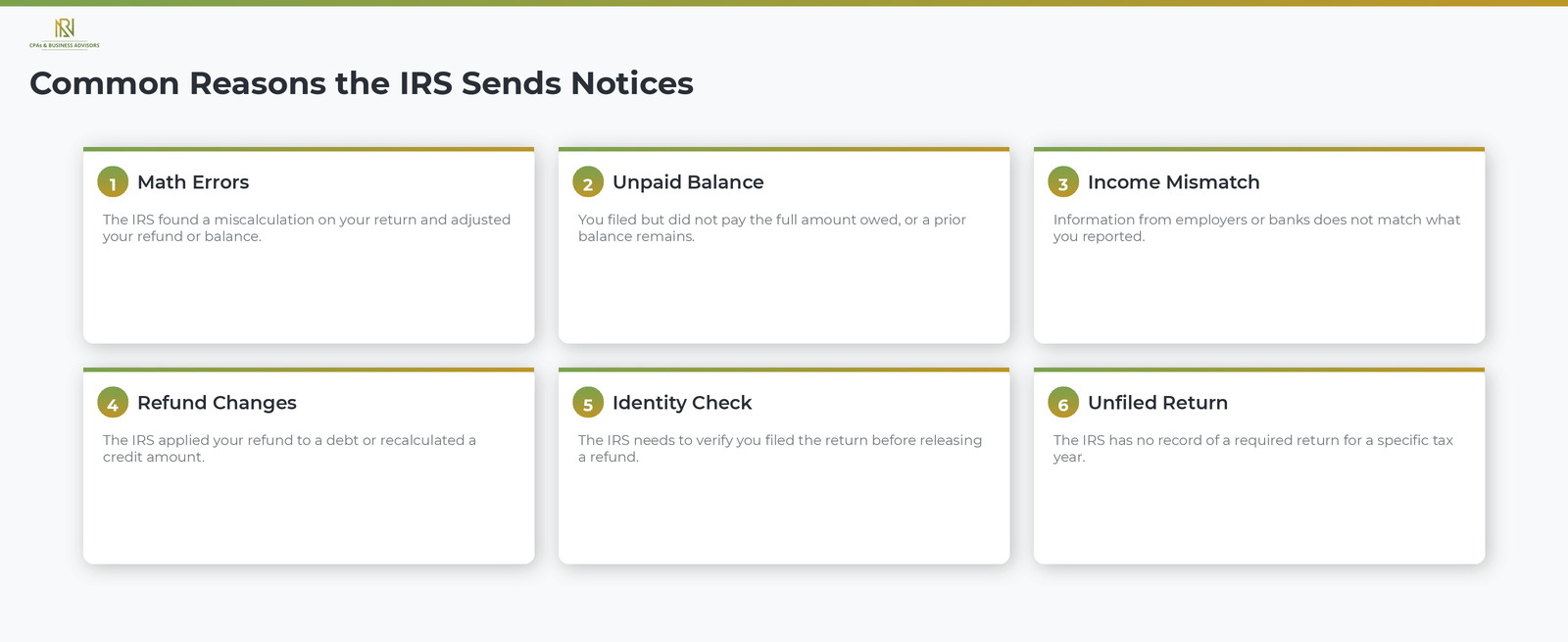
The IRS sends notices most often because of a discrepancy on your tax return, an unpaid balance, or a change the agency made to your account. According to the IRS, the most frequent triggers include the following situations.
- Math errors or miscalculations on your return. The IRS caught an arithmetic mistake and adjusted your refund or balance accordingly.
- An unpaid tax balance. You filed a return but did not pay the full amount owed, or a prior balance remains on your account.
- Unreported or underreported income. Information the IRS received from employers, banks, or other third parties does not match what you reported on your return.
- Refund changes. The IRS applied your refund to a prior debt or adjusted the amount because of a credit recalculation.
- Identity verification. The IRS needs to confirm that you filed the return before releasing a refund.
- Unfiled returns. The IRS has no record of a required return for a specific tax year.
Not every IRS notice signals a problem. Some correspondence simply confirms a change you requested, acknowledges information you submitted, or notifies you that the IRS closed its review of your account.

Most Common Types Of IRS Notices
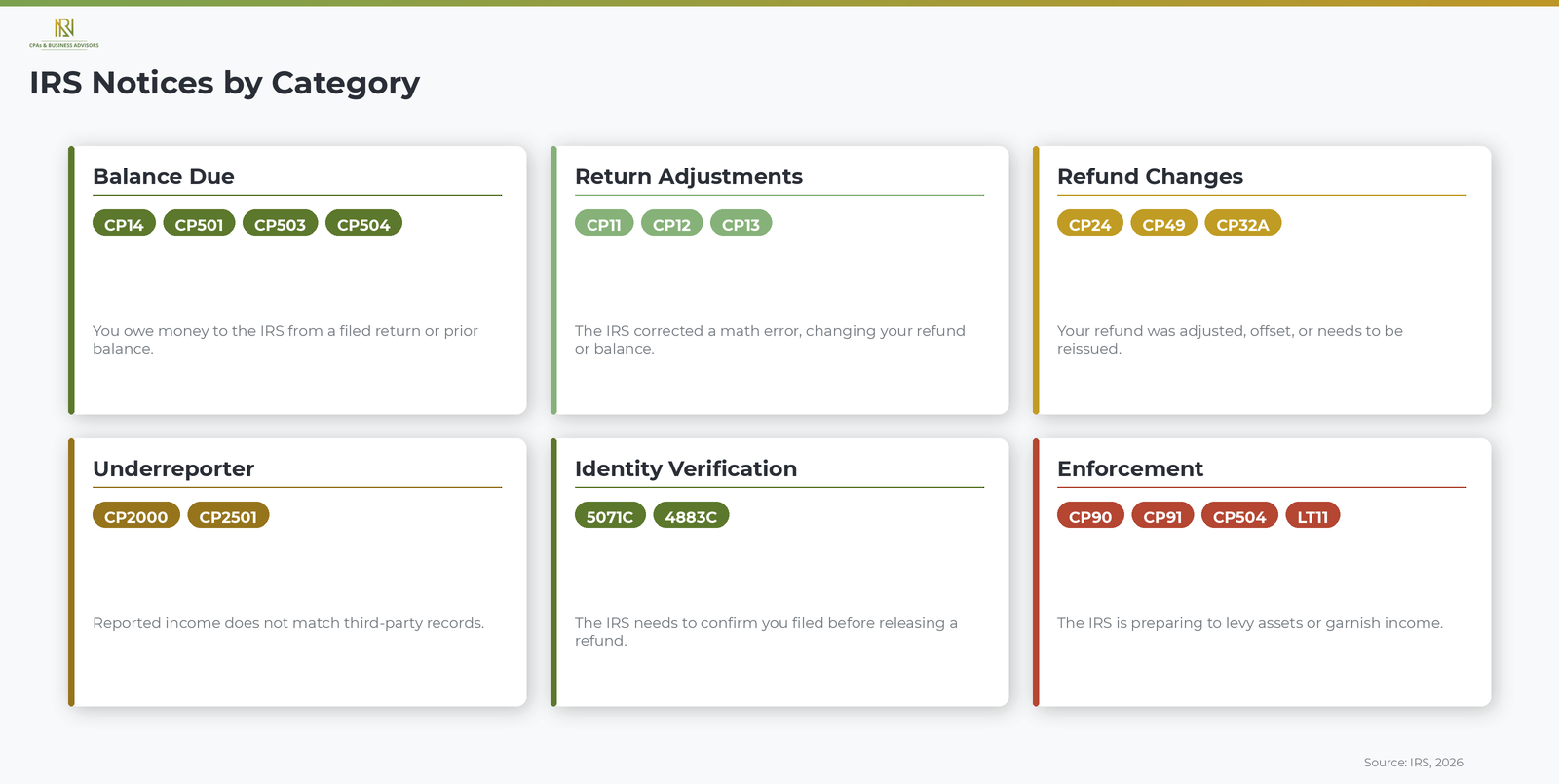
IRS notices fall into several broad categories based on why the agency issued them. Understanding which category your notice belongs to helps you assess its urgency and determine what kind of response it requires. The notice number, printed in the upper right corner of the first page, identifies the specific type.
Balance Due Notices
Balance due notices inform you that you owe money to the IRS. The most common is the CP14, which is the initial notice the agency sends when a filed return shows an unpaid amount. If you received a CP14 notice, our complete guide to this balance due letter explains the specific charges, deadlines, and response options. Subsequent reminders in the collection sequence include the CP501, CP503, and CP504, each carrying increased urgency.
Return Adjustment Notices
The IRS sends adjustment notices when it corrects an error on your return. A CP11 means the correction resulted in a balance you now owe. A CP12 means the correction resulted in a larger refund or a change to the amount you expected. A CP13 means the correction left your balance at zero with no additional amount owed and no refund due. According to the IRS, each of these notices explains exactly what changed and how the recalculated amount was determined.
Refund-Related Notices
These notices address changes to the amount or timing of your refund. A CP24 notifies you that the IRS found a difference between your estimated tax payments and the amount posted to your account, resulting in a potential overpayment credit. A CP49 notifies you that the IRS applied all or part of your refund to a prior tax debt. A CP32A asks you to contact the IRS so the agency can reissue a refund check.
Underreporter Notices
An underreporter notice means the income or payment information the IRS received from third parties does not match what you reported. The CP2000 is the primary notice in this category and one of the most frequently issued IRS letters. According to the IRS, a CP2000 is not a bill but a proposed adjustment that explains how the recalculated tax was determined. Taxpayers who receive a CP2000 notice can review our full guide to this underreporter letter for response steps and dispute options.
Identity Verification Notices
Identity verification notices ask you to confirm that you filed the return in question before the IRS will release a refund. Common examples include Letter 5071C and Letter 4883C. According to the IRS, these letters are part of the agency's efforts to prevent tax-related identity theft and typically require you to verify your identity online at IRS.gov or by calling the toll-free number printed on the letter.
Enforcement And Collection Notices
Enforcement notices signal that the IRS is preparing to take collection action against your assets. A CP504 warns that the IRS intends to levy your state tax refund. A CP90 or LT11 is a final notice of intent to levy bank accounts, wages, and other property, and it grants you the right to request a Collection Due Process hearing within 30 days. Certain enforcement notices, such as the CP90, may arrive as certified mail requiring your signature. A CP91 warns that the IRS intends to levy up to 15 percent of your Social Security benefits.

How IRS Notices Escalate From Reminder To Enforcement
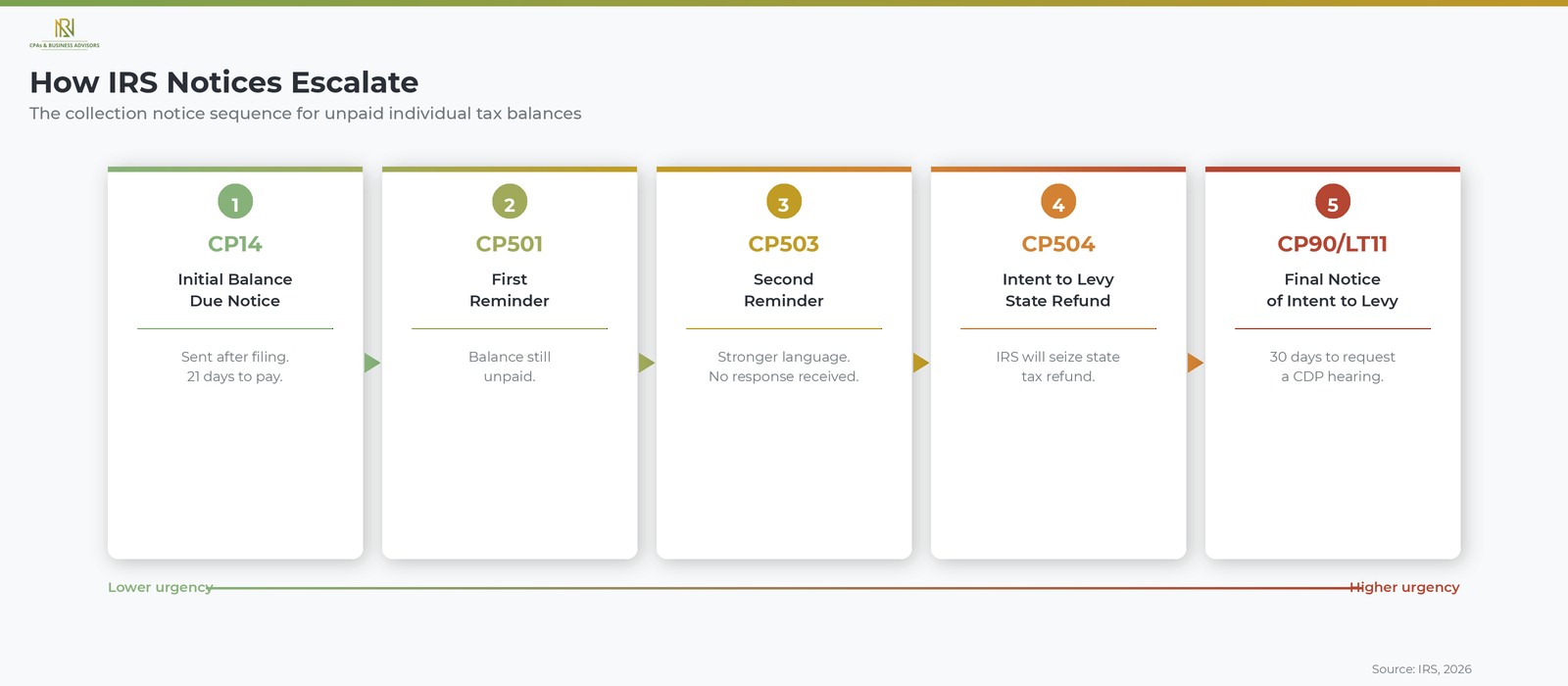
IRS collection notices follow a specific sequence that grows more urgent at each stage, and each notice includes a deadline that starts the clock on the next escalation step. According to the IRS, the standard progression for an unpaid individual tax balance works as follows.
- CP14: the initial balance due notice, sent shortly after you file a return with an unpaid amount.
- CP501: a first reminder that your balance remains unpaid.
- CP503: a second reminder with stronger language, noting that the IRS still has not received your payment or a response.
- CP504: a notice of intent to levy your state income tax refund if you do not pay or contact the IRS to arrange a resolution.
- CP90 or LT11: the final notice of intent to levy your wages, bank accounts, and other assets. This notice also informs you of your right to a Collection Due Process hearing, which you must request within 30 days.
Responding at any point in this sequence can slow or stop the escalation. Taxpayers who cannot pay the full amount may qualify for a structured IRS payment plan or installment agreement. Our guide to these structured repayment options covers the application process, payment thresholds, and how interest is calculated on the remaining balance. Those facing significant financial hardship may also qualify for the IRS Fresh Start program, which provides expanded installment terms and penalty relief for eligible individuals and businesses.

How To Verify Your IRS Notice Is Legitimate
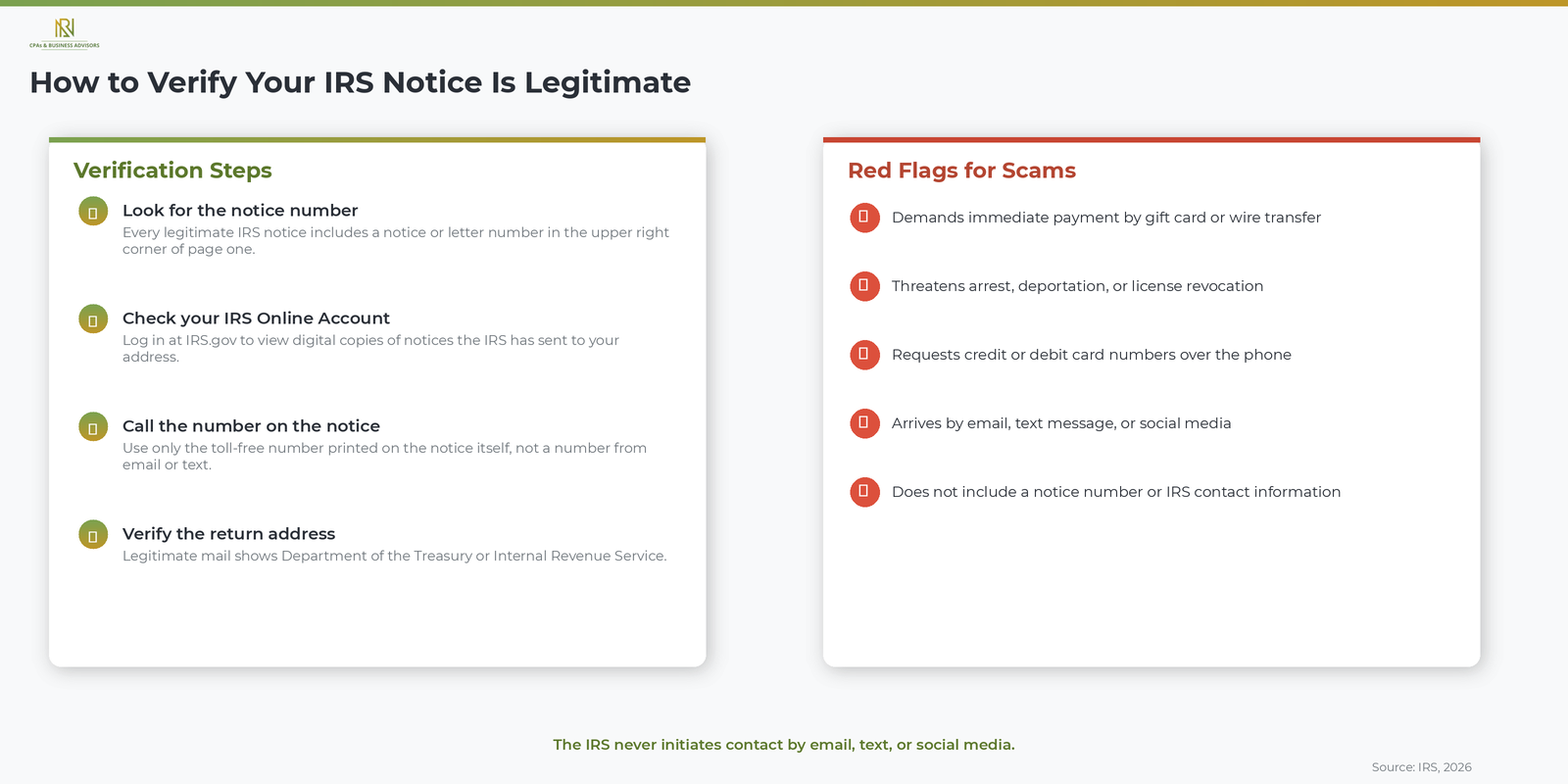
A legitimate IRS notice arrives by U.S. mail, references a specific tax year and notice number, and never asks you to click a link or provide personal information through email or text. According to the IRS, the agency does not initiate contact with taxpayers by email, text message, or social media to request personal or financial information. Any communication that does so is a scam.
To confirm that a notice you received is genuine, take the following steps.
- Look for the notice or letter number in the upper right corner of the first page. Every legitimate IRS notice includes one.
- Log in to your IRS Online Account at IRS.gov. According to the IRS, many notices are viewable in your online account, which allows you to verify the correspondence directly against what the agency has on file.
- Call the toll-free number printed on the notice itself, not a number from an email, a text, or a website you found through a search.
- Check the return address. Legitimate IRS mail comes from a recognized IRS processing center, and the envelope typically includes "Department of the Treasury" or "Internal Revenue Service" in the return address.
According to the IRS, common red flags for fraudulent correspondence include demands for immediate payment by gift card or wire transfer, threats of arrest or deportation, and requests for credit or debit card numbers over the phone.

What To Do When You Receive An IRS Notice
Read the notice carefully, compare the information to your own tax records, and respond by the deadline printed on the document. Most IRS notices explain exactly what changed, why it changed, and what action you need to take. If you agree with the notice, follow the payment or documentation instructions provided. If you disagree, the notice will explain how to dispute the changes, which typically involves mailing a written response with supporting documents to the address on the notice.
The most critical step is acting before the deadline. Late responses can limit your options for disputing proposed changes or requesting a hearing. For a complete walkthrough of what to do when you receive an IRS notice, including what documentation to gather and how to organize your reply, our step-by-step response guide covers every stage from opening the envelope to confirming the issue is resolved.
When To Get Professional Help With An IRS Notice
Consider working with a CPA, Enrolled Agent, or tax attorney when your notice involves a large balance due, a proposed audit, an enforcement action such as a levy or lien, or a situation you do not fully understand. A qualified tax professional can communicate directly with the IRS on your behalf, identify resolution options you may not be aware of, and ensure your rights as a taxpayer are protected throughout the process. According to the IRS, you can authorize a representative by filing Form 2848, Power of Attorney and Declaration of Representative. Simple notices confirming a small refund adjustment or a zero-balance correction typically do not require professional assistance.
Frequently Asked Questions About IRS Notices
What Is The Most Common IRS Notice?
The CP14 is the most commonly issued IRS notice. According to the IRS, a CP14 is sent when a filed tax return shows an unpaid balance. The notice lists the amount owed, the payment due date, and the options available for resolving the balance.
How Do I Know If My IRS Notice Is Real?
A real IRS notice arrives by U.S. mail, includes a notice number in the upper right corner, and references a tax year tied to your account. According to the IRS, the agency never initiates contact by email, text, or social media. You can verify any notice by logging in to your IRS Online Account at IRS.gov.
What Happens If I Ignore An IRS Notice?
Ignoring an IRS notice allows penalties and interest to accumulate and moves your case further along the collection process. According to the IRS, unresolved balances can eventually lead to a federal tax lien on your property, levies on your bank accounts and wages, and garnishment of up to 15 percent of your Social Security benefits.
Can I View My IRS Notices Online?
Yes, many IRS notices are available through your IRS Online Account. According to the IRS, you can log in at IRS.gov to view digital copies of notices the agency has sent to your address on file, which provides a convenient way to review your correspondence without waiting for mail delivery.
Tax and Financial Insights
by NR CPAs & Business Advisors


IRS Notices Explained: What Each Letter Means And What To Do?
What Is An IRS Notice
An IRS notice is official correspondence that the Internal Revenue Service sends through the U.S. mail to inform you about a specific issue with your federal tax return or account. According to the IRS, the agency sends notices for reasons ranging from a simple math correction on your return to an unpaid balance or a request for additional documentation. Receiving a notice does not necessarily mean you made a mistake or owe additional tax, and many notices can be resolved by following the instructions printed on the document.
The IRS draws a practical distinction between two categories of mail. A notice is typically system-generated and addresses a specific account issue such as a balance due, a refund adjustment, or a processing change. A letter, by contrast, often comes from an individual IRS employee or department and may request information, confirm an action, or relate to an ongoing examination. Both arrive by U.S. mail, and both include a notice or letter number in the upper right corner of the first page that identifies exactly what the correspondence is about.
Common Reasons The IRS Sends Notices
The IRS sends notices most often because of a discrepancy on your tax return, an unpaid balance, or a change the agency made to your account. According to the IRS, the most frequent triggers include the following situations.
- Math errors or miscalculations on your return. The IRS caught an arithmetic mistake and adjusted your refund or balance accordingly.
- An unpaid tax balance. You filed a return but did not pay the full amount owed, or a prior balance remains on your account.
- Unreported or underreported income. Information the IRS received from employers, banks, or other third parties does not match what you reported on your return.
- Refund changes. The IRS applied your refund to a prior debt or adjusted the amount because of a credit recalculation.
- Identity verification. The IRS needs to confirm that you filed the return before releasing a refund.
- Unfiled returns. The IRS has no record of a required return for a specific tax year.
Not every IRS notice signals a problem. Some correspondence simply confirms a change you requested, acknowledges information you submitted, or notifies you that the IRS closed its review of your account.

Most Common Types Of IRS Notices
IRS notices fall into several broad categories based on why the agency issued them. Understanding which category your notice belongs to helps you assess its urgency and determine what kind of response it requires. The notice number, printed in the upper right corner of the first page, identifies the specific type.
Balance Due Notices
Balance due notices inform you that you owe money to the IRS. The most common is the CP14, which is the initial notice the agency sends when a filed return shows an unpaid amount. If you received a CP14 notice, our complete guide to this balance due letter explains the specific charges, deadlines, and response options. Subsequent reminders in the collection sequence include the CP501, CP503, and CP504, each carrying increased urgency.
Return Adjustment Notices
The IRS sends adjustment notices when it corrects an error on your return. A CP11 means the correction resulted in a balance you now owe. A CP12 means the correction resulted in a larger refund or a change to the amount you expected. A CP13 means the correction left your balance at zero with no additional amount owed and no refund due. According to the IRS, each of these notices explains exactly what changed and how the recalculated amount was determined.
Refund-Related Notices
These notices address changes to the amount or timing of your refund. A CP24 notifies you that the IRS found a difference between your estimated tax payments and the amount posted to your account, resulting in a potential overpayment credit. A CP49 notifies you that the IRS applied all or part of your refund to a prior tax debt. A CP32A asks you to contact the IRS so the agency can reissue a refund check.
Underreporter Notices
An underreporter notice means the income or payment information the IRS received from third parties does not match what you reported. The CP2000 is the primary notice in this category and one of the most frequently issued IRS letters. According to the IRS, a CP2000 is not a bill but a proposed adjustment that explains how the recalculated tax was determined. Taxpayers who receive a CP2000 notice can review our full guide to this underreporter letter for response steps and dispute options.
Identity Verification Notices
Identity verification notices ask you to confirm that you filed the return in question before the IRS will release a refund. Common examples include Letter 5071C and Letter 4883C. According to the IRS, these letters are part of the agency's efforts to prevent tax-related identity theft and typically require you to verify your identity online at IRS.gov or by calling the toll-free number printed on the letter.
Enforcement And Collection Notices
Enforcement notices signal that the IRS is preparing to take collection action against your assets. A CP504 warns that the IRS intends to levy your state tax refund. A CP90 or LT11 is a final notice of intent to levy bank accounts, wages, and other property, and it grants you the right to request a Collection Due Process hearing within 30 days. Certain enforcement notices, such as the CP90, may arrive as certified mail requiring your signature. A CP91 warns that the IRS intends to levy up to 15 percent of your Social Security benefits.

How IRS Notices Escalate From Reminder To Enforcement
IRS collection notices follow a specific sequence that grows more urgent at each stage, and each notice includes a deadline that starts the clock on the next escalation step. According to the IRS, the standard progression for an unpaid individual tax balance works as follows.
- CP14: the initial balance due notice, sent shortly after you file a return with an unpaid amount.
- CP501: a first reminder that your balance remains unpaid.
- CP503: a second reminder with stronger language, noting that the IRS still has not received your payment or a response.
- CP504: a notice of intent to levy your state income tax refund if you do not pay or contact the IRS to arrange a resolution.
- CP90 or LT11: the final notice of intent to levy your wages, bank accounts, and other assets. This notice also informs you of your right to a Collection Due Process hearing, which you must request within 30 days.
Responding at any point in this sequence can slow or stop the escalation. Taxpayers who cannot pay the full amount may qualify for a structured IRS payment plan or installment agreement. Our guide to these structured repayment options covers the application process, payment thresholds, and how interest is calculated on the remaining balance. Those facing significant financial hardship may also qualify for the IRS Fresh Start program, which provides expanded installment terms and penalty relief for eligible individuals and businesses.

How To Verify Your IRS Notice Is Legitimate
A legitimate IRS notice arrives by U.S. mail, references a specific tax year and notice number, and never asks you to click a link or provide personal information through email or text. According to the IRS, the agency does not initiate contact with taxpayers by email, text message, or social media to request personal or financial information. Any communication that does so is a scam.
To confirm that a notice you received is genuine, take the following steps.
- Look for the notice or letter number in the upper right corner of the first page. Every legitimate IRS notice includes one.
- Log in to your IRS Online Account at IRS.gov. According to the IRS, many notices are viewable in your online account, which allows you to verify the correspondence directly against what the agency has on file.
- Call the toll-free number printed on the notice itself, not a number from an email, a text, or a website you found through a search.
- Check the return address. Legitimate IRS mail comes from a recognized IRS processing center, and the envelope typically includes "Department of the Treasury" or "Internal Revenue Service" in the return address.
According to the IRS, common red flags for fraudulent correspondence include demands for immediate payment by gift card or wire transfer, threats of arrest or deportation, and requests for credit or debit card numbers over the phone.

What To Do When You Receive An IRS Notice
Read the notice carefully, compare the information to your own tax records, and respond by the deadline printed on the document. Most IRS notices explain exactly what changed, why it changed, and what action you need to take. If you agree with the notice, follow the payment or documentation instructions provided. If you disagree, the notice will explain how to dispute the changes, which typically involves mailing a written response with supporting documents to the address on the notice.
The most critical step is acting before the deadline. Late responses can limit your options for disputing proposed changes or requesting a hearing. For a complete walkthrough of what to do when you receive an IRS notice, including what documentation to gather and how to organize your reply, our step-by-step response guide covers every stage from opening the envelope to confirming the issue is resolved.
When To Get Professional Help With An IRS Notice
Consider working with a CPA, Enrolled Agent, or tax attorney when your notice involves a large balance due, a proposed audit, an enforcement action such as a levy or lien, or a situation you do not fully understand. A qualified tax professional can communicate directly with the IRS on your behalf, identify resolution options you may not be aware of, and ensure your rights as a taxpayer are protected throughout the process. According to the IRS, you can authorize a representative by filing Form 2848, Power of Attorney and Declaration of Representative. Simple notices confirming a small refund adjustment or a zero-balance correction typically do not require professional assistance.
Frequently Asked Questions About IRS Notices
What Is The Most Common IRS Notice?
The CP14 is the most commonly issued IRS notice. According to the IRS, a CP14 is sent when a filed tax return shows an unpaid balance. The notice lists the amount owed, the payment due date, and the options available for resolving the balance.
How Do I Know If My IRS Notice Is Real?
A real IRS notice arrives by U.S. mail, includes a notice number in the upper right corner, and references a tax year tied to your account. According to the IRS, the agency never initiates contact by email, text, or social media. You can verify any notice by logging in to your IRS Online Account at IRS.gov.
What Happens If I Ignore An IRS Notice?
Ignoring an IRS notice allows penalties and interest to accumulate and moves your case further along the collection process. According to the IRS, unresolved balances can eventually lead to a federal tax lien on your property, levies on your bank accounts and wages, and garnishment of up to 15 percent of your Social Security benefits.
Can I View My IRS Notices Online?
Yes, many IRS notices are available through your IRS Online Account. According to the IRS, you can log in at IRS.gov to view digital copies of notices the agency has sent to your address on file, which provides a convenient way to review your correspondence without waiting for mail delivery.


IRS CP14 Notice: Your First Bill For Unpaid Taxes
An IRS CP14 notice is the IRS's first bill, a letter telling you that you owe money on unpaid taxes and asking you to pay within 21 days. According to the IRS, it is not an audit; it means your return was processed and your account shows a balance due, including any interest and penalties. If you already paid, you may not owe anything, so it is worth verifying before you send a payment.
What Is An IRS CP14 Notice?
A CP14 is the IRS's first billing notice, formally the Notice of Tax Due and Demand for Payment, sent when your account shows an unpaid balance. According to the IRS, it is issued after your tax return is processed and the records show you owe money on unpaid taxes. The notice lays out the tax year, the amount you owe in tax, interest, and penalties, and a deadline to pay. Receiving one does not mean you are being audited or that a lien or levy has started. It is the opening step in resolving a balance, and the IRS sends millions of them each year.
Is A CP14 Notice Bad?
A CP14 is serious but routine, and it is fixable. It is the IRS's standard first request for payment, not a penalty notice in itself and not a sign of an audit, though the balance it shows can include penalties and interest on top of the tax. What matters is acting on it rather than ignoring it, because the amount only grows while it sits. Handled promptly, most CP14 balances are straightforward to pay or dispute.
Why Did You Get A CP14 Notice?
You received a CP14 because the IRS processed a return showing a balance due that was not paid in full by the deadline. According to the IRS, the two basic triggers are filing a return with a balance due and not paying the taxes owed by the due date. Common underlying causes include underpaid estimated taxes, an extension that postponed your filing date but not your payment due date, or a balance left after the IRS adjusted your return. Sometimes it is simply a timing issue, where you paid but the payment had not yet posted to your account when the notice was generated.
How Much You Owe And When It's Due
The CP14 shows your full balance, tax plus interest and penalties, and asks you to pay within 21 days of the notice date. According to the IRS, interest accrues on the unpaid amount and a failure-to-pay penalty is added while the balance goes unpaid, so paying in full by the date on the notice stops further interest and penalties from building. The Taxpayer Advocate Service notes that if the balance is not fully paid within about 60 days, the IRS can move forward with collection. The 21-day request is the window to act, not a hard cutoff after which nothing else happens.

What If You Already Paid?
If you already paid in full, don't pay again; verify your account first, because the IRS has acknowledged sending CP14 notices in error. According to the IRS, some taxpayers who paid on time, electronically or by check, received a CP14 because the payment had not finished processing or posted with an error, and it advised those taxpayers not to respond or pay a second time while it corrects the accounts, with penalties and interest adjusted automatically once the payment is applied. To confirm where you stand, sign in to your IRS Online Account and review your tax account transcript, checking that each payment posted to the right year and amount. A misapplied payment, a still-processing amended return, or an estimated payment credited to the wrong period are common reasons a balance shows when you don't actually owe it. If your records don't match the notice, dispute it in writing to the address on the notice, including your name, the tax year, and copies of your proof such as cancelled checks or payment confirmations, and keep your originals.

How To Pay Your CP14
If the amount is correct, the fastest resolution is to pay it. According to the IRS, you can pay online, and paying by the due date on the notice limits the interest and penalties you owe. Include the notice's reference details with your payment so it is applied to the right year, and keep a record of the confirmation. Paying the full balance closes the notice; if you can't pay all of it, you still have options.
What If You Can't Pay In Full?
If you can't pay the whole balance, you have several options, and you can set most of them up yourself. According to the IRS, the main paths are:
- A payment plan, or installment agreement, that lets you pay the balance in monthly amounts over time, available online for many individual balances.
- An offer in compromise, which settles the debt for less than the full amount when you qualify.
- First-time penalty abatement or reasonable-cause relief, which can remove the failure-to-pay penalty if you have a clean recent history or a valid reason.
- A temporary delay of collection, sometimes called currently not collectible status, if paying would create real hardship.

Even if you choose a plan, paying as much as you can now reduces the interest that keeps accruing on the remaining balance. Setting up an installment agreement with your response also signals to the IRS that you intend to resolve the balance.
What Happens If You Ignore A CP14 Notice?
Ignoring a CP14 doesn't stop the balance; it grows the debt and moves you toward collection. According to the IRS, interest and the failure-to-pay penalty keep accruing on the unpaid amount, and if you don't resolve the balance the account advances through further notices demanding payment. Left unaddressed, that path leads to enforced collection, which can include a federal tax lien or a levy on wages or bank accounts. Because the CP14 is the first and easiest point to deal with the balance, responding now, by paying, arranging a plan, or disputing it, is far cheaper than waiting.

Should You Handle It Yourself Or Get Help?
You can handle most CP14 notices yourself, especially when the balance is correct and you can pay or set up a plan online. According to the IRS, you can resolve a debt and manage your account without calling. Consider professional help when the balance is large, when you believe the notice is wrong and need to build a documented dispute, or when paying would cause hardship. A CPA or enrolled agent can pull your transcripts, verify the amount, and deal with the IRS for you, and a firm offering IRS tax resolution services can manage the response end to end. If cost is a barrier, a Low Income Taxpayer Clinic may help for free or a small fee. Either way, if you're not sure what your letter is asking, start with our overview of the general steps for any IRS letter.
Frequently Asked Questions
What is a CP14 notice? It is the IRS's first bill, telling you that you owe money on unpaid taxes and asking for payment within 21 days.
Is a CP14 notice bad? It is serious but routine and fixable. It is not an audit, and acting on it promptly keeps interest and penalties from growing.
How do I respond to a CP14 notice? Verify the balance against your records, then pay it, set up a payment plan if you can't pay in full, or dispute it in writing if the amount is wrong.
Is notice CP14 a civil penalty? No. The CP14 is a demand for payment of tax you owe, though the balance can include penalties and interest in addition to the tax.
What if I paid my taxes but received a CP14? Don't pay twice. Check your IRS account to confirm the payment posted, and if you paid in full and on time, the IRS has said affected taxpayers should not respond while it corrects the account.
A CP14 notice is the IRS letting you know about a balance and asking you to settle it, not a penalty or an audit. Confirm the amount is right, pay it or arrange a plan if it is, and dispute it with proof if it isn't. Dealt with inside the window it gives you, a CP14 is one of the simpler IRS notices to put behind you.

%201.avif)


.png)
.png)